Home » Products » Steel Structures » Steel Roof Trusses

Steel Roof Truss Manufacturer

Fabricated chords, webs and connections for building roofs

Hollow-section or open-section chords, cut web members and matched connection steel form one roof-truss fabrication lot. We supply assembled trusses or paired shipping sections, with the member-end details and site-joint parts matched to their piece marks.

Supply format
Made to project drawings
Member sections
Hollow or open steel sections
Assembly route
Shop joints and field splices
Surface finish
Painted or galvanized

What is included in the roof-truss package

Primary membersTop chord, bottom chord and web members from the fabrication schedule
Connection steelGussets, splice plates, end plates and seats shown on the released drawings
Steel specificationSpecified material grade and section standard; material identity follows the member marks
Shop assemblyWelded or bolted subassemblies to the approved joint details
Site connectionsSplice locations, bolt assemblies and accessible installation clearances defined in the connection schedule
ProtectionSpecified paint system or hot-dip galvanizing, including joint-surface treatment
Packing basisPiece-marked shipping units grouped by roof zone and erection sequence

Bolt and standard-hole sizes for truss connections

A bolt diameter and a hole diameter are separate callouts. These nominal standard-hole pairs help read a US connection schedule before splice plates and gussets are fabricated.

Bolt diameter (in.)Nominal standard round hole (in.)Nominal hole diameter (mm)
1/29/1614.29
5/811/1617.46
3/413/1620.64
7/815/1623.81
11-1/828.58
1-1/81-1/431.75
1-1/41-3/834.93

No matching specification. Clear the search to see every row.

Scroll sideways to see every column.

Nominal connection-hole reference: RCSC Specification for Structural Joints Using High-Strength Bolts, June 11, 2020, Table 3.1. Millimeters are converted from inches using 25.4 mm/in. The approved connection detail determines hole type, spacing, edge distance and bolt assembly.

Material and connection documents for fabricated trusses

Member grades stay with the member marks

The member schedule identifies the material grade, section size and thickness for each chord and web. A structural-steel grade and a hollow-section manufacturing standard describe different requirements, and both stay on the schedule.

Connection design controls fabrication

Gusset thickness, weld size, bolt grade and splice arrangement come from the released connection details. Our fabrication scope follows those details, including any specified weld examination and joint-surface preparation.

One current drawing revision

General arrangement, member drawings and connection sheets need the same revision basis. We keep the fabrication and packing identifiers linked to that release so a revised seat or purlin attachment ships with the matching assembly.

Shop assemblies, site splices and support details

Hollow-section or open-section members

Hollow-section webs need the correct end cut and fit against the chord face. Open-section details can use paired angles and gussets, with the connection plate thickness entering the member arrangement. We retain the actual section and node detail, pricing each route on its own.

Paired shipping sections and splice orientation

A split truss is ordered as a set of mating pieces. Splice plates, bolt patterns and chord ends keep their own marks, so a mirrored end or a different roof slope stays a distinct piece even at the same overall length.

Bearing seats and end interfaces

The support detail identifies the bearing face, seat elevation and connection to the column or support girder. A vertical end plate and a horizontal bearing seat produce different fabrication. Bolt access, slot direction and the left/right end arrangement stay with that support mark.

Purlin and bracing attachments

Each cleat or lug has a defined position and face on the truss. Two assemblies with the same main members are still distinct where their purlin cleats, bracing lugs or end attachments differ. Those small parts remain in the fabrication count.

Protection around the joints

Painting or galvanizing is coordinated with the connection type and required faying surfaces. Masked areas, touch-up locations and any galvanizing vent or drain details are established before the members enter surface treatment.

Roof-truss supply for industrial and commercial buildings

Industrial roof packages

Repeated trusses are ordered by assembly type and piece count. A different end seat, roof slope or secondary attachment creates a distinct marked assembly even where the chord and web sections repeat across the building.

Roofs with services below the chords

Duct routes, suspended services and maintenance access can affect the truss depth and attachment points. Those interfaces belong in the coordinated design, since cutting a web later changes the structural member.

Exposed structural roofs

Visible trusses add requirements for weld appearance, plate alignment and finish. These appearance criteria are agreed with the fabrication drawings, alongside the structural acceptance requirements.

Truss geometry, welds and connection fit

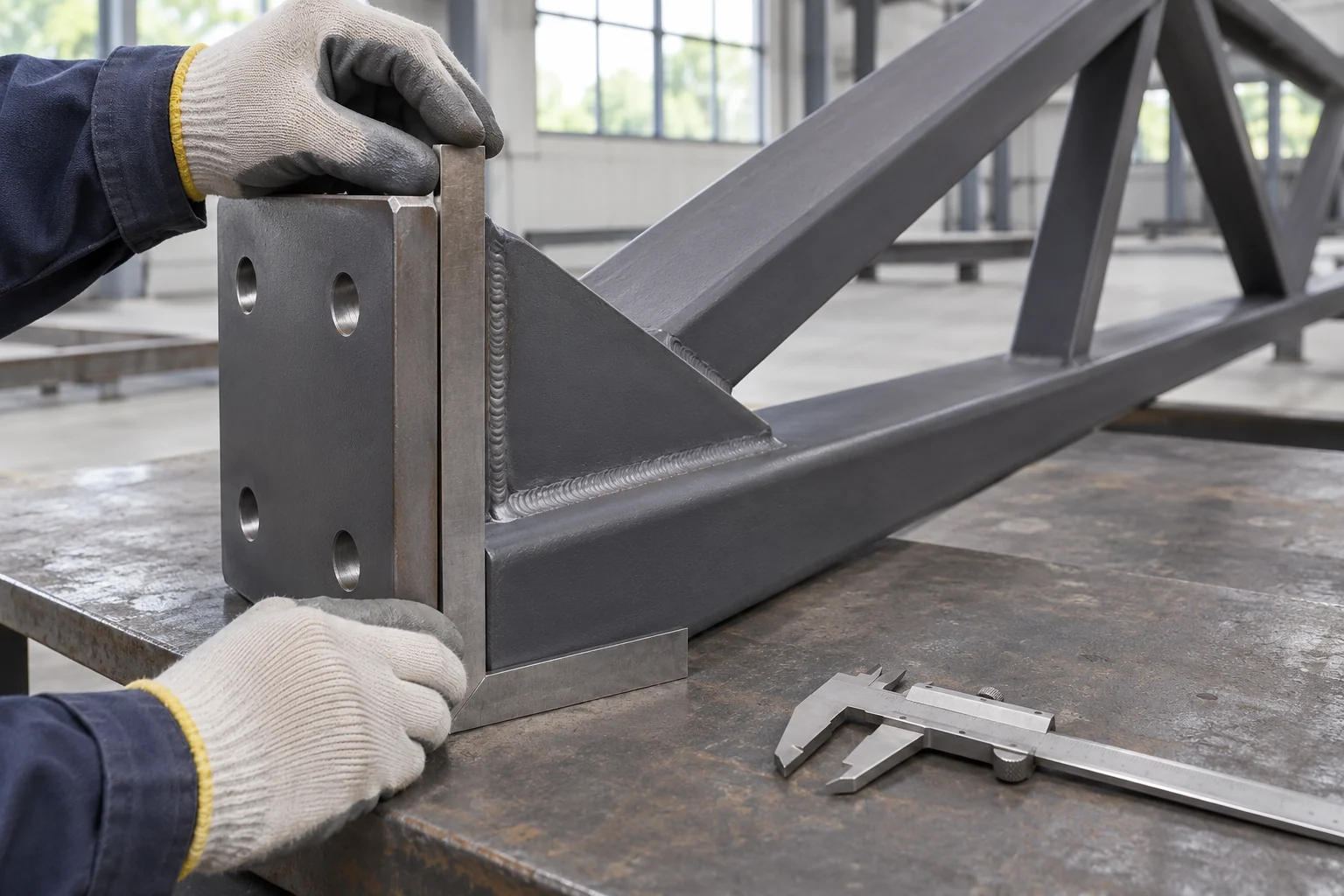
Dimensional inspection of a fabricated roof-truss node and connection plate

Panel points and member-end datums

Node locations and panel spacing are checked from the drawing datums, alongside chord alignment and end-connection orientation. Those datum checks are what confirm the intermediate webs and roof attachments.

Weld access and examination

Weld size, length and continuity are checked against the joint detail. Any specified NDT follows the inspection plan, with each examination method applied as listed.

Splice and seat fit

Hole size, pattern, plate orientation and access for the selected bolts are checked at the site interfaces. Trial assembly can be included where the order requires a fit-up record.

Marks after surface treatment

Finished pieces retain identification for the drawing revision and erection location. Inspection and packing records use those same identifiers, including loose gussets or splice plates shipped with the assemblies.

Records tied to the supplied trusses

Member identificationDimensional resultsSpecified weld recordsProtection inspectionPiece-marked packing list
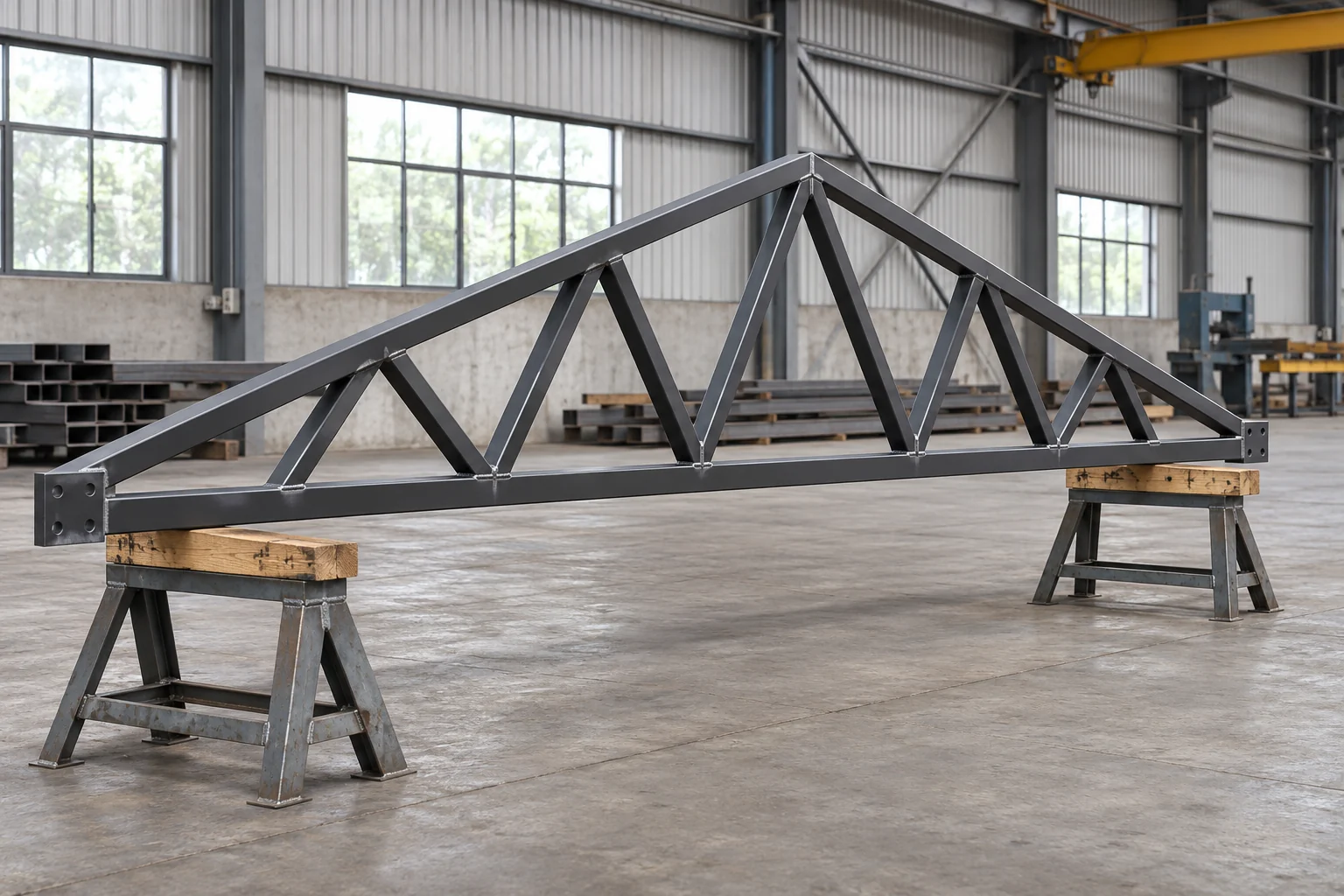
Packing roof trusses for the erection sequence

Supported shipping pieces

Truss assemblies need support and restraint at suitable locations during storage and transport. Packing protects projecting plates and finished surfaces without treating a slender web member as a general lifting point.

Mating halves and loose joint parts

Paired shipping sections remain linked to their splice plates and any included bolt kits. Left/right pieces and repeated-but-different attachment patterns keep separate marks, so receiving counts show a complete or incomplete truss set.

A comparable fabrication quote

Our quotation separates the fabricated assemblies, loose connection steel, surface treatment and agreed inspection or trial-assembly work. Shipment dimensions and packing scope follow the selected shop-to-site split.

A planar roof truss or a space-frame roof

The roof-system geometry changes the supply package. Each product is its own fabrication.

Buying decisionPlanar roof trussSpace frame
Member arrangementChords and webs principally in one truss planeThree-dimensional member and node grid
Key interfacesBearing seats, purlins and inter-truss bracingNode geometry, grid supports and module connections
Shipping scheduleMarked complete or split truss assembliesCoordinated members, nodes or assembled modules

The project design establishes the complete roof load path and stability system. This comparison identifies the package to purchase.

Steel roof-truss purchasing questions

Can roof trusses be supplied as complete welded assemblies?

Yes, where the released design and transport dimensions allow it. A larger truss can instead be supplied as shop-fabricated sections with its designed field splices. The quote and packing list identify the chosen arrangement.

Are repeated trusses interchangeable between roof bays?

Only when the released assembly marks identify them as the same part. End seats, roof pitch, cleat positions and bracing attachments can distinguish two trusses that use the same main steel sections. The piece-mark schedule controls where each assembly belongs.

Can the truss be galvanized after fabrication?

Hot-dip galvanizing is a fabrication option for suitable assemblies. Member venting and draining, assembly dimensions, joint details and any movement or distortion concerns must be resolved as part of that protection route.

Can existing columns be used as the truss supports?

The truss can be fabricated for the connection details provided for those columns. The responsible project engineer establishes the support capacity, bearing elevation, reactions and attachment details; fabrication to a matching bolt pattern alone does not verify the existing frame.

Are field splice bolts supplied with the steel?

Bolt assemblies can be included when they are listed in the order. Diameter, grade, length, coating and installation requirement need to match the designed connection, with quantities separated from the loose splice plates.

How are changes to a roof-truss drawing handled?

A revision is checked against the fabrication stage and affected piece marks. The agreed change identifies replaced members or plates and any rework, so new-revision parts are not mixed with earlier assemblies.

Is a standard span or load rating available for every truss?

These trusses are made to the project member and connection schedule, rather than a universal span-and-load catalog. The design establishes span, depth, loading, restraint and support details before those values become fabrication dimensions.

Can a truss be supplied as loose cut members instead of a welded assembly?

A prepared-member package can be quoted against the required cutting, end preparation and connection details. It is a different scope from a shop-assembled truss: the quote identifies which fitting, welding, assembly and inspection work remains at site or with the receiving fabricator.

Get a steel roof-truss fabrication quote

Send the roof-steel drawings or member schedule, quantities, finish and destination. We will price the truss assemblies, connection steel and packing around the defined shop-to-site split.

Metdax
Get a quote
Search Metdax

Language

Get a factory quote

Send your specifications or attach a material list.

Steel Roof Trusses

Your information is used to respond to this inquiry. Privacy policy

sales@metdax.com

+86 177 7599 6440