Home » Products » Construction & Infrastructure Products » Highway Guardrails

Highway Guardrail Supplier

Factory supply of W-beam and thrie-beam panels, posts and hardware

W-beam and thrie-beam rails combine with posts, offset blocks and hardware in the specified roadside barrier. Straight or curved panels follow that barrier drawing, with matching attachment details and the protective finish required for the components.

Rail profiles
W-beam and thrie-beam
Panel options
Straight or curved
Supply scope
Panels, posts and hardware
Finish options
Galvanized or coated

China-origin components for contracts that accept this source. Your quote identifies the required barrier configuration, component records and source-approval conditions.

Guardrail panels, steel posts and connection parts

Rail panels are supplied on their own or with the scheduled posts and accessories. Each package lists its counted components, finish and required records.

Components available for a drawing-defined guardrail order
Order itemSupply optionsDetail that defines the item
Corrugated railsW-beam or thrie-beam; straight or curvedSection, sheet thickness, panel ends and holes
Steel postsRound, square or I-section; plain or flanged mountingPost section, length, attachment and base detail
Offset blocks and capsDrawing-defined steel blocks and post capsPost-to-rail offset and matching attachment geometry
Connection hardwareScheduled bolts, nuts and washersFastener type, dimensions, finish and piece count

Scroll sideways to see every column.

An energy-absorbing terminal or barrier transition is a separate specified assembly. Ordinary rail ends, post caps and loose bolts do not constitute that assembly; its product identity and approved supply scope stay on their own purchase lines.

W-beam and thrie-beam panel dimensions

The catalog envelopes below give a starting point for profile selection. Your quoted panel drawing fixes the corrugation, steel thickness, overall length, splice overlap and hole pattern. Nominal coverage and overall piece length remain separate dimensions.

Find a profile or published dimensional range.

Published panel envelopes — W-beam and thrie-beam
Panel profileProfile width × height (mm)Sheet thickness (mm)Overall length (mm)
W-beam300–600 × 50–1002–64,100–4,400
Thrie-beam400–900 × 50–1002–64,100–4,400

No matching requirement. Clear the search to restore the table.

Scroll sideways to see every column.

These are catalog envelopes, with the actual combination returned on the quoted panel drawing. The selected barrier detail also sets the post, block, fastener and splice arrangement, together with the project’s required source and product records.

Rail profiles and specified post arrangements

W-beam or thrie-beam

W-beam has two corrugations; thrie-beam has three. Profile height, bends, base-steel thickness and the attachment pattern follow the selected rail detail. A change of profile changes the component identity, even when the panels have similar nominal lengths.

Posts and offset blocks

Our post range includes round, square and I-section steel forms. The barrier schedule selects the section, mounting method and blockout; steel offset blocks are supplied where that combination is specified. A drawing-specified timber or composite block retains its own required source and identity; a steel block with matching holes is a different component.

Steel specification and hardware

The material list states the rail steel requirements and the adopted specification, such as AASHTO M 180 where required. Posts and fastening parts retain their own material descriptions. Button-head splice bolts and post bolts have distinct functions, so bolt type, length, nut and washer arrangement are listed by joint.

Galvanized rails and coated component finishes

Finish specified for each component

Hot-dip galvanized and coated guardrail parts are available to the order specification. The finish schedule identifies the rail, post, offset block and hardware separately, with the required coverage and inspection criteria. A colored coating order also identifies its color and the coating system beneath it.

Edges, bends and connection faces

Formed edges, corrugations and punched slots remain part of the finished panel. Their coating checks follow the specified acceptance requirements, including any permitted repair method. Mating rail ends and hardware seats retain the contact and fastening geometry of the component detail.

Panel ends, slot positions and curved rail identity

Holes located from the panel ends

Splice holes and post-bolt slots use the positions shown on the rail drawing. End offsets, hole centers and slot direction establish how the next panel and post connect. We retain that pattern with the panel mark, keeping different hole schedules identifiable through forming and finishing.

Overlap and splice orientation

A splice joins matching corrugated sections in the specified orientation. The overlap and end-hole pattern define the connection, while the prescribed bolt heads and nuts complete it. Panel-end identification also matters where a run meets a separately specified terminal or transition.

Radius and direction for curved rails

A curved panel order identifies the radius, curve direction and reference face on its detail. The rail profile and end pattern remain part of that curved item. Opposite-hand curves retain separate marks, so receiving crews can distinguish the pieces before distributing them along the run.

Wholesale guardrail packages and replacement components

Road-project component schedules

Road orders are grouped by barrier run and component mark. Special panels and transition interfaces keep their own quantities, with terminal equipment and installation listed under their separate responsibilities.

Distributor lots and identified repairs

Distributor orders can combine several panel or post items in one shipment while retaining their drawing and finish identities. For an identified repair, the purchasing list distinguishes components being replaced from the retained barrier. That distinction keeps a replacement panel order tied to its existing holes, post/block arrangement and connecting parts.

Component checks and US project purchasing requirements

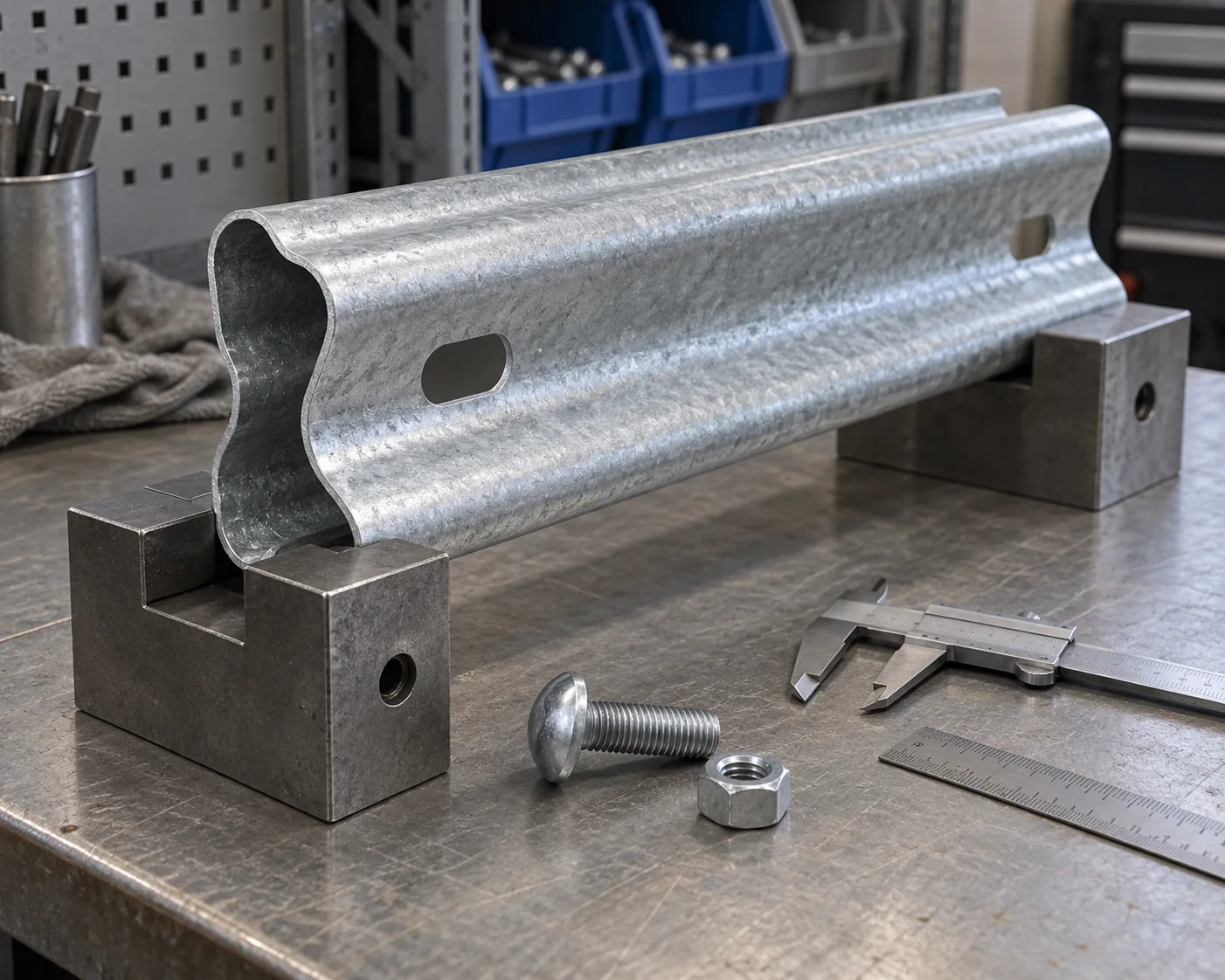
Corrugated guardrail panel sample in a bench fixture beside measuring tools and splice hardware

Profile and attachment geometry

Dimensional checks cover the formed profile, base thickness, panel ends, holes and specified curvature. Post and block checks use their own section and attachment details. The records identify the component drawing and revision associated with those measured features.

Materials, finish and item identity

The required material and coating records follow the supplied panel, post and accessory lines. Hardware identification retains the specified bolt type, nut and washer scope. Part marks and counts link the checked items to the component schedule and packing register.

Accepted barrier configuration

The purchasing agency defines the barrier, terminal and transition configuration and the system evidence it accepts. Steel-component requirements such as M 180 remain distinct from MASH crash-test evidence. Our component quotation identifies the requested records and actual supply scope; it does not establish a new tested or agency-approved barrier.

China origin and the contract

Our manufacturing origin is China. US purchasing review therefore checks the contract’s accepted-source and country-of-origin requirements before an order is placed. Federal-aid highway contracts can require domestic manufacture for permanently incorporated steel; these China-made components are not offered as US-made or Buy America-compliant products.

Records for the guardrail component order

Drawing and revisionMaterial and coatingHardware scheduleOrigin and supply scope

Itemized guardrail pricing and protected component packing

Rail Panels, Posts and Accessories Prices

Guardrail prices list panel quantities and lengths, posts and accessories against the selected drawing and finish. Required records, packing groups and delivery terms accompany the component schedule.

Bundles separated by panel and post type

Rails are supported and secured with protection at corrugated edges and finished surfaces. Different lengths, curved items and hole schedules remain distinguishable in the packing list. Posts and offset blocks travel as separate component groups rather than loose parts concealed within a rail bundle.

Hardware counted against its joint

Splice and post fasteners are packed by their specified item and quantity, with additional spares shown separately. The receiving list reconciles each hardware group with the rail and post schedule. Small-part identification makes shortages or mixed bolt types visible before the components are sent to individual work areas.

Guardrail component purchasing questions

Can a photograph identify the replacement panel?

A photograph helps identify the profile and visible arrangement. It does not reveal every steel thickness, hidden slot or drawing revision. Add the existing system reference and panel measurements to the repair request; the quotation identifies which component details have been established and which still need agreement.

Can installers enlarge a slot to make a rail fit?

A changed slot alters the specified component and its joint. The responsible project authority needs to review that change before the part is used. For a replacement order, the accepted revised detail defines the panel being purchased; field alteration is not treated as routine fit-up.

Can one order be packed for several receiving locations?

Yes. A location schedule can divide the component quantities into separately identified receiving groups. Each group keeps its panel, post and hardware counts. The quote identifies the agreed packing and shipment basis for those destinations.

Is overall panel length the same as installed coverage?

A panel’s splice overlap reduces its contribution to the installed run. The selected barrier drawing states the nominal coverage and overlap, which are used for the takeoff rather than the overall panel length alone.

Does AASHTO M 180 establish a MASH-tested barrier system?

M 180 addresses steel-component requirements. MASH system evidence is a separate purchasing requirement for the actual barrier, terminal or transition configuration accepted by the agency.

Can curved rails be ordered with straight replacement panels?

Yes. Curved rails retain their radius, direction and component marks on the schedule. Straight panels and curved items are counted and packed separately with the matching hole and splice details.

Get your highway guardrail supply quote

Send the barrier drawing and component schedule with their revisions, required material and system records, and accepted sourcing requirements. Include panel and post quantities, curved items, hardware, finish and delivery destination. We return an itemized factory offer identifying the supplied components, documentation and packed groups.

METDAX
Get a quote
Search METDAX

Language

Get a factory quote

Send your specifications or attach a material list.

Highway Guardrails

Your information is used to respond to this inquiry. Privacy policy

ruofan1901@gmail.com