What Changes When You Buy Full-Width or Slit Coil?
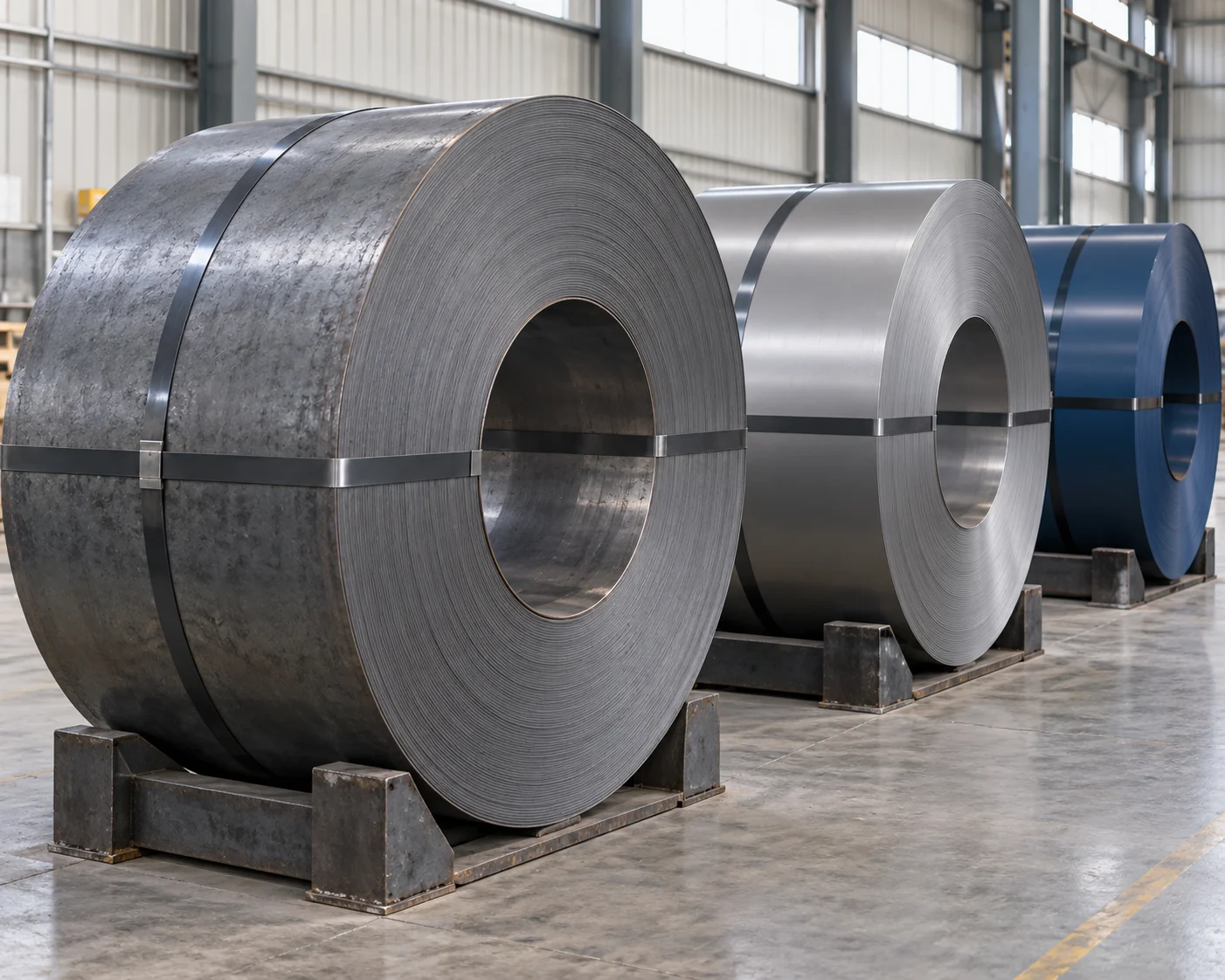
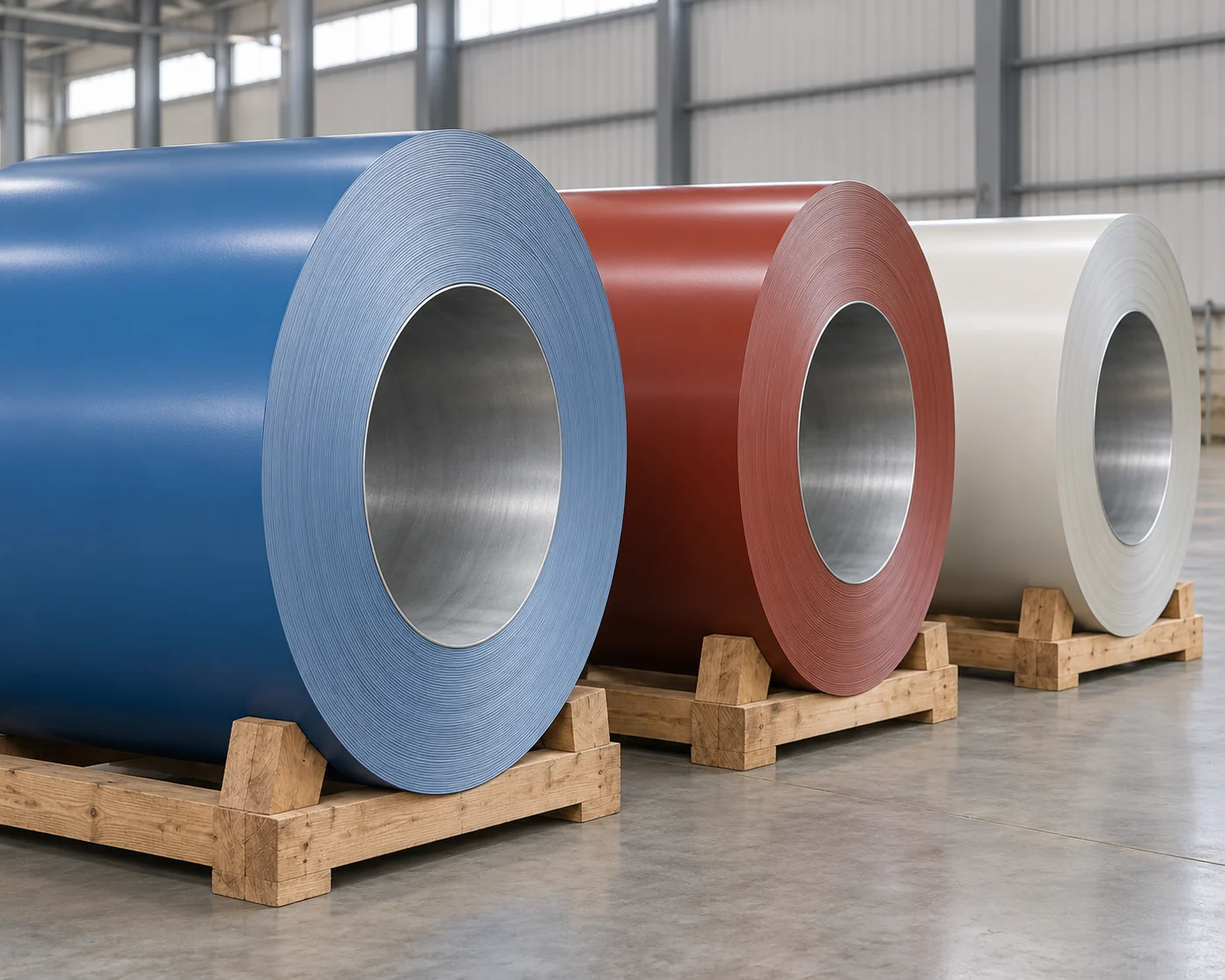
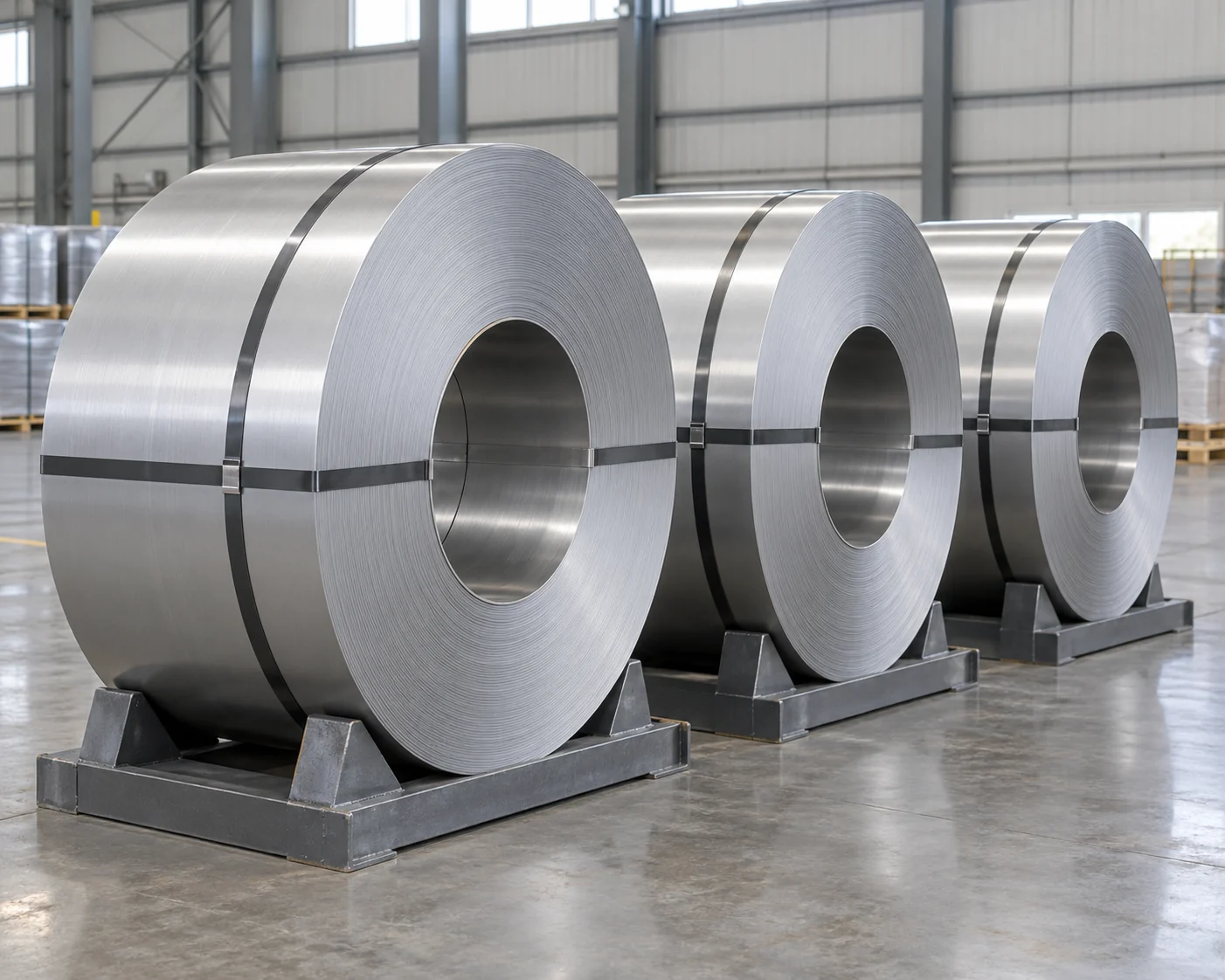
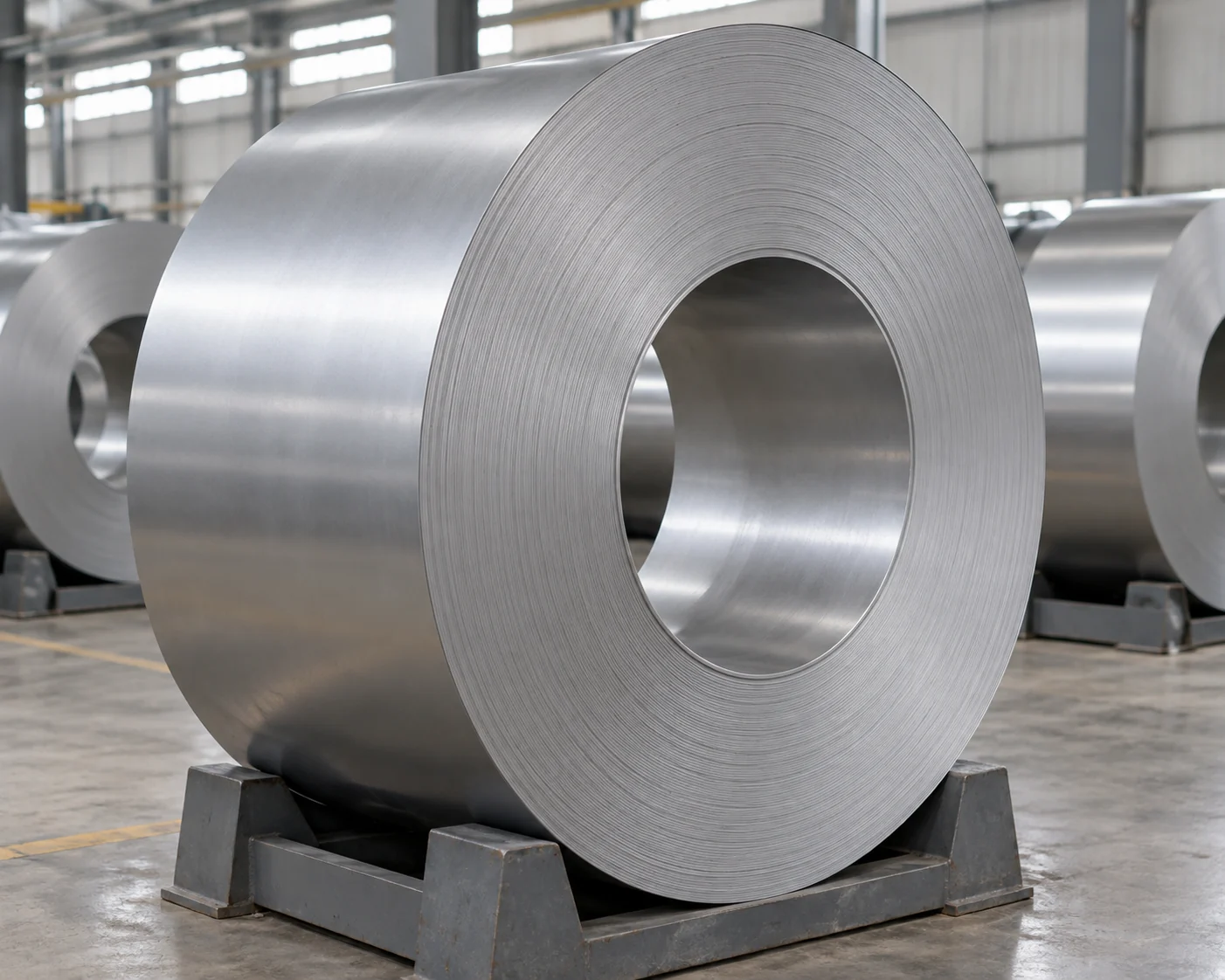
Full-width coil is the wider parent coil supplied before the width cuts required for your product. Slit coil is narrower strip cut lengthwise from a parent coil and rewound. Here, “full-width” means the parent width offered for the order, not a universal mill width or an assurance that its original edges are untrimmed.
The Same Roll Former Can Receive the Same Strip
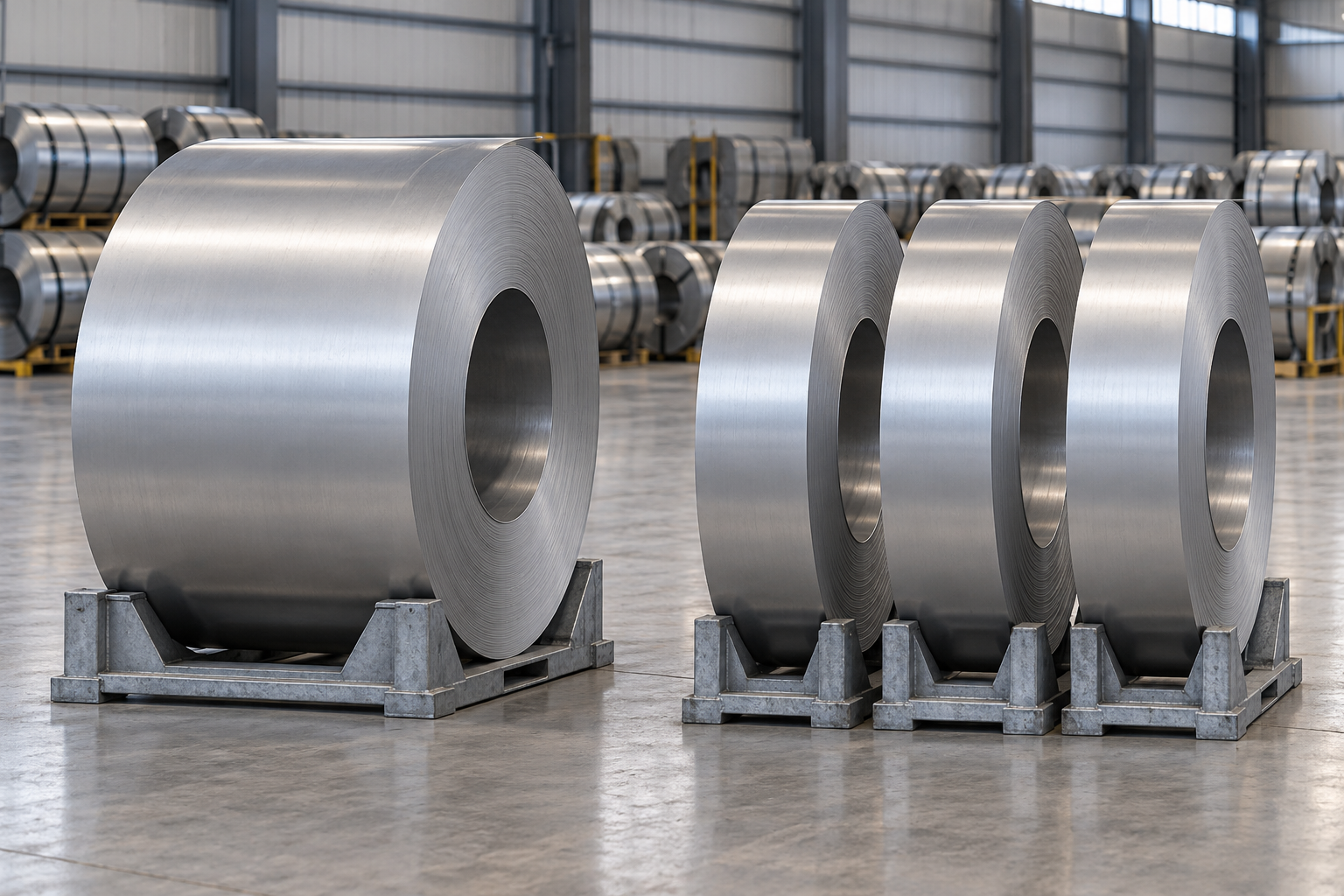
If the selected profile needs a narrow strip, buying a wider parent coil does not let you feed that wider material into the same tooling. The strip must be prepared first. A ready-slit supplier performs or arranges that preparation before delivery; a parent-coil buyer arranges it after purchasing the parent.
Compare the same steel grade, thickness, finish, required strip width, accepted quantity and delivery date. A lower parent-coil price per tonne is only one input. It excludes work that may already be included in the ready-slit price.
The Buyer’s Responsibilities at a Glance
Swipe to view the complete table.
| Factor | Buy full-width coil | Buy ready-slit coil |
|---|---|---|
| Slitting | Arrange an in-house or contracted slitting slot | Supplier delivers the agreed slit strip |
| Material balance | Account for parent mass, trim and any unused strip widths | Agree the accepted strip quantity and any minimum order |
| Coil dimensions | Specify both parent-coil and finished-coil limits | Specify the finished coil limits for receiving and feeding |
| Quality acceptance | Control parent material and the subsequent slitting result | Accept delivered material, width, edge and winding condition |
| Cost | Add processing, transport between stages and handling | Identify which preparation and delivery items are included |
When Is Each Purchase the Better Fit?
Equipment Fit Comes Before Price
Start with the required strip and the actual machinery. Obtain the profile’s input width and material limits, then the roll former’s coil inside diameter, outside diameter and mass limits. For a full-width purchase, check the slitter’s incoming and outgoing limits too. A parent coil that fits the slitter can still produce coils that do not fit the roll-forming uncoiler.
Ready-Slit Coil for Limited Capacity or Changing Demand
Favor ready-slit supply when you lack a qualified slitting operation, its available slot would miss the production date, or the order is too small or irregular to use the parent efficiently. It can also simplify a stable, repeat-width program when the supplier consistently meets your finished-coil specification.
Full-Width Coil for a Qualified, Repeatable Program
Favor full-width supply when you have a capable processor with available capacity, a repeatable cutting layout that matches demand, and a complete cost advantage. Before assigning that advantage, establish the finished strip quality and coil sizes—not just the processor’s maximum incoming coil mass.
A Mixed Purchase for Uneven Width Demand
Use a mixed approach when demand differs by width. A stable high-volume width may justify a parent-coil program while a low-volume or changing width is bought ready-slit. Do not count every strip in a multi-width layout as useful output unless there is a firm production use for it. Unallocated strips create inventory rather than savings.
Width tolerance is only part of acceptance. Agree how width, edge burr, camber, edge wave and winding condition will be measured and judged for the selected material and line. Use the actual product and equipment requirements rather than borrowing one processor’s advertised tolerance. When a new material, width or processor is proposed, use an agreed trial to establish whether the strip feeds and forms the required product.
A Worked Order: Material Utilization and Coil Changes
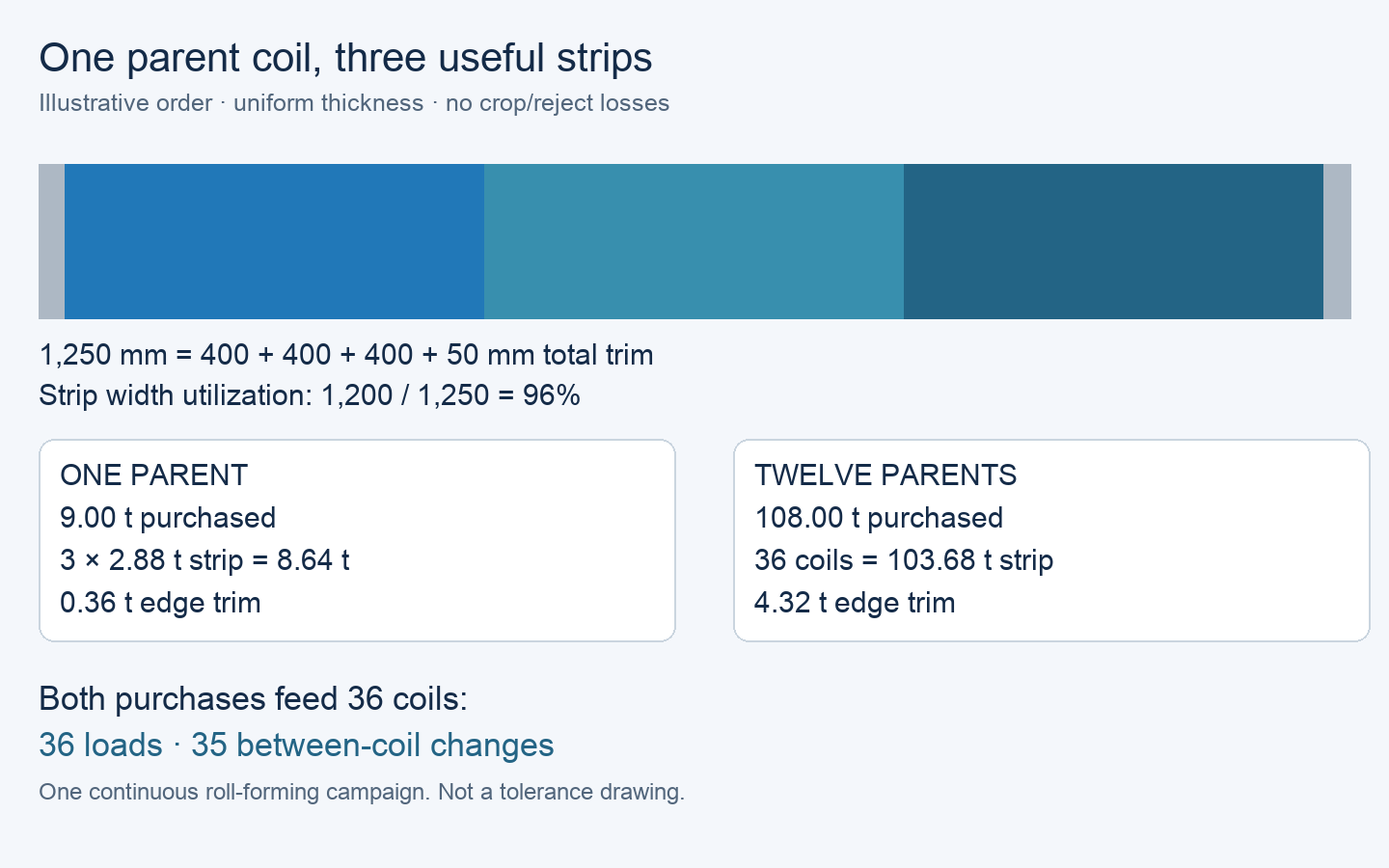
Consider a hypothetical order for 103.68 metric tonnes of accepted 400 mm strip. Both purchases use the same approved material, thickness and finish; a 1,250 mm parent width; 9 t per parent; and a qualified processor with a confirmed slot. The downstream line accepts 400 mm strip and coils up to 3 t, with compatible inside and outside diameters.
From Parent Width to Usable Strip Mass
The assumed layout produces three 400 mm strips and removes a total of 50 mm as edge trim. That gives a geometric width utilization of 1,200 ÷ 1,250 = 96%. At uniform thickness and equal strip length, each finished coil weighs 9 × 400 ÷ 1,250 = 2.88 t. Three finished coils total 8.64 t; trim accounts for 0.36 t. This simplified balance excludes head and tail crops, rejected material and later forming losses; include those in an actual order.
Twelve parents therefore purchase 108 t and produce 36 slit coils containing 103.68 t, plus 4.32 t of trim. The ready-slit quotation in this example offers the same 36 coils at 2.88 t each. Every kilogram of the accepted strip has an assigned use.
Count Changes at the Roll Former, Not the Slitter
Swipe to view the complete table.
| Quantity | Full-width purchase, then slit | Ready-slit purchase |
|---|---|---|
| Parent coils loaded at the slitter | 12 | Handled before delivery |
| Coils loaded at the roll former | 36 at 2.88 t | 36 at 2.88 t |
| Between-coil changes in one continuous campaign | 35 | 35 |
| Accepted strip mass | 103.68 t | 103.68 t |
Both options require 36 roll-former loads and 35 changes between coils for one continuous campaign. Comparing 12 parent coils with 36 slit coils would confuse two different production stages. Multiple campaigns, grade changes or a different supply coil size would change the operating count.
If the same line could accept only 1.5 t per coil, each 2.88 t strip coil would need to be divided into two 1.44 t coils by a processor able to provide that configuration. The order would then contain 72 coils and 71 between-coil changes. Requote the extra recoiling, packaging and handling before choosing either purchase.
How to Compare Cost for the Same Usable Output
Add Only the Costs Each Quote Leaves to the Buyer
Compare total spending to deliver the same accepted strip at the same receiving point. If the slit price already includes slitting, do not add that charge again. Include parent processing, transport between facilities, packing, receiving, handling and holding where they are separate. Keep any expected scrap credit separate until its value and ownership are established.
The following fictional USD quotations continue the same order. Both are assumed to meet the strip acceptance requirements and production date. The material and processing quotations include the agreed packaging and acceptance inspections for their respective delivery stages. Common downstream forming costs are identical and excluded. No tax, financing difference, start/end loss or scrap credit is included. These figures demonstrate the calculation; they are not current market prices.
An Illustrative Cost Comparison
Swipe to view the complete table.
| Cost item | Full-width purchase, then slit | Ready-slit purchase |
|---|---|---|
| Material | 108 t × $980/t = $105,840.00 | 103.68 t × $1,070/t = $110,937.60 |
| Slitting and recoiling | Separate: $2,600.00 | Included in strip price |
| Freight to the receiving plant | $2,000.00; includes all transport stages | $2,400.00 |
| Buyer handling and holding | $900.00 | $500.00 |
| Total spending | $111,340.00 | $113,837.60 |
| Spending per accepted tonne | $1,073.88/t | $1,097.97/t |
Under these assumptions, choose the full-width purchase with the qualified processor: it supplies the same accepted strip on time for $2,497.60 less. It does not reduce the downstream coil-change count. The advantage disappears if net additional costs on that option, relative to ready-slit supply, exceed $2,497.60. Unpriced extra recoiling, storage or transport must be resolved before placing the order.
If a quote leaves acceptance testing, transport or a processing charge “to be confirmed,” record it as unknown rather than zero. If the processor cannot establish strip quality or a workable slot, the cheaper calculation does not make the full-width purchase suitable. Select a qualified ready-slit offer or obtain a revised processing proposal.
How Slit-Coil Quality Affects Production
Edge Condition and Straight Feeding
A burr is a raised cut edge. Its height and direction can affect edge handling and contact with guides or forming rolls. Specify which face is checked, the measurement method and the acceptance agreed for the actual material thickness and equipment. Do not adopt one generic burr limit for every coil.
Camber is sideways curvature of the strip when viewed in its plane. A curved strip can steer against entry guides and contribute to alignment or profile problems. Measure against the agreed reference length and method. Check the guide alignment as well: a feeding problem does not prove the incoming slit coil is its sole cause.
Flatness at the Entry
Edge wave describes a wavy edge relative to the rest of the strip. Unequal elongation across the width can leave the edges longer than the center, so they do not sit flat. The result can disturb entry support and forming consistency. Record the relevant unloaded/loaded condition, support method and agreed flatness measurement rather than guessing acceptance from a photograph.
These checks apply to the finished feed coil in either purchase arrangement. Once both supplies meet the line’s acceptance, use the worked material-utilization and complete-cost comparison to choose the purchase.
What to Specify Before Placing the Order
Finished-Coil Dimensions and Acceptance
State the grade, thickness basis and finish, required strip width and its acceptance method, quantity by width, and the finished coil inside diameter, outside diameter and maximum mass. Include the material or profile trial requirement when applicable. A maximum mass alone does not establish that a coil fits the mandrel or available diameter clearance.
Processing Scope and Parent-to-Strip Traceability
For a full-width purchase, name the processing location and the person or company buying the slitting service. Assign responsibility for the parent-to-strip mass record, retained material, trim ownership and a rejected strip. For ready-slit supply, put the corresponding delivered-coil acceptance requirements in the purchase terms.
At receiving, use a coil list that maps each slit coil to its parent and material documents. For the example, a row might identify parent P01, strip P01-A, 400 mm width, 2.88 t nominal example mass and the agreed inspection record. Match the actual labels, measured quantities and documents before releasing the coils to production. Decide in advance how nonconforming coils will be held and replaced.
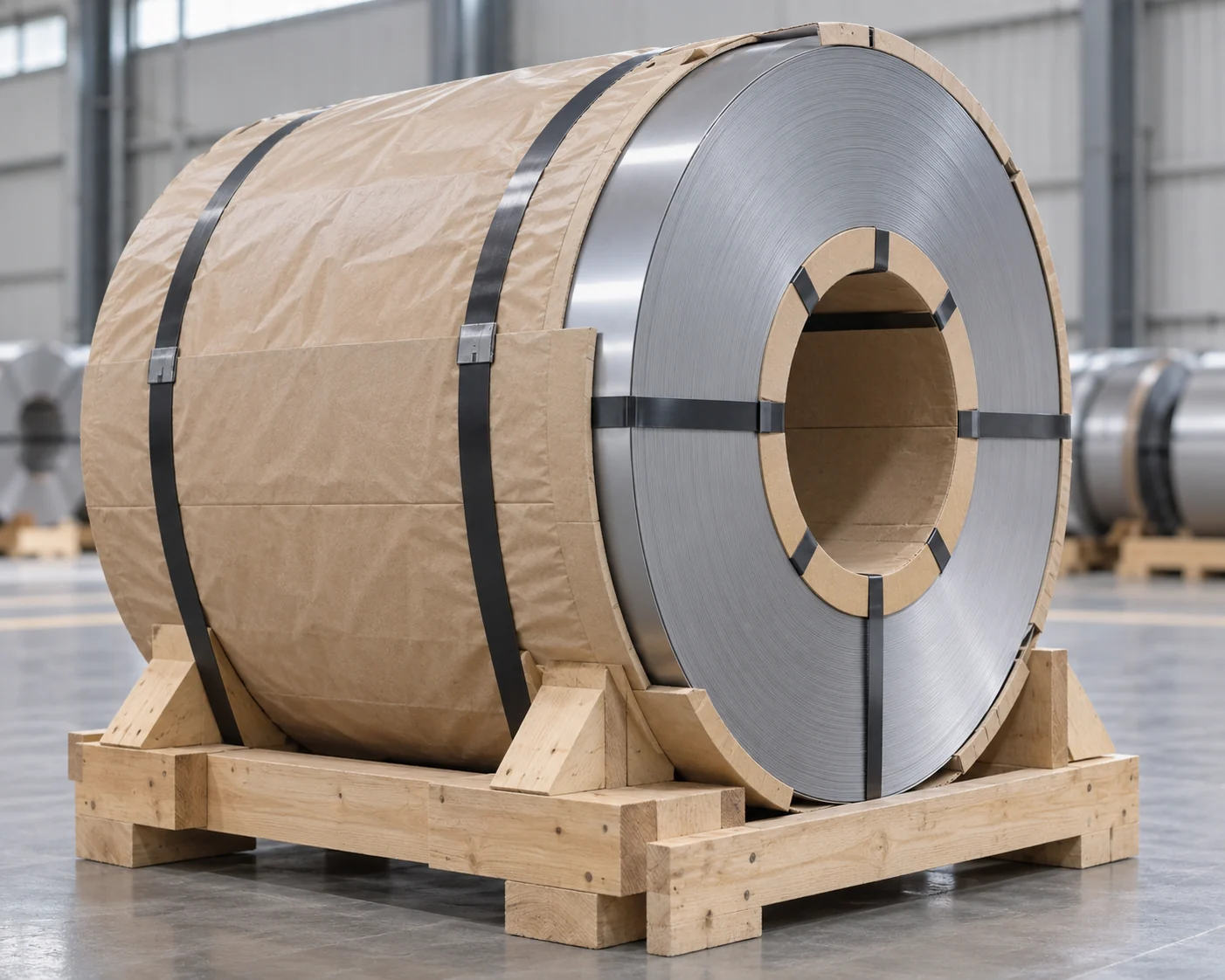
If this strip will become roofing, compare its required metallic coating separately.
Frequently asked questions
Can a service center slit a parent coil that I purchase separately?
Yes, if the selected service center accepts that material, parent size and work scope. Quote the processing slot, strip acceptance, transport and finished coil dimensions before buying the parent. Parent ownership and slitting responsibility can be split between companies without changing the required finished strip.
Does tighter slit-width tolerance also mean tighter thickness tolerance?
No. Slitting controls the width cut; it does not establish a new steel thickness specification. Specify the thickness basis and acceptance separately from width, then check both against the selected product and forming equipment.
Can different strip widths share one parent coil?
They can when the processor can produce the agreed layout and the widths fit with the necessary trim. The useful yield depends on demand for every resulting width. Price unused strips as retained inventory or another agreed disposition rather than treating them as accepted output for this order.
Will a larger parent coil reduce roll-former downtime?
Only if it ultimately produces larger compatible feed coils or otherwise improves the actual production schedule. Parent coil size alone does not reduce downstream changes. In the worked order, both purchases deliver the same 36 feed coils, so their between-coil change counts are the same.
Can painted steel be slit after coating?
It can be offered that way, but the sequence and acceptance requirements must suit the specified coating and product. Ask for the slit-edge condition, surface protection, packaging and applicable coating terms. Do not assume a resin name proves that a particular slitting and forming process is acceptable.
What should happen if a delivered coil passes width inspection but will not feed correctly?
Hold the affected coil and compare its actual inside diameter, outside diameter, mass, winding and strip condition with the agreed requirements and machine configuration. Record the coil identity and observed problem. A passing width measurement alone does not establish line compatibility, and a photograph alone cannot identify the cause.
Technical Basis and Source Scope
Technical basis: Roll-Kraft, Entry Guides—Where Proper Roll Forming Begins, entry alignment and camber discussion; Bradbury, Flat Book Part 1, edge-wave/unequal-elongation explanation. These machine/process sources support the mechanisms, not universal tolerances or claims that slitting causes every defect. The mass and cost comparison remains fictional.