The Main Differences Between Steel Coil and Flat Sheet
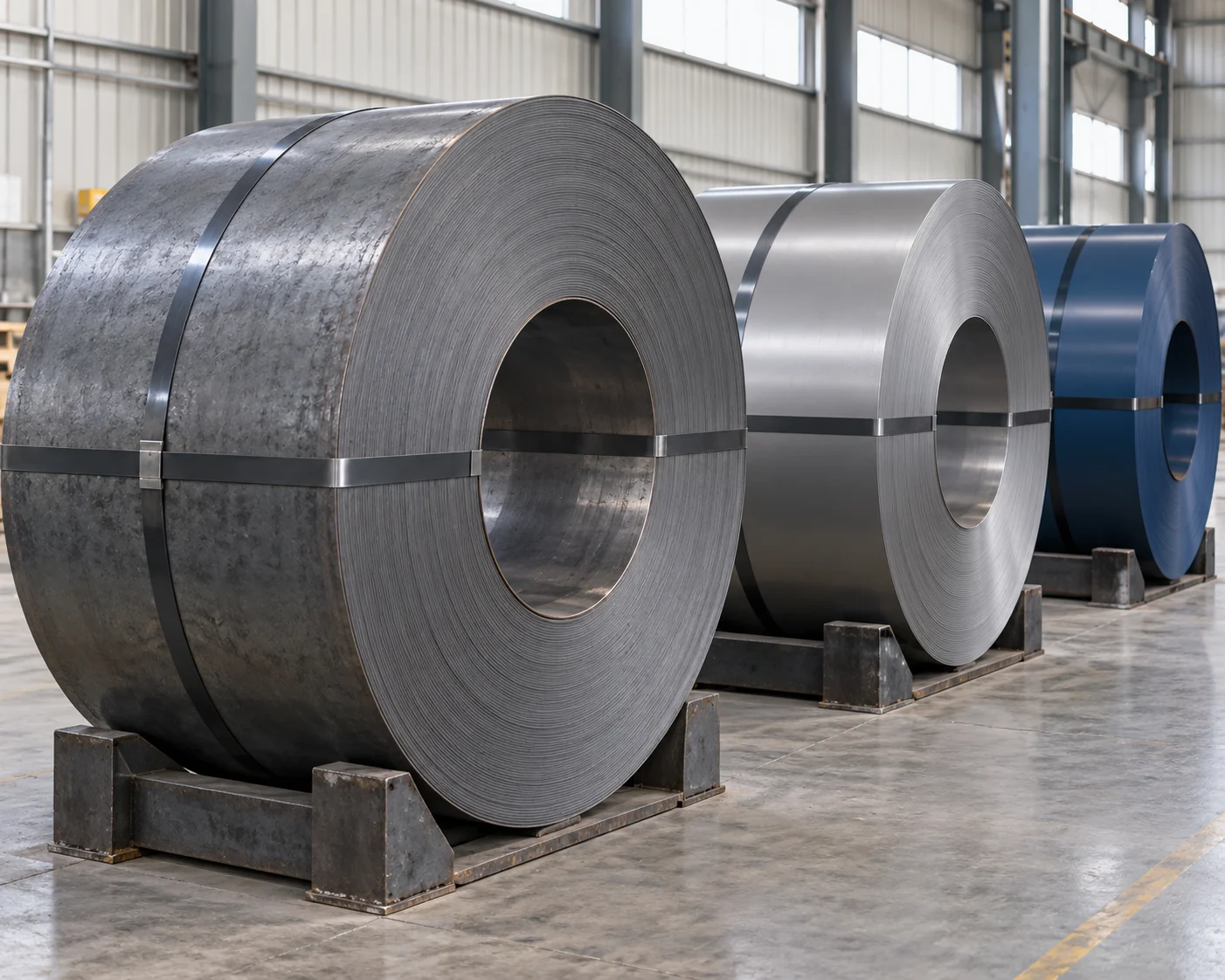
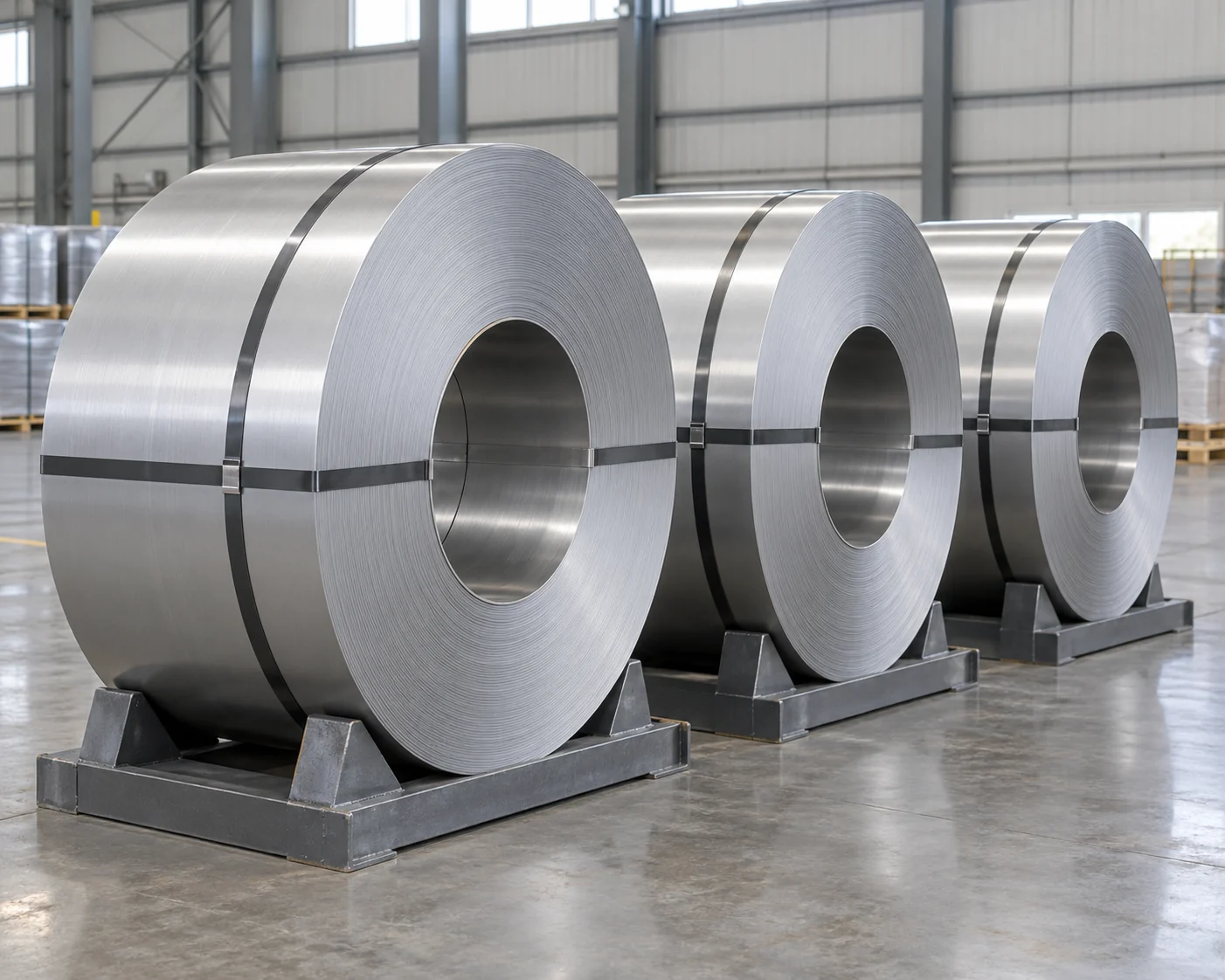
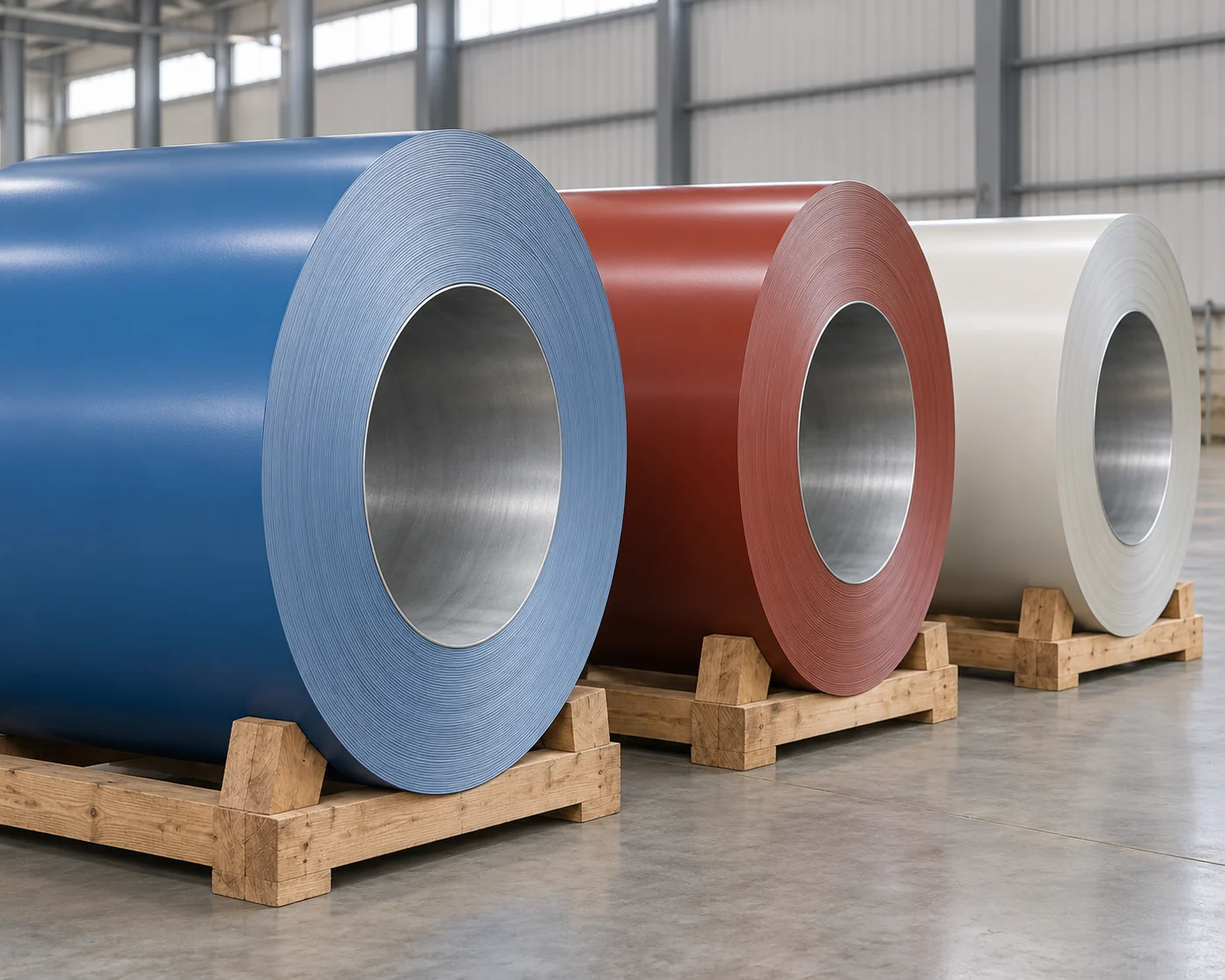
Steel coil is a continuous strip wound around a central eye. Flat cut-to-length sheet arrives as separate, unformed blanks cut to an agreed length. Both need forming to become roof panels. Specify “flat unformed sheet” in an inquiry, because a listing for “cut-to-length roofing sheet” may describe an already-profiled panel.
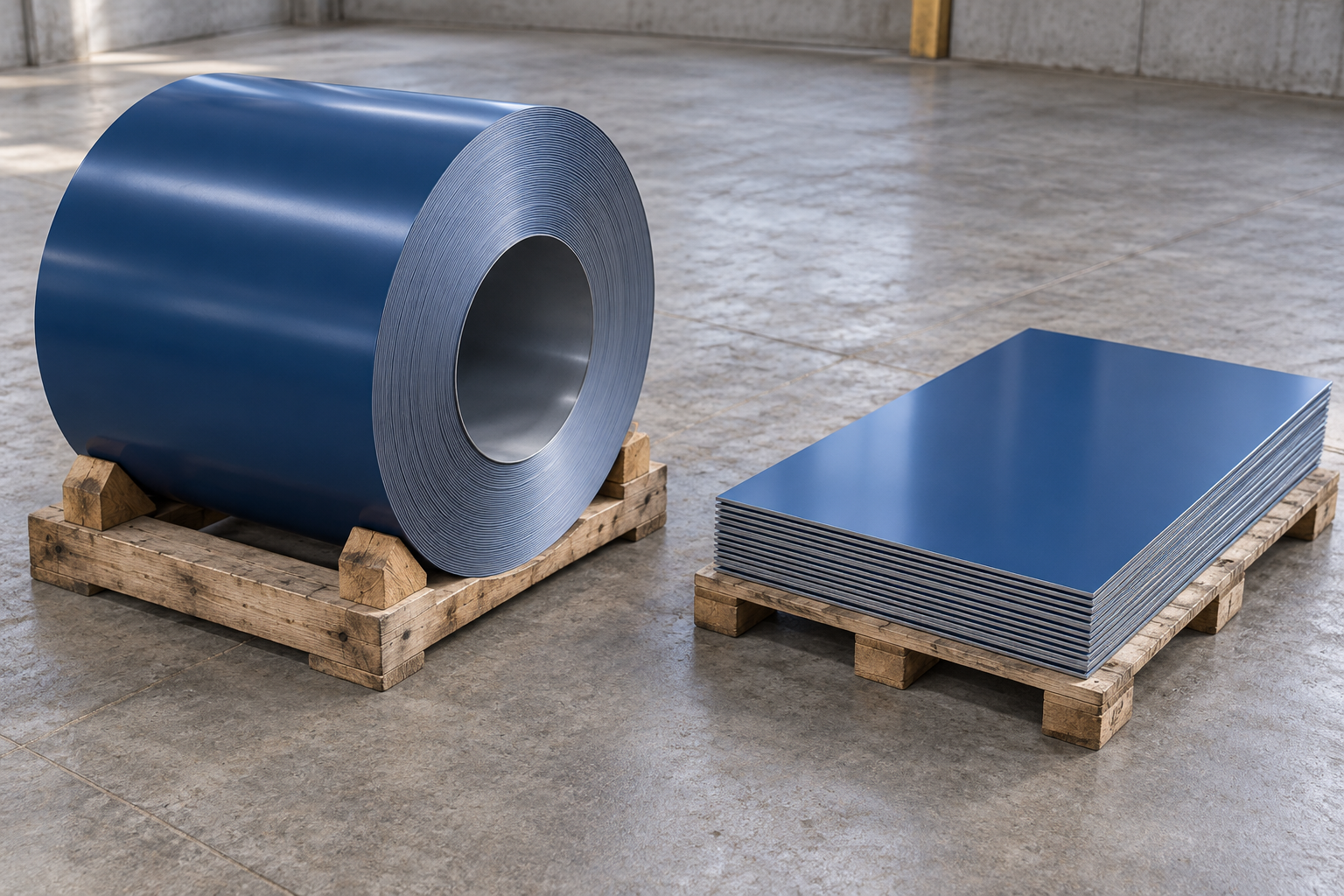
With coil, the fabricator or its processor handles uncoiling and any required leveling, slitting and cutting. With flat sheet, some of that work has already been done before delivery. A machine that cuts purchased coil into blanks before forming still starts with a coil purchase. Compare quotations at the same processing stage.
Input Width and Panel Cover Width
Input width is the flat strip or blank width before forming. Cover width is the width the finished panel covers across the roof. Forming the panel legs uses part of the input width. Use the widths on the selected profile drawing; a fixed allowance does not apply to every panel.
Coil and Flat Sheet at a Glance
Swipe to view the complete table.
| Factor | Steel coil | Flat cut-to-length sheet |
|---|---|---|
| Equipment | Needs compatible uncoiling, handling and feeding equipment | Needs a process that accepts individual blanks and their lengths |
| Length flexibility | Cut lengths can follow the panel order within the line’s limits | Supplied blank lengths determine how much re-cutting is needed |
| Handling and storage | Handle coil mass and keep the remaining strip protected | Handle and protect individual sheets or bundles |
| Material balance | Separate start/end losses from usable remaining coil | Separate offcuts from pieces with a confirmed next use |
| Cost comparison | Include coil preparation, forming, handling and balance holding | Include supplier cutting and any buyer re-cutting, feeding and handling |
Which Form Can Your Roof Panel Line Process?
Coil Feeding and Handling
For coil, check input width, thickness and material strength against the forming line’s limits. Then check the coil’s inside diameter, outside diameter and mass against the uncoiler and lifting equipment. The selected profile and material must be supported by that machine configuration.
Sheet Feeding and Blank Length
For flat sheet, check that the line accepts sheet feeding, guides the blank correctly and supports the required lengths. Also agree the flatness and edge condition needed for feeding. If the installed configuration accepts only coil for your panel, flat blanks are not an alternative on that line.
Some profiling machines accept sheet and coil, with material limits and minimum panel lengths that depend on the profile and configuration. Check the model you will actually use. A folding or batch process is an alternative when it can produce the same specified panel.
How Much Material Does Each Option Use?
A 240-Panel Order With Two Required Lengths
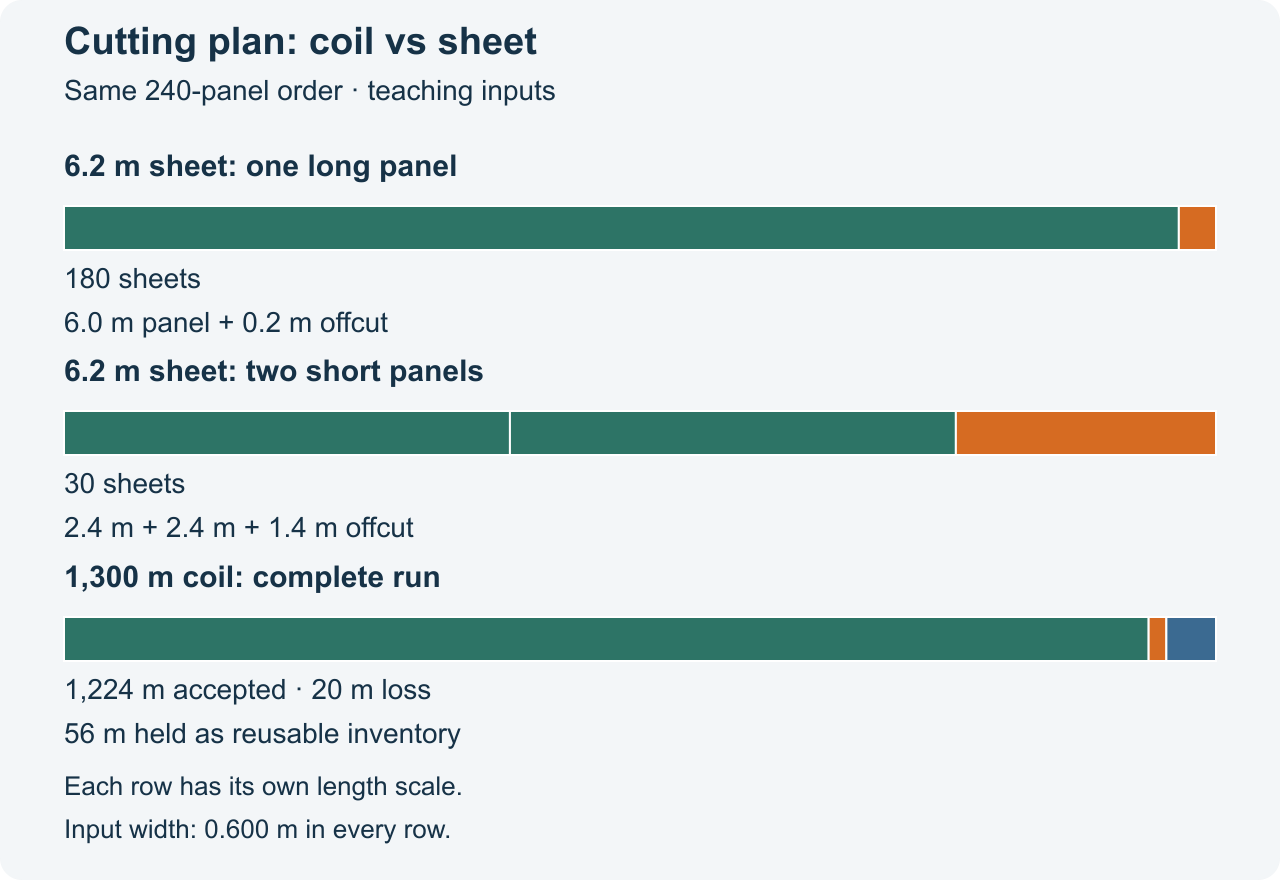
In this hypothetical comparison, the order needs 180 panels at 6.0 m and 60 panels at 2.4 m. Both processes can make the specified panel on time. Quantities, losses, equipment suitability and prices are assumed for the calculation. The lengths include fabrication allowances; no extra crop, kerf or rejected panels are included.
For this order, assume the sheet supplier can meet the quantity and delivery date only with 6.2 m blanks. Matching 6.0 m and 2.4 m blanks have not been quoted for those conditions. This supply-length constraint explains the sheet re-cutting below; it is not an inherent disadvantage of flat sheet.
Keep three quantities separate: purchased flat material area, finished panel cover area, and material left for a confirmed later use. At 0.600 m input width and 0.500 m cover width, the order needs (180 × 6.0) + (60 × 2.4) = 1,224 m of accepted panel length. That uses 734.4 m² of developed material and produces 612.0 m² of nominal panel cover. Roof laps and openings would affect the installed coverage calculation.
The Cutting Plans and Material Balance
Swipe to view the complete table.
| Measure | Coil purchase | 6.2 m sheet purchase |
|---|---|---|
| Purchased input | 1,300 m × 0.600 m = 780.0 m² | 210 blanks × 6.2 m × 0.600 m = 781.2 m² |
| Cutting plan | 1,224 m accepted panel length; 20 m total setup/end loss | 180 blanks yield one 6.0 m panel each; 30 blanks yield two 2.4 m panels each |
| Accepted developed area | 734.4 m² | 734.4 m² |
| Loss/offcuts with no planned reuse in this example | 20 × 0.600 = 12.0 m² | (180 × 0.2 + 30 × 1.4) × 0.600 = 46.8 m² |
| Usable material kept for a later run | 56 × 0.600 = 33.6 m² | 0.0 m² in this assumed plan |
| Accepted panel cover area | 612.0 m² | 612.0 m² |
Usable Stock and Process Yield
The coil balance is 780.0 = 734.4 m² in panels + 12.0 m² lost + 33.6 m² retained. The sheet balance is 781.2 = 734.4 m² in panels + 46.8 m² of offcuts. The retained coil is usable stock in this example; in a real order, check its remaining dimensions, condition and expected use before assigning it that value.
Measured against consumed material, the example’s coil yield is 734.4 ÷ (734.4 + 12.0) = 98.4%; sheet yield is 734.4 ÷ 781.2 = 94.0%. The 33.6 m² held for another run is excluded from the coil denominator. These percentages describe this cutting plan, not typical production yields. Material formed into panel legs remains part of the usable developed area.
Sheet offcuts depend on how well the purchased lengths match the order. Blanks supplied to the required lengths can reduce re-cutting at the fabricator. Supplier cutting losses and processing costs still belong in the material quote. Recalculate both plans for the actual offered lengths, fabrication allowances and expected rejects.
Which Option Costs Less for This Panel Order?
Total Spending and Consumed-Material Cost
Compare the total spending needed to produce the same panels at the same delivery point and date. For this funding comparison, count all the purchased material, including the coil left for another run. An internal consumed-material cost can allocate that stock separately, but it does not reduce the cash paid for this purchase.
The assumed material quotes include the finish, documentation and packaging. Production budgets include preparation, forming, handling and holding the remaining coil for the planning period. Both freight quotes end at the same fabricator. Taxes and duties are assumed equal and excluded from both totals.
Swipe to view the complete table.
| Cost or output | Coil purchase | 6.2 m sheet purchase | What is included |
|---|---|---|---|
| Material package | 7,020 quoted | 7,180 quoted, including supplier cut-to-length | Count purchased quantities; do not charge supplier cutting again |
| Buyer preparation/forming/handling budget | 800 | 950 | Include setup, sheet re-cutting/feeding, finish protection and balance holding as applicable |
| Freight to the same fabricator | 400 quoted | 400 quoted | Same receiving boundary |
| Total order spending | 8,220 | 8,530 | No speculative remnant or scrap-sale credit |
| Spending per panel cover m² | 8,220 ÷ 612 = 13.43 | 8,530 ÷ 612 = 13.94 | Same accepted output; USD/m², rounded to cents |
The USD 310 Difference and What Could Reverse It
Coil is the lower-cost choice for this example order: USD 8,220 versus USD 8,530, a difference of USD 310. Both processes meet the specified panel and delivery date. Coil also has less consumed-material loss in the stated cutting plan, while the full cost of its retained stock remains in the spending total.
The USD 310 difference is the decision margin. With the panel output and other costs unchanged, USD 310 of additional coil costs relative to sheet would make the totals equal; a larger net increase would make sheet cheaper. Check uncertain coil handling, preparation or storage costs first, without counting costs already included in the budget twice.
A quote for blanks matched to the required lengths could also change the choice. Compare its complete material, processing, freight and buyer-production costs against USD 8,220, with the same panel output and date. The quote must show whether supplier preparation is included; less cutting at your shop does not mean that processing costs disappear from the supply chain.
Remove any option that cannot meet the machine or panel requirements before comparing price. If freight, necessary processing or expected usable output is missing, show the known subtotal and request that item before making a final cost choice.
Optional: Calculate a Batch Break-Even Point
For a range of batch sizes with constant costs, write total coil cost as F_C + v_C × Q and sheet cost as F_S + v_S × Q. Q is the same output unit for both, such as panel cover m²; F includes all fixed costs in USD, including setup and applicable one-time order or freight charges; v is USD per output unit.
When v_S is greater than v_C, the crossover is Q = (F_C − F_S) ÷ (v_S − v_C). Use it only if the result is positive and within both processes’ supported and quote-valid ranges. Coil has lower modeled cost above that crossover; sheet has lower modeled cost below it. Minimum purchases, remaining inventory and changing production rates can make the simple linear model unsuitable.
What to Specify When Ordering Coil or Flat Sheet
Material, Sizes and Delivery Conditions
Compare the same steel grade, thickness basis, metallic coating, topcoat and backcoat, color and profile revision. Distinguish base-metal thickness from total coated thickness. Include input width, cover width and the panel lengths and quantities.
For coil, add inside/outside diameter limits, maximum mass and any required slit width. For sheet, add blank width, requested lengths and counts, tolerances, flatness and edge condition. State coating orientation, package protection and the receiving date. Use the coating producer’s conditions for the actual product; replacement-batch and film questions are covered below.

FAQs About Coil and Sheet for Roof Panels
Can two short sheets be joined to make one longer roof panel?
Use the specified panel length unless the responsible designer and roof-system requirements accept a joint. Joining two short pieces changes the roof detail and can affect performance and warranty conditions. Include the added fabrication, installation and inspection work in the comparison if the joint is accepted. The worked example uses continuous, unjoined panels.
Is there a fixed batch size at which coil becomes cheaper than sheet?
There is no universal panel count. Coil and sheet have different setup costs, processing rates, purchase quantities and remaining-stock costs. Compare complete spending over the batch sizes you expect, using the same panel output and delivery conditions. The optional calculation in the cost section applies only where those costs remain constant.
Can one wide coil supply several roof-panel input widths?
Yes, if the material can be slit into widths that suit the receiving lines. Specify the coating and slitting sequence, strip widths, edge-trim allowance, resulting coil masses and finish condition. Include the service in the material cost. A line’s edge-trimming attachment alone does not establish a multi-strip slitting and recoiling capability.
Can the sheet offcuts be used for flashings or trim?
Yes, when the offcuts fit a confirmed trim cut list, the specified material and finish, and the forming process. Check dimensions, finish direction and quantity first. The 1.4 m pieces in this example are not suitable for every flashing. Assigning usable offcuts to another job can change internal material-cost allocation; it does not reduce the cash paid for the original purchase.
Can another paint batch be used for a few replacement panels?
Check the original finish, batch and surface direction, then compare actual samples and agree the replacement scope before ordering. Follow the coating producer’s batch and direction requirements for the specified finish. Where those conditions apply, keep them consistent across the visible roof face; a matching color code alone does not confirm the required appearance.
Should coils and flat blanks use the same protective film?
Choose film and packaging for the exact coating product and delivery form. Ask the coating producer to confirm film compatibility, removal timing and packaging support for wound coils, including any effect on winding stability. Flat blanks also need suitable surface protection, but the same film arrangement does not automatically suit a wound coil.
Technical Basis and Source Scope
The worked example assumes that both processes can produce the specified panels. Confirm feed width, thickness, material and handling limits for the machine configuration you will use. The material-use calculation and $310 cash-outlay difference use the same accepted panel quantities, lengths and developed and coverage widths.