Define the support-steel package before comparing prices
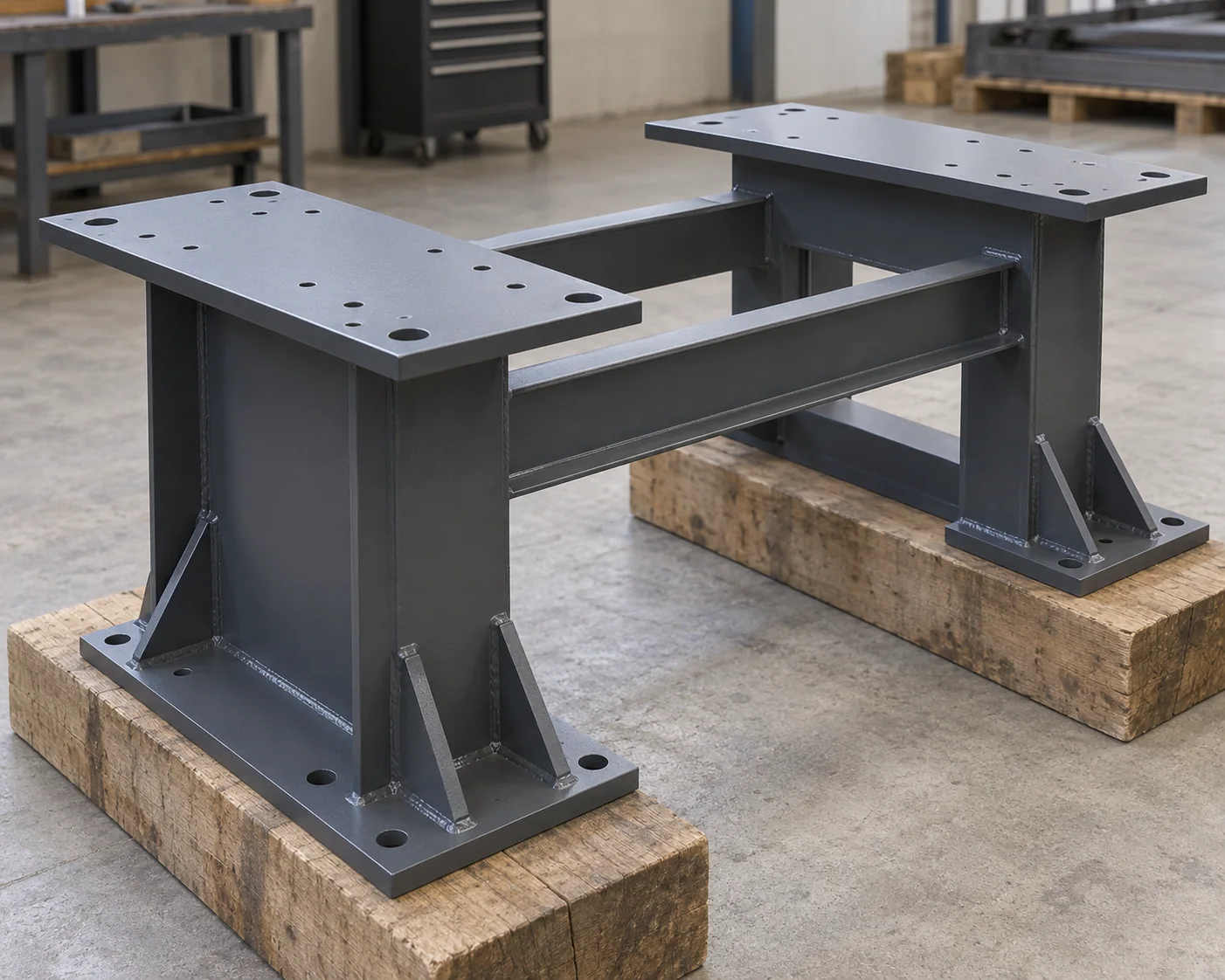
For this comparison, custom industrial support steelwork means the fabricated members, attached plates, specified connection hardware, protective finish and agreed factory records supplied for equipment frames, conveyor supports or plant support structures. A platform frame does not automatically include decking, stairs or handrails. Identify those additional items when required.
Compare the same completion stage
Fix the drawing revision, assembly quantities, equipment interfaces, finish and delivery endpoint. Separate structural design, foundations, equipment, unloading and site erection from the supplied package unless the offer expressly includes them. A delivered finished assembly and loose cut members are different purchases even when their quoted steel weights match.
The seven drivers below explain the work inside a matched fabrication and delivery scope. Their relative cost depends on the actual design and offers.
Seven cost drivers to check in a custom steelwork offer
Ask the estimator to connect a price difference to the affected parts or operations. This makes the response useful: it can identify a design change worth considering, a necessary requirement to retain or a service missing from the competing offer.
Swipe to view the complete table.
| Cost driver | How it changes cost | Evidence behind the allowance | Input to review |
|---|---|---|---|
| 1. Material specification and purchased yield | Specified grade/product form, stock lengths or plates, cutting allowance and usable remnants determine what must be bought—not only what remains in the finished frame. | Released material takeoff, purchase quantities and supplier material basis. | Keep the accepted material; ask whether a different stock format or combined cutting lot reduces purchased material without creating unwanted stock. |
| 2. Part variety and preparation | Unique marks, repeated quantities, cuts, holes, copes and bends drive detailing, programming, fixtures and processing work. Equal weight can contain very different numbers of operations. | Part/operation schedule and separate first-unit or setup charges. | Group truly identical pieces and price variants separately; ask the designer about avoidable one-off details before release. |
| 3. Joint fit-up, welding and assembly | Joint type, weld dimensions, access, positioning and assembly sequence change preparation, fitting, welding and handling. A weld-length total alone is incomplete. | Joint schedule, shop/field split, weld requirements and proposed fabrication sequence. | Have the designer and fabricator assess simpler suitable details; do not reduce welds or add field joints through a purchasing instruction. |
| 4. Finished-interface precision | Machined faces, mating-hole relationships and tighter finished geometry can add operations, fixtures and intermediate control after welding or finishing. | Equipment/interface requirements with datums, measured parameters, permitted deviations and measurement stage. | Apply tighter requirements to the features that need them; price their completion separately from ordinary member preparation. |
| 5. Surface preparation and protective finish | Area, access, system build, masking, handling and repair scope affect coating work. Galvanizing can require fabrication details for venting and drainage. | Finish schedule, area/assembly basis, reserved faces and treatment/repair scope. | Price the specified complete system; coordinate the fabrication with the finishing process before changing paint to galvanizing or vice versa. |
| 6. Inspection, testing and traceability | The required methods, extent, witness points and records consume inspection and coordination work beyond making the part. Different joint details may have different examination scopes. | Inspection/test plan tied to part and joint marks, acceptance basis, reporting and independent-party responsibilities. | Agree the required scope and price its included services once; distinguish routine checks from additional contract testing. |
| 7. Shipping units and delivery pattern | Assembly envelope, protection, handling, packing, load utilization and number of deliveries affect delivered cost. Smaller units may add designed shipping joints and site work. | Packed-unit schedule, handling masses, receiving restrictions, shipment lots and freight quotation. | Compare feasible shipping arrangements with their connection consequences; confirm whether unloading and site assembly are outside the price. |
1. Separate purchased material from finished and shipping weight
Finished steel weight describes the designed members and plates. Purchased material also depends on the actual stock and cutting plan. Gross shipping weight adds the other shipped items and packing. State which quantity appears in a price denominator; do not assume a fabrication rate includes material, or use a packing-list weight as the net structural takeoff.
2. Count unique parts and their preparation
A support with many small plates and different holes can need more preparation than a heavier repeated member. Count the unique part marks and quantities against the operations required. A first-unit fixture or program can serve repeat pieces, while a handed or changed interface may need its own preparation. Obtain the fabricator’s price for that actual mix rather than applying an assumed volume discount.
3. Price the actual joints and assembly access
Count joints as well as pieces. The joint schedule controls preparation and the weld geometry; the shop plan controls how the joint is reached and positioned. AISC’s Scheduling and Estimating Module, §2.22, identifies weld-joint type, length and effective throat as estimating inputs and notes that some welds need multiple passes. Those inputs explain why equal feet of weld need not mean equal work.
4. Specify the finished equipment interfaces
For equipment seating and mating interfaces, identify the finished parameter and where it is measured. Overall frame size, a local hole pattern and the relationship between mounting faces are different requirements. Machining or another accepted completion process may be needed; the equipment’s actual requirement decides.
ANSI/AISC 303-22, §11.2 commentary, calls for additional design tolerances to be identified in the contract documents as a measured parameter and acceptable deviation. Its general structural fabrication tolerances are not a finished machine-interface specification. Agree the required interface condition after the relevant welding and finishing operations, so a supplier does not price ordinary fabrication while the buyer expects a precision-completed support.
5. Carry the complete finish through the fabrication
Finish cost follows the specified preparation, coating system and surfaces as well as mass. Include inaccessible corners, reserved seating/contact faces, protection during handling and the specified touch-up scope. For hot-dip galvanizing after fabrication, resolve venting and drainage with the designer and galvanizer before the assembly is closed. AGA’s Venting & Drainage guidance explains why the treatment liquids and zinc need a free flow path; it does not provide a substitute for the project’s accepted detail.
6. Identify the inspection service being bought
Inspection is a separate allowance even when it is bundled into the assembly price. Identify the required dimensional checks, weld examination, coating checks and material/part records. The contract should identify any independent testing and who pays for it. A higher inspection price may reflect additional specified examinations, not a claim that another supplier is entitled to skip the common acceptance requirements.
7. Price feasible packed units and delivery lots
Use the actual shipping units and destination constraints. An assembled frame may reduce site completion but occupy more space on a truck; a split frame may travel more compactly while adding plates, bolts and field assembly. Compare both with their full connection and receiving arrangements. Freight economy does not establish that the design can be divided at a convenient packing line.
Example: explain a price gap between equal-weight support packages
Assume a purchase of 16 equipment-support kits for one US plant. Two alternative designs are already accepted for the same equipment reactions, movement, mounting interfaces, finish and operating access. Both can be delivered and assembled under the initial receiving plan. A uses more shop-completed assemblies; B divides each kit into smaller shipping units with its own accepted connections.
Assume each hypothetical 16-kit package contains 8,000 lb of finished members and plates, excluding loose fasteners, coating and packing from that weight. Both quoted prices include their scheduled fasteners. A has 112 cut/drilled pieces with seven unique marks and 64 shop-welded joints; B has 176 pieces with eleven unique marks and 96 shop-welded joints.
The offers use the same hypothetical USD inputs and pre-tax delivered-supply boundary at the plant gate, before unloading. Each includes material purchasing, the listed fabrication/finish/inspection services, packing, supplier handling and freight, with overhead and margin already allocated to its lines. Both use the same required finished-interface criteria. Their accepted inspection plans require different joint-examination extents, reflected in the offered allowances. Structural design, foundations, equipment, unloading, site assembly and applicable buyer taxes are excluded from both totals.
Swipe to view the complete table.
| Priced work | A: shop-completed units | B: smaller shipping units | B minus A |
|---|---|---|---|
| 1. Material purchase and scheduled hardware | $18,000 | $18,000 | $0 |
| 2. Detailing, cutting/drilling and setup | $4,200 | $5,200 | +$1,000 |
| 3. Joint fit-up, welding and assembly | $6,300 | $9,000 | +$2,700 |
| 4. Finished-interface completion | $1,600 | $1,600 | $0 |
| 5. Surface preparation and finish | $3,200 | $3,500 | +$300 |
| 6. Specified inspection and records | $1,200 | $1,800 | +$600 |
| 7. Packing, handling and freight | $3,000 | $2,200 | −$800 |
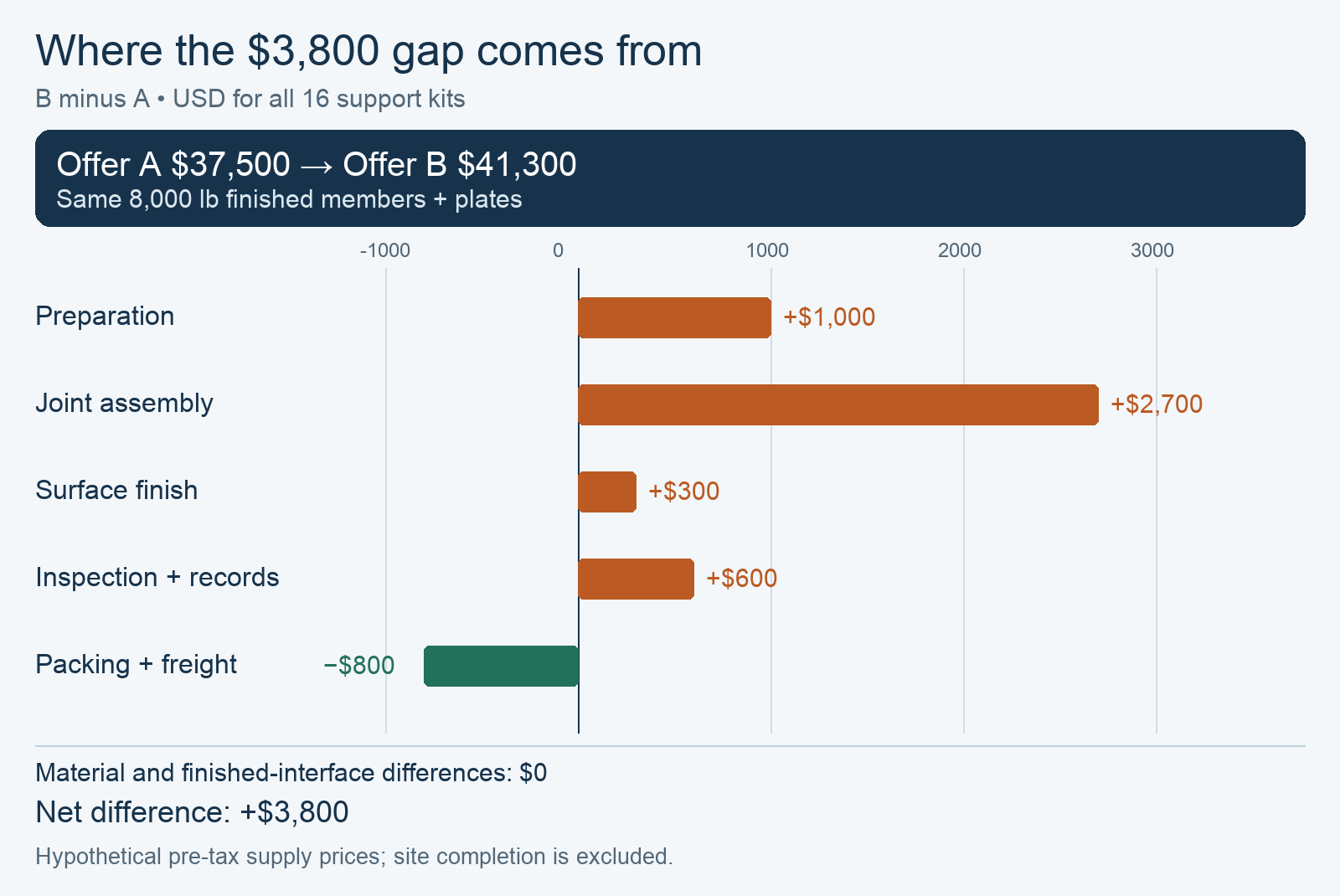
| Matched delivered-supply total | $37,500 | $41,300 | +$3,800 |
Calculate the difference and identify what caused it
A totals $18,000 + $4,200 + $6,300 + $1,600 + $3,200 + $1,200 + $3,000 = $37,500. B totals $18,000 + $5,200 + $9,000 + $1,600 + $3,500 + $1,800 + $2,200 = $41,300. The $3,800 difference is $1,000 + $2,700 + $300 + $600 − $800. Material and finished-interface allowances do not contribute to that gap.
For this matched supply comparison, prefer A while both accepted designs and receiving plans remain valid: its lower preparation, assembly, finish and inspection allowances outweigh B’s $800 packing/freight advantage. The equal finished weight does not explain those differences. Do not turn the example into a per-pound market rate or assume that shop completion always wins.
Keep site completion outside the supply comparison
The site still needs a separate completion budget. B’s field assembly is outside its supply total, just as A’s unloading and site work are outside A’s. Obtain those costs before naming the lower fully installed option. Neither omitted work nor a buyer responsibility is zero.
A changed receiving route can overturn the choice
Now change the receiving condition: intervening equipment makes A’s assembled units too large for the available route, while B’s accepted smaller units still fit. A is no longer a feasible purchase as offered. Keep B as the workable option or obtain an accepted split-unit redesign and revised price for A; the old $37,500 total cannot price that new configuration.
Frequently asked questions
What should happen when a quote expires before the drawings are released?
Reconfirm the price and schedule against the final revision and remaining commercial assumptions. Ask which material, subcontract or freight allowances have changed and which remain firm. Do not treat an expired budget price as a committed production price, or apply a blanket percentage update without the supplier’s revised basis.
Can a steel-price adjustment be applied to the entire assembly price?
Use the adjustment terms actually agreed for the order. Identify the price component, reference date, trigger and calculation basis. Material, shop work, testing and freight are separate cost elements; a change in one does not establish the same change in all others. Obtain the revised total rather than multiplying the whole package by a raw-steel index.
If the buyer pays for a fixture, who owns it for the next order?
Record ownership, storage, maintenance, reuse rights and any transfer conditions in the purchase agreement. Paying a setup line does not explain whether the charge buys a physical fixture, programming work or only the first production setup. Tie any repeat-order price assumption to the tooling and records that will actually remain available.
How should a drawing change after cutting be priced?
Identify the affected piece marks and the work already completed. Separate usable material, replacement parts, additional preparation, rework, finish restoration and any changed inspection or freight. Agree the revision and adjustment before treating the old unit price as valid for the new configuration; unaffected pieces can retain their existing price basis.
Who pays for re-inspection after a weld repair?
Use the order’s agreed nonconformance and inspection terms. First obtain the required technical authorization for the proposed repair; then identify repair execution, re-examination, any witness return visit and the related charges. Keep these records against the affected joint mark. Do not assume that a repair is automatically permitted or that one party always pays every follow-up cost.
Can offers in different currencies be compared using one converted total?
Use a stated comparison currency, conversion source and date, and preserve the original quoted amounts. Keep actual payment currency, fees, payment dates and any exchange-adjustment terms visible. A conversion can align the worksheet for comparison; it does not lock the exchange rate or guarantee the eventual amount paid.
Technical Basis and Source Scope
AISC-hosted construction-management teaching material, Scheduling and Estimating Module, Module Two, §§2.20–2.22, printed pp. 72–80: takeoff, fabricator scope, detailing and fabrication operations, finishing, inspection, handling and freight; weld quantity inputs on p. 80. The text identifies its preparation context as 1999. Only the qualitative work breakdown is used; historical prices, percentages, productivity and code references are not current estimating data.
ANSI/AISC 303-22, Code of Standard Practice for Steel Buildings and Bridges, May 9, 2022, §11.2 commentary, printed p. 16.3-63: additional design tolerances should identify the measured parameter and permitted deviation in the contract documents. General structural fabrication tolerances do not establish the equipment’s final interface requirements.
American Galvanizers Association, Venting & Drainage, updated October 2019, opening explanation and Drainage section, checked October 20, 2026: fabrication flow paths for galvanizing after fabrication. No universal hole dimensions or finish price is prescribed here. The seven-driver grouping, commercial comparison actions and all example offers are editorial or hypothetical as identified.