Choose delivery lots around workface capacity
Compare three feasible material-delivery strategies
Define the objective as complete, usable work with materials that the site can identify, protect and receive. Then compare feasible delivery arrangements. All three options below can work when their storage, counting and replenishment requirements are provided; none is inherently the cheapest.
Keep truck loads separate from installation packages
An installation package is a defined scope for a workface and stage. A shipping lot is the material moved in a particular dispatch. One truck may carry several separately identified installation packages, while one package may arrive in several consignments and remain incomplete until its final required item is accepted. Consolidation does not erase either identity.
Swipe to view the complete table.
| Delivery strategy | Prefer it when | Useful difference | Tradeoff to plan for |
|---|---|---|---|
| Supplier-family bulk deliveries | The site has protected stores, reliable picking and stable, repeatable part identities. | Common stock can serve several ready workfaces without waiting for a new prepacked lot. | More site inventory and sorting; stock must still be reserved and checked against each package. |
| All stages for one workface delivered together | Space near that workface can protect the complete set, and later replenishment is less dependable. | The later-stage material is already available when the workface progresses. | More material waits on site and may obstruct later access unless its storage is planned. |
| Workface packages delivered in installation stages | Laydown is constrained and an available supplier or consolidation point can count and replenish the next stage. | Only the near-term stage occupies the planned site holding area. | More release decisions and bookings; an omitted small part can defeat a carefully timed delivery. |
For the constrained-site example below, choose workface packages delivered in stages. If dependable replenishment becomes unavailable but protected workface storage is available, delivering that workface’s complete set earlier becomes preferable. If the site instead has a well-managed store and changing workface priorities, bulk stock with controlled reservations can offer more allocation flexibility. These choices concern material availability and space; compare actual packing, transport, storage and rehandling offers before declaring a cost winner.
Define a complete steel, piping or solar mounting package
Set a finishable work boundary
Start from the accepted work boundary and its installation and inspection requirements. Name the workface, stage and exact work that can be finished. Identify its predecessor work, required access and buyer-supplied interfaces. A complete steel material package may be the first stage of a larger cross-trade workface; it does not have to include every later pipe spool and solar clamp in the same physical delivery.
Count assemblies, loose pieces and complete kits
Use the accepted BOM to list marked assemblies and every separate connection item. For steel, distinguish shop-attached plates from loose connection plates and fastening kits. For piping, keep each specified joint’s mating pieces, seals and fastening items together with the relevant support devices. For solar mounting, distinguish rail lengths, splice kits, rail attachments, end clamps and mid clamps; a clamp body is not automatically a fastening kit.
A named manufacturer example shows why the distinction matters. IronRidge’s Flush Mount Installation Manual, Version 2.0, ©2019, pages 3–5, identifies the rail, bonded splice and joining screws separately, followed by its specified clamp assemblies. Those historical part details apply to that configuration. For the purchased mounting system, retain the actual part list, instructions and compatible interfaces rather than choosing a similar-looking splice or bolt.
Preserve the shared interface revision
Give each package a unique label connected to the BOM revision and packing list. Link steel, piping and mounting drawings through their shared interface revision. If a bracket hole pattern or rail attachment changes, reopen the affected packages and identify whether the old items are unshipped, stored or already installed. A newer document date alone does not establish that old parts remain usable.
Two workfaces and one missing saddle kit
Set the package and receiving conditions
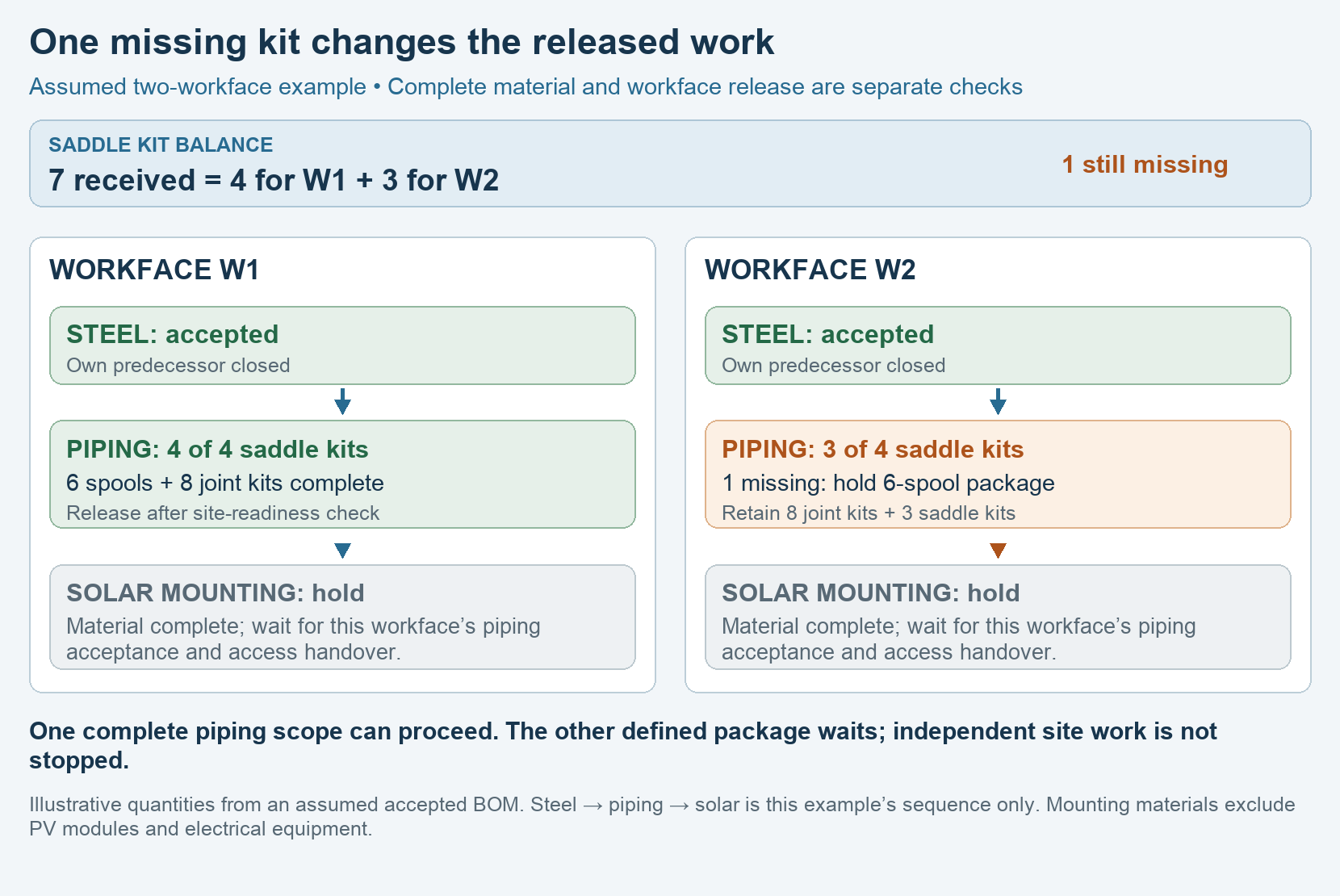
Assume two independent workfaces, W1 and W2. Each piping package—P1 or P2—needs six marked spools, eight complete joint kits and four complete saddle kits. All spools and joint kits have passed receiving checks, but only seven of the eight saddle kits have arrived. The quantities are hypothetical; each complete kit includes its specified hardware. No smaller piping package has been defined.
Allocate one complete piping package
Both workfaces’ steel stages have been accepted. The site can receive only the next installation stage, with W1 taking priority. Reserve four saddle kits for P1 and three for P2. P1 is materially complete but may dispatch only after its access and receiving check; P2 remains one kit short. The project sequence places each solar mounting stage, V1 or V2, after its own piping acceptance and access handover. PV modules and electrical work are supplied by other parties.
Swipe to view the complete table.
| BOM item | Required, both workfaces | Received | P1 allocation | P2 allocation | Still missing |
|---|---|---|---|---|---|
| Marked pipe spool assemblies | 12 | 12 | 6 | 6 | 0 |
| Complete joint kits | 16 | 16 | 8 | 8 | 0 |
| Complete saddle kits | 8 | 7 | 4 | 3 | 1 |
Close the shortage or change the package boundary
A smaller W2 package can proceed only if the team defines a finishable scope with all required supports, joints, access and independent inspection. Revise its bill of materials and dependent releases before dispatch; three saddle kits alone do not define that scope.
Alternatively, transfer an identical accepted kit from another reservation and update both allocations, including any shortage created elsewhere. When P2 has four complete kits, repeat its receiving and access check. V2 still waits for P2 acceptance and handover.
Protect stored materials and release the next usable lot
Match the holding location to the actual material
Assign actual holding locations before dispatch. Keep long steel and pipe groups stable and identified, protect the mating faces and finish required by their instructions, and keep small-part containers connected to their package codes. Separate similar sizes and revisions so a receiving count can distinguish a correct kit from an equal quantity of the wrong part.
For US construction work, OSHA 29 CFR 1926.250 addresses stable storage in (a)(1), floor load limits in (a)(2)(i), clear access in (a)(3), and incompatible-material segregation in (b)(3). Paragraph (b)(9) requires pipe and structural steel, unless racked, to be stacked and blocked against spreading or tilting. These requirements constrain the planned storage arrangement; they do not determine a universal truck count or authorize storage on a roof.
Use the actual product’s storage and preservation instructions for closures, seals, coated surfaces, packaging and exposure. Assign protected, labeled small-part storage at the consolidation point and the site; outdoor laydown space alone does not prove that every item can wait there. If a holding location or permitted storage condition becomes unavailable, postpone dispatch or use an agreed suitable alternative instead of sending a complete but unmanageable lot.
Check both material readiness and workface readiness
At the release decision, reconcile the package’s current BOM, accepted quantities and item records; check that its predecessor and inspection holds are closed; and have the site confirm its receiving location, access and handling arrangements. The logistics coordinator then maps the released package IDs to the actual dispatch and packing-list IDs. Material readiness and workface readiness are separate fields, so a complete V2 kit can remain clearly marked “hold—P2 handover open.”
At receiving, verify the package labels, revisions, counted kit contents and condition against the dispatch record. Record a shortage or damaged item against its actual package, revise the usable-work result and keep rejected or unresolved items out of released stock. Reconcile the balance at the consolidation point as well, so the next dispatch does not reuse a reservation that has already left.
Frequently asked questions
Can several installation packages share one truck?
Yes, if the transport and site receiving arrangements can handle that shipment and preserve package identity. List each package ID, container or bundle reference, quantity and destination on the dispatch record. A shared vehicle does not make an incomplete package complete, and the carrier and site still need an appropriate loading, protection and handling arrangement.
Should a small missing part delay all materials for the site?
Only the affected scope and its dependent releases need to be held. In the example, one missing saddle holds the defined P2 piping package and its solar-stage handover, while complete P1 can proceed. Other independent work can continue. A smaller partial scope needs its own accepted material, support and inspection boundary before release.
How should spare fasteners and contingency quantities be packed?
List them separately from the quantity reserved for each complete installation package, with the same part and revision identity. Decide who may release that reserve. If a spare kit is used to close P2, record the transfer and the reduced reserve; do not continue showing the same pieces as both installed-package stock and contingency stock.
What if a packing list counts cartons rather than complete kits?
Use the carton reference to find the contents, then reconcile pieces or defined kits to the BOM. Record the kit’s included hardware and verify the agreed count and condition checks. Ten clamp bodies and ten bags of unspecified bolts do not establish ten accepted clamp kits. Keep shortages visible at the component level that prevents completion.
What should happen when a drawing changes after part of a lot arrives?
Identify the changed interface and affected package IDs, then separate old-revision items from the new requirement. Obtain the project’s disposition for material already stored or installed. Update the BOM, reservations, packing instructions and dependent releases together. Do not relabel old parts as current merely because the new drawing has the same product-family name.
When is a larger delivery better than frequent staged deliveries?
A larger complete-workface delivery can be preferable when protected storage and access are available but later replenishment is uncertain. Bulk supplier-family deliveries can also suit a site with a capable store and flexible picking. Compare actual storage, packing, transport and rehandling scope; a fuller truck by itself does not show lower total cost or more usable work.
Technical Basis and Source Scope
OSHA, 29 CFR 1926.250, General requirements for storage, current text checked October 19, 2026: (a)(1), (a)(2)(i), (a)(3), (b)(3) and (b)(9). Used for stable storage, clear access, storage-load limits, incompatible-material segregation and restrained pipe/structural-steel storage; it does not specify a universal delivery-lot size.
IronRidge, Flush Mount Installation Manual, Version 2.0, ©2019, pages 3–5: component checklist and separate rail, bonded-splice, fastener and clamp assembly steps. This named historical configuration illustrates component-versus-kit identity; use the current instructions for the actual purchased system. No IronRidge component is specified or substituted in the worked example.