Reduce the new buy without losing required material
For an EPC steel and piping package, reconcile quantities at the same item, revision and unit before reducing an order. Installed demand, deliberate spares, supplied assemblies, usable stock, existing commitments and the additional purchase are different quantities. Treating all of them as a single gross takeoff makes surplus difficult to prevent or explain.
Keep demand, reserves and supply credits separate
Calculate the shortfall from current installed demand plus approved spares, less material already included in other supplied scope, less accepted stock allocated to this requirement, less usable incoming commitments. Buy only a positive shortfall: the new requirement cannot be less than zero. Convert that shortfall to the supplier’s actual stock length, pack and minimum-order basis, and confirm that every credited quantity is available by the required date.
This is source reduction: preventing unnecessary purchases, rather than disposing of extra material later. EPA’s Sustainable Management of Construction and Demolition Materials guidance identifies purchasing agreements that prevent excess materials from arriving on site as a source-reduction measure. Recycling an offcut can be worthwhile, but it does not undo the original overpurchase.
Seven ways to reduce surplus in the steel and piping order
Apply these actions from design reconciliation through order amendment and final material recovery. Each removes a different source of excess; none permits a substitute material, an unapproved design change or an unsupported reduction in the required spare stock.
Swipe to view the complete table.
| Method | Surplus mechanism | Action and input | Who and when | Completed result |
|---|---|---|---|---|
| 1. Replace superseded demand | Deleted runs, supports or connections remain in the purchase quantity. | Reconcile the released design against the previous takeoff; identify additions, deletions and unchanged lines. | Design/materials lead, before the affected order release. | Remove obsolete uncommitted demand; disposition material already ordered separately. |
| 2. Remove overlapping supply scope | Loose plates, fittings or fasteners are bought again although included in an assembly or another contractor’s order. | Map each supplied assembly to its included pieces and assign one purchasing owner to each requirement. | Package buyer and fabricator, before combining quotations. | Deduct the included quantity once from the separate loose-material requirement. |
| 3. Apply available stock to a named requirement | Accepted material is repurchased, or the same stock is promised to two packages. | Count and identify actual stock; confirm condition, records, ownership and existing reservations; authorize any transfer. | Stores/materials control, before calculating the new buy. | Reserve eligible stock once; keep unresolved or unavailable quantities visible. |
| 4. Pool exact-match lines before rounding | Separate small orders each create a full extra carton, bundle or minimum lot. | Combine only technically identical requirements with compatible need dates and a controlled allocation. | Buyer, before accepting order multiples. | Apply the confirmed pack or lot multiple to the combined new requirement, then allocate its contents. |
| 5. Convert demand to the real purchasing unit | Nominal metres or finished weight understate the stock lengths, cutting allowance or order minimum actually bought. | Use the accepted cut plan, usable stock dimensions, process allowance, supplied unit and line-specific minimum. | Fabricator and buyer, before material purchase/cutting. | Buy the quantity that produces the required accepted output; identify resulting offcuts and rounding surplus. |
| 6. Give spares their own basis and owner | Several parties add contingency to the same demand, hiding reserve inside construction quantities. | State the specific spare items, quantities, purpose and release authority; check whether another offer already includes them. | Project/maintenance owner and buyer, before final quantity approval. | Retain the agreed reserve separately from installed demand; remove duplicate contingency only. |
| 7. Act before commitments become irreversible | A revised spreadsheet reduces the demand but leaves the old supplier release, shop cut or field reservation unchanged. | Obtain the actual production/dispatch status and agreed change, return or transfer disposition by affected line. | Buyer and supplier, at the contract’s change decision and during closeout. | Amend only what can be changed; retain and account for committed or returned material until its disposition is authorized. |
1. Remove quantities from superseded design
Compare the current released takeoff with the previous one by item and location. A deleted pipe run may remove elbows, supports and joint materials together, while another revision may merely change a connection. Update the affected lines and their interfaces; do not carry both old and new quantities into the purchase total. A pending design decision remains a pending quantity, with its release boundary identified.
2. Buy assembly contents only once
Read the supplier’s assembly contents against the EPC takeoff. A fabricated support can include attached plates and specified fastening sets; a spool can include fittings that also appear in an early bulk list. Identify what is included, what remains loose and what another party buys. Remove the overlap from the additional order, while preserving the quantity required in the finished work.
3. Reserve accepted stock before buying again
Credit a physical item only after its identity, condition, required records and availability are established. Check its reservation and the owner’s authority to move it. A counted item reserved for another work package is not free stock. An unidentified or quarantined quantity is unresolved—not a confirmed credit and not proof that the yard contains none. Give it a resolution date before the affected purchase is committed.
4. Combine common requirements before pack rounding
Pool only exact matches: the same product specification, size, wall or thickness, material, finish, connection and relevant revision. Keep technically different elbows, handed members or fastening sets separate. For common items, combine the remaining requirements before rounding to cartons or minimum lots. Allocate the purchased contents back to the work packages so a pooled order does not become an unowned store of surplus.
5. Order for the actual cutting and selling unit
For cut steel, use the fabricator’s actual output per stock length, including usable dimensions and cutting/end allowances. For fittings or fasteners, confirm whether the selling unit is a piece, complete set, carton or lot. A six-metre nominal length is not six metres of finished parts, and a carton minimum is not an engineering requirement. Ask for an alternative supply format or lot only when it meets the accepted product and schedule requirements.
6. Preserve intentional spares and remove duplicated contingency
Keep a spare schedule with specific quantities and reasons: commissioning replacements, a named maintenance holding or a justified construction contingency. Check the quantities already included by equipment suppliers, fabricators and subcontractors before adding another reserve. No single percentage suits all lines. Reduce duplicate allowances while retaining the project’s deliberate spare requirement.
7. Change the supplier release and close the remaining balance
Before issuing an amendment, ask which material is unpurchased, purchased but uncut, cut, assembled, packed or dispatched. Obtain the supplier’s written response under the actual order terms. A reduction in required quantity is not an automatic full credit or cancellation right. Keep usable committed material in the balance; agree any return, alternate use or disposal separately. After construction, reconcile unused returns and remaining supplier balances so the next buy does not recreate the same excess.
Example: amend three material lines and retain the required spares
Consider a hypothetical steel-support and piping package for two plant work areas. Assume the stated material definitions and applications have been accepted. The current release is Rev C; the original additional order used Rev B before stock, assembly contents and common-item quantities were reconciled. The following quantities, inspection outcomes and supplier-agreed amendments are example inputs.
The original changeable lines are twelve 6.00 m RHS stock lengths, eighty identical 4 in. 90-degree long-radius butt-weld elbows and two hundred complete loose fastening sets. Each fastening set here contains one specified bolt, one nut and two washers; its grade, length and finish follow the assumed connection drawing. The buyer and supplier have agreed in writing to amend these unstarted lines before cutting or pack allocation. Separate earlier commitments listed below are already made and are retained; the example does not cancel them.
Rev C requires twenty finished 2.40 m RHS rails, fifty-eight elbows and thirty-six steel connections with four fastening sets per connection. The project separately retains two spare rails, two spare elbows and eight spare fastening sets. Twelve connection kits bought within the steelwork scope already include forty-eight of the required fastening sets; those sets are not another loose purchase.
Stores has four accepted, unreserved finished rails, three accepted elbows and twenty-four accepted loose fastening sets. Two additional rails have unresolved identity, four elbows are quarantined, and twelve further accepted fastening sets are reserved for another package. These quantities remain separately recorded and are not credited to this order. The earlier usable commitments are four finished rails, seven elbows and twenty loose fastening sets, confirmed for the needed date.
The assumed supplier confirms two accepted 2.40 m rails from each 6.00 m stock length, with 0.03 m total cutting/end allowance per length. There is no bar minimum beyond a whole length. Elbows sell in packs of ten with no larger minimum; loose fastening sets sell in packs of twenty with no larger minimum. Both work areas can use the same elbow specification and need date. Their remaining elbow requirements are twenty-four for area 1 and twenty-six covering area 2 together with the central reserve.
Swipe to view the complete table.
| Purchase line | Current demand including spares | Credits retained for this demand | Remaining new requirement | Original → amended additional order |
|---|---|---|---|---|
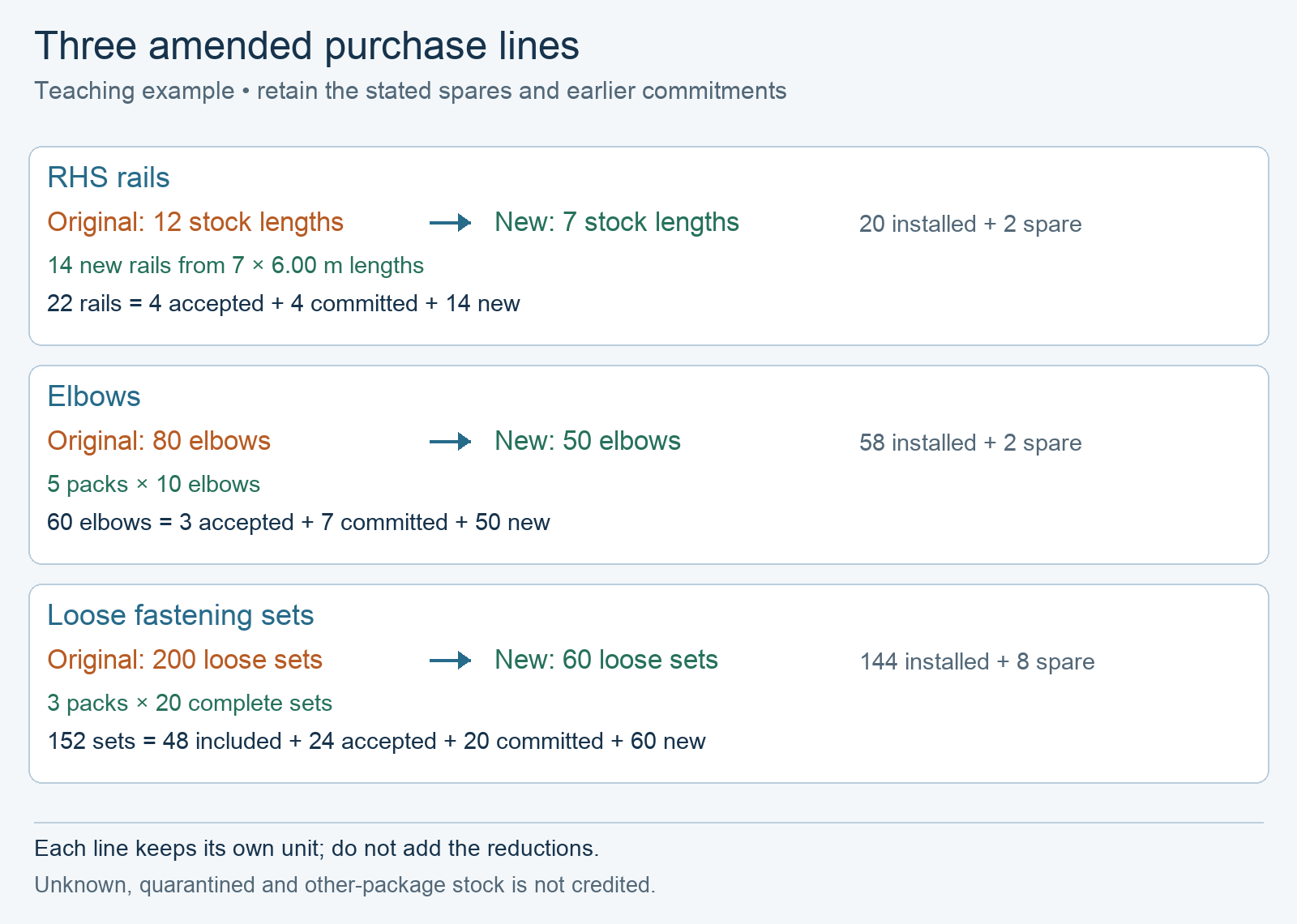
| RHS stock for finished rails | 20 installed + 2 spare = 22 rails | 4 accepted rails + 4 previously committed finished rails | 22 − 4 − 4 = 14 rails; 2 per stock length | 12 → 7 stock lengths, each 6.00 m; supply 14 finished rails |
| Identical 4 in. 90° LR elbows | 58 installed + 2 spare = 60 elbows | 3 accepted + 7 previously committed elbows | 60 − 3 − 7 = 50 elbows; pool 24 + 26 before pack rounding | 80 → 50 elbows, in 5 packs of 10 |
| Specified complete loose fastening sets | 36 × 4 installed + 8 spare = 152 sets | 48 included in connection kits + 24 accepted loose + 20 previously committed loose | 152 − 48 − 24 − 20 = 60 loose sets | 200 → 60 loose sets, in 3 packs of 20 |
Issue the amended order and allocate every retained quantity
Issue the agreed amendment for seven stock lengths cut into fourteen rails, fifty elbows and sixty loose fastening sets. Retain the earlier commitments and reserve the accepted stock to this package. Allocate the resulting supply as twenty installed rails plus two spares, fifty-eight installed elbows plus two spares, and one hundred forty-four installed fastening sets plus eight spares. The installed quantities have not been reduced to make the order smaller.
Pooling matters on the elbow line: rounding twenty-four and twenty-six separately to ten-piece packs buys thirty plus thirty, or sixty. The combined fifty-piece requirement buys exactly five packs. The rail line instead depends on the confirmed two-cut output; the fastening line removes the forty-eight sets already included in connection kits before applying its twenty-set pack.
Keep cutting remnants and future changes visible
The seven new stock lengths contain 42.00 m of RHS. Fourteen finished rails contain 33.60 m, the stated allowances total 0.21 m, and the remaining offcuts total 8.19 m. Record the actual offcut identities and dimensions after cutting; this case has no approved next use for them. They are not automatically credited as recovered production or counted as purchased material avoided. Agree ownership and delivery of these offcuts in the cutting order.
The additional order is smaller by five stock lengths, thirty elbows and one hundred forty loose fastening sets. Report those three changes separately. They are not a combined waste-reduction percentage, a monetary saving or the final surplus at completion. The unresolved rails, quarantined elbows and other package’s reserved fastening sets remain outside this balance until their status changes.
If both unresolved rails are reliably identified and accepted in time, the remaining rail requirement falls from fourteen to twelve and the new order can fall from seven to six stock lengths—but only if the supplier agrees before that material is committed. If the seven previously committed elbows become unusable or late, the new requirement becomes fifty-seven, rounded to sixty in six ten-piece packs, leaving three pieces of pack-rounding excess. If the supplier raises its elbow minimum to eight packs, the proposed purchase becomes eighty and creates thirty elbows beyond the current sixty-piece total requirement after the ten credited elbows; seek a technically acceptable smaller-lot source or obtain an explicit disposition for that excess before accepting the changed offer.
Frequently asked questions
How should kilogram receipts be reconciled with a piece-count order?
Keep the commercial weight record and the required piece balance separately. Use the actual supplied lengths or item counts and the agreed measurement basis; do not convert a gross bundle weight, including packing, into an exact number of accepted pieces. Resolve a unit mismatch before posting the receipt as full coverage of the order.
Can material issued to a work area still be counted as available stock?
Not as free warehouse stock. Keep it assigned to that work area until its use or physical return is reconciled. A return needs a count, identity and condition check, followed by release of its old reservation and authorization for the next allocation. An installation report and an unposted return should not create two credits for the same pieces.
What if a supplier is permitted to deliver more than the nominal order quantity?
Check the order’s actual quantity-tolerance or overdelivery terms before calculating the expected receipt. State how an allowed extra quantity will be allocated, retained, returned or otherwise handled. A packing list that exceeds the nominal count does not by itself establish a buyer’s return right or make those extra pieces required construction material.
Can surplus Government-owned material be transferred to another project?
Where FAR 52.245-1 applies to the Government property, paragraph (c)(1) limits its use to performing that contract unless the contract provides otherwise or the Contracting Officer approves. Its property-control and disposal provisions also remain relevant. Obtain the applicable authorization rather than treating a technically matching item as freely transferable. This is a specific federal-contract example; private-owner material follows its own ownership and contract terms.
Does a supplier’s credit note close the physical material return?
Reconcile the commercial credit and the material movement separately. Keep the authorized return quantity, item identity, dispatch and receiving confirmation connected to the credit reference. A promised credit does not show that the material left the site, and a truck leaving the gate does not establish the accepted credit amount. Close both records under the agreed return terms.
What if stock and incoming commitments already exceed revised demand?
Set the new buy to zero, then record the excess separately. For example, a revised total requirement of twelve pieces, including the agreed spares, with nine allocated accepted pieces and five usable committed pieces leaves no new purchase and two excess pieces. Keep the stock and incoming commitments identified until the owner and contract authorize their disposition. The arithmetic does not cancel an incoming order, permit a transfer or remove the genuinely required spares.
Technical Basis and Source Scope
U.S. EPA, Sustainable Management of Construction and Demolition Materials, updated March 18, 2026, “Source Reduction/Reducing Materials Use,” checked October 20, 2026: purchasing agreements can prevent excess materials and packaging from arriving on site. Used for the distinction between preventing excess and managing waste already generated, not for an EPC reduction rate or product-acceptance rule.
Federal Acquisition Regulation, 52.245-1, Government Property (September 2021), current official page checked October 20, 2026: (c)(1), authorized use; (f)(1)(iii)–(iv), records and physical inventory; (f)(1)(viii)(A), use and excess property; (j), inventory disposal. These provisions are used only for the expressly identified Government-property example, not as rules for every private EPC order.
The seven-action workflow and purchase reconciliation are editorial recommendations. All case quantities, stock acceptance, cutting output, pack sizes, minimums, commitments and agreed amendments are hypothetical inputs; the arithmetic does not establish supplier availability, project qualification, a cancellation entitlement or financial savings.