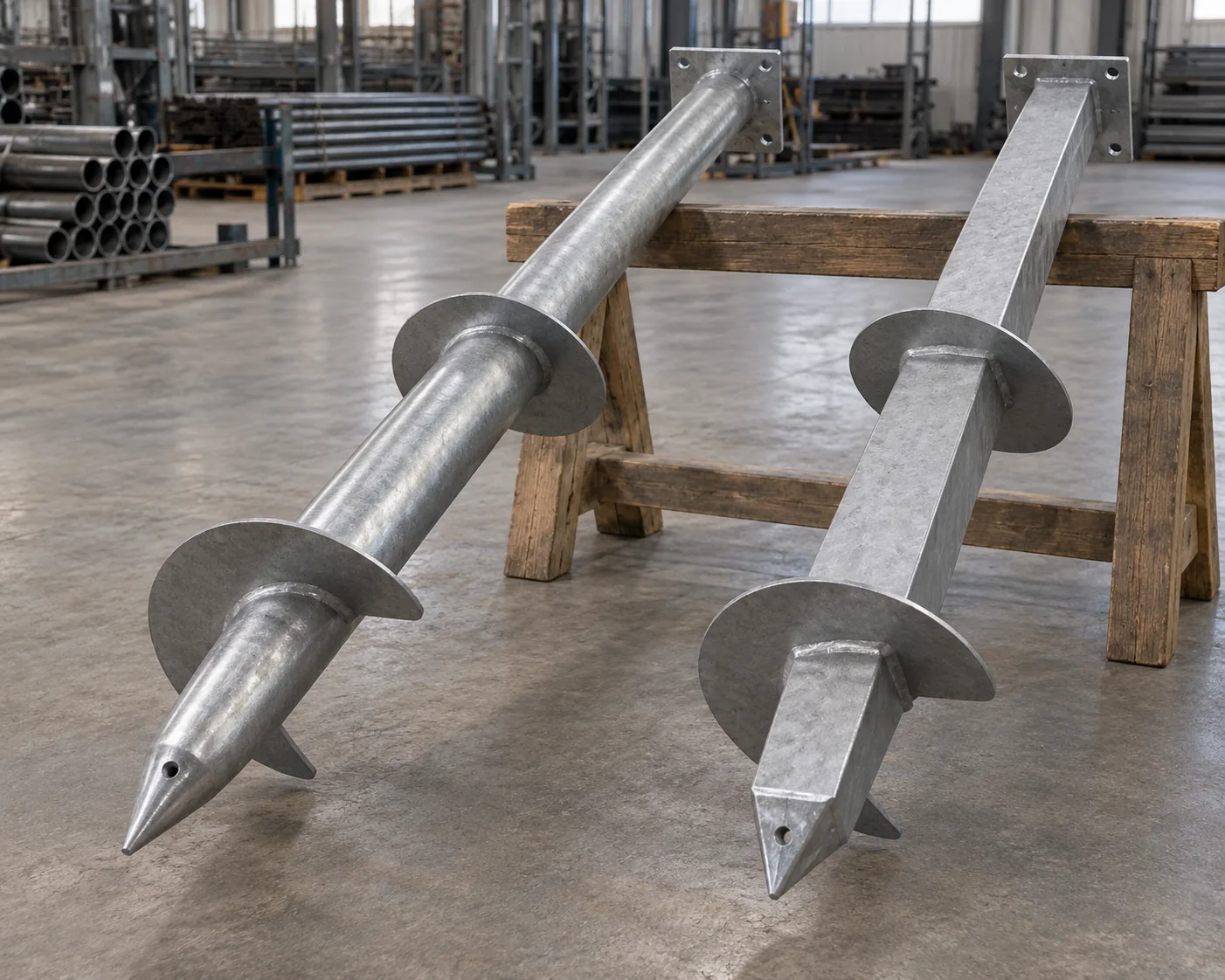
Translate Soil Zones into Foundation Supply Requirements
Map the Foundation Locations, Not Just Soil Labels
Use the geotechnical interpretation and the array layout together. A zone should identify the foundation locations to which the design assumptions apply, not merely a colored area on an early soil map. Groundwater, fill, obstructions and changes in strata may affect both the finished foundation and how it can be installed.
Keep Racking Loads and Installation Conditions Together
Connect each zone to the required compression, uplift and lateral performance, movement limits and durability provisions. Include the racking reactions and pile-head arrangement. The geotechnical and structural designers select and qualify the foundation; procurement turns that selection into the correct material and installation scope.
Keep uncertainty visible at zone boundaries. A successful trial at one location does not prove every nearby position has the same ground. Agree on the observations and acceptance criteria that tell the installer when to continue, seek a routine adjustment or stop for a revised design.
Choose One Agreement, Staged Lots or Specialist Packages
When a Single Production Order Works
Use one complete production order when the relevant zones, quantities and designs are settled and one supplier can meet the full scope. The order can still contain different lengths, sections or foundation systems. Standardizing paperwork is useful; standardizing an unsuitable foundation is not.
When Staged or Specialist Packages Work Better
Use a supply agreement with separate zone releases when part of the site can proceed while other areas are still being resolved. Agree on the commercial rules for each later release, including minimum lots, price validity, lead-time start and cancellation exposure. A reservation for future capacity is different from authorization to manufacture final parts.
Use separate specialist packages where a zone needs a different manufacturing or installation capability, or where qualified independent supply materially improves the project plan. Keep the interface to the racking coordinated. Multiple contracts can be appropriate, but they need an owner for the boundaries between foundations, installation and the structure above.
Compare these approaches after checking supplier capability. A supplier’s offer to provide steel does not establish that it supplies the complete foundation system, installation tooling or field testing. Those scope differences must be resolved before comparing the commercial alternatives.
Swipe to view the complete table.
| Project condition | Approach to evaluate | Tradeoff to price and plan |
|---|---|---|
| All zones and quantities accepted; supplier covers every required variant | One complete order with zone-specific lines | Simpler purchasing, but less freedom to change quantities after manufacture |
| Accepted zones can start before the remaining areas are resolved | One agreement with separately authorized production lots | Earlier work against possible extra lot, transport and mobilization costs |
| A zone requires a capability outside the main supplier’s qualified scope | Separate specialist package | Useful expertise with an additional racking and delivery interface |
| A common component is genuinely accepted across zones | Consolidated purchase of that component | Common drawings and acceptance are required; appearance alone is insufficient |
Standardize Only the Foundation Interfaces That Are Accepted
Common Racking Connections Can Simplify Supply
Look first for useful common interfaces: the racking connection, identification system, documentation format and delivery packaging. Common pile heads or extensions are possible only where the accepted designs permit the same parts. A matching bolt pattern alone does not establish equal load transfer or movement behavior.

Extensions and Couplings Belong to a Defined System
For a system that uses extensions, identify the approved shaft, coupling, fasteners and installation limits as a set. Do not buy a generic extension allowance and assume it can correct every unexpected ground condition. A different section, length or connection may require a revised design and installation assessment.
Keep material identification linked to the zone and drawing revision through fabrication and delivery. If two visually similar piles have different requirements, a shared loose stack can erase the distinction the procurement plan was meant to preserve.
Example: Release Two Accepted Zones and Keep the Third Open
Compare Two Qualified Supply Arrangements
Consider a hypothetical solar site with 1,000 foundation locations: 600 in Zone A, 300 in Zone B and 100 in Zone C. The designers have accepted different foundation variants and installation criteria for A and B, including the required trials. Zone C has unresolved obstructions and awaits its final design.
Two supply arrangements are qualified for A and B. Supplier X can provide both accepted variants under one agreement, with separate zone packing and production releases. Alternatively, suppliers Y and Z can each deliver one zone to the same quality and delivery requirements. Both arrangements can meet the construction schedule. The owner’s stated priority is one consistent interface for the accepted racking connections and later drawing changes, rather than separate supplier redundancy.
The Selected Plan and What Would Change It
Choose X with zone-specific releases for A and B. The initial accepted scope covers 900 foundation locations, while C’s 100 locations remain provisional. Order the actual parts from the approved bills of materials; 900 locations do not automatically mean 900 individual steel pieces. X’s agreement may reserve a later production window for C, but must not authorize its final parts before the design is accepted.
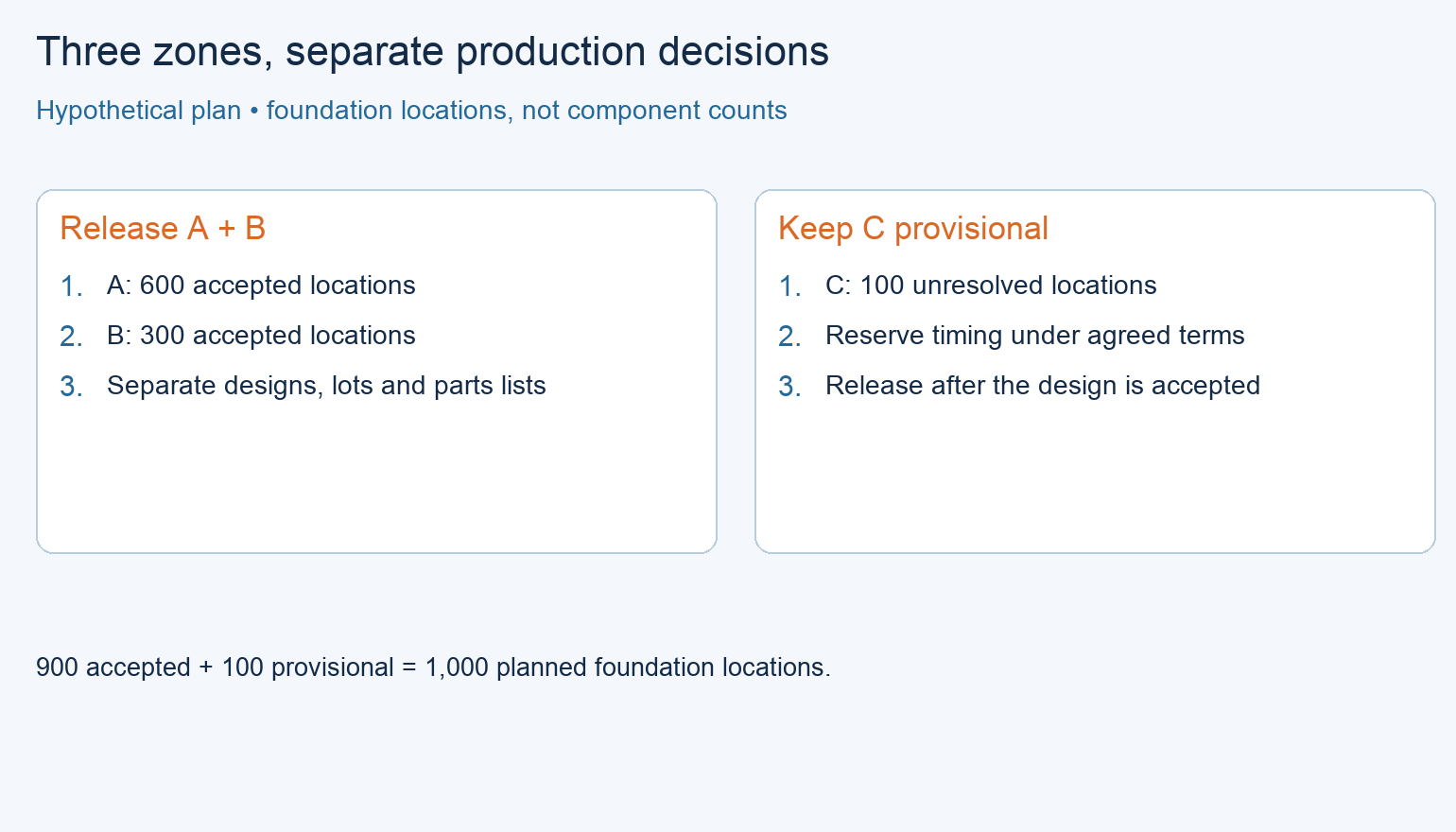
This choice preserves progress on A and B and provides the coordination arrangement the owner prefers. Separate Y and Z packages remain a valid alternative if independent supply becomes the priority or their complete installed offers are more attractive. No saving is claimed without prices for the same materials, installation, testing and delivery scope.
If C ultimately requires a system outside X’s capability, procure that zone from a qualified specialist and reconcile its racking interface before release. If revised ground information affects B, pause B’s unmanufactured balance and review that zone. The agreement should allow a targeted response rather than forcing the team to treat all 1,000 locations as identical.
Price the Complete Foundation Lot and Handle Ground Changes
Separate Steel Supply from Installation and Testing
Align the quotation with the installation plan. Identify lead sections or piles, extensions, heads, connections, finishes and required documents. Separately identify installation, mobilization, testing, transport and any agreed standby work. A low steel-unit price cannot be compared directly with a complete installed foundation offer.

Tie Exceptions to the Affected Locations
Agree on the treatment of a ground-related exception before the crew encounters one. Record the location, observed condition, work already completed and the designer’s accepted response. Obtain the corresponding commercial adjustment under the contract. Do not let a field substitution silently become the new supply standard for the rest of the zone.
Pack and mark deliveries by installation lot, keeping the current drawing and part references with each load. Release paperwork should state the locations and quantities actually authorized. Future quantities belong in the forecast until their release conditions are met.
Frequently asked questions
Does every soil zone need a different foundation type?
No. An accepted design may cover more than one zone, sometimes with different dimensions or installation requirements. The designers must establish that coverage; procurement should not infer it from nearby successful installations.
Can the buyer reserve steel before every foundation is finalized?
Potentially, if the commercial commitment and change exposure are clear. Distinguish raw-material reservation, production capacity and finished-part manufacture. Do not assume that reserved material remains usable after a section, grade or finish changes.
How many foundation tests should be ordered?
Use the project’s geotechnical and structural testing plan. The number, locations, load directions and acceptance criteria depend on the foundation system and site variability. This procurement strategy does not prescribe a universal test count.
Can spare extensions be moved freely between zones?
Only when the accepted systems use the same compatible parts and their installation requirements permit the transfer. Update the lot records. Similar appearance or shaft diameter is not enough to establish interchangeability.
What should happen when a pile meets an unexpected obstruction?
Follow the project’s stop, inspection and exception procedure. Record the affected location and installation observations, then obtain the accepted response before changing the foundation. Do not improvise extra driving, cutting or relocation from a purchasing rule.
When is waiting for the whole site preferable to early zone releases?
Waiting may be preferable when the schedule allows it and separate lots would add disproportionate transport, storage or mobilization work. Compare those actual consequences with the value of starting accepted zones sooner. Staging is useful only when it serves the project.
Technical Basis and Source Scope
Federal Highway Administration, Acceptance Procedures for Structural Foundations of Transportation Structures, FHWA-HIF-22-024, April 2022, sections 2.3.1–2.3.2: site characterization, construction uncertainty and acceptance planning. The transportation guidance supports these general principles; it does not prescribe this solar procurement strategy or solar test quantities.
FHWA, Subsurface Investigation, overview updated September 23, 2026; U.S. Department of Energy, Life Cycle of Photovoltaic Systems: Install and Commission a Photovoltaic System, structural/site and ground-mounted PV considerations, checked October 19, 2026. The three-zone quantities and supplier arrangements are hypothetical.

