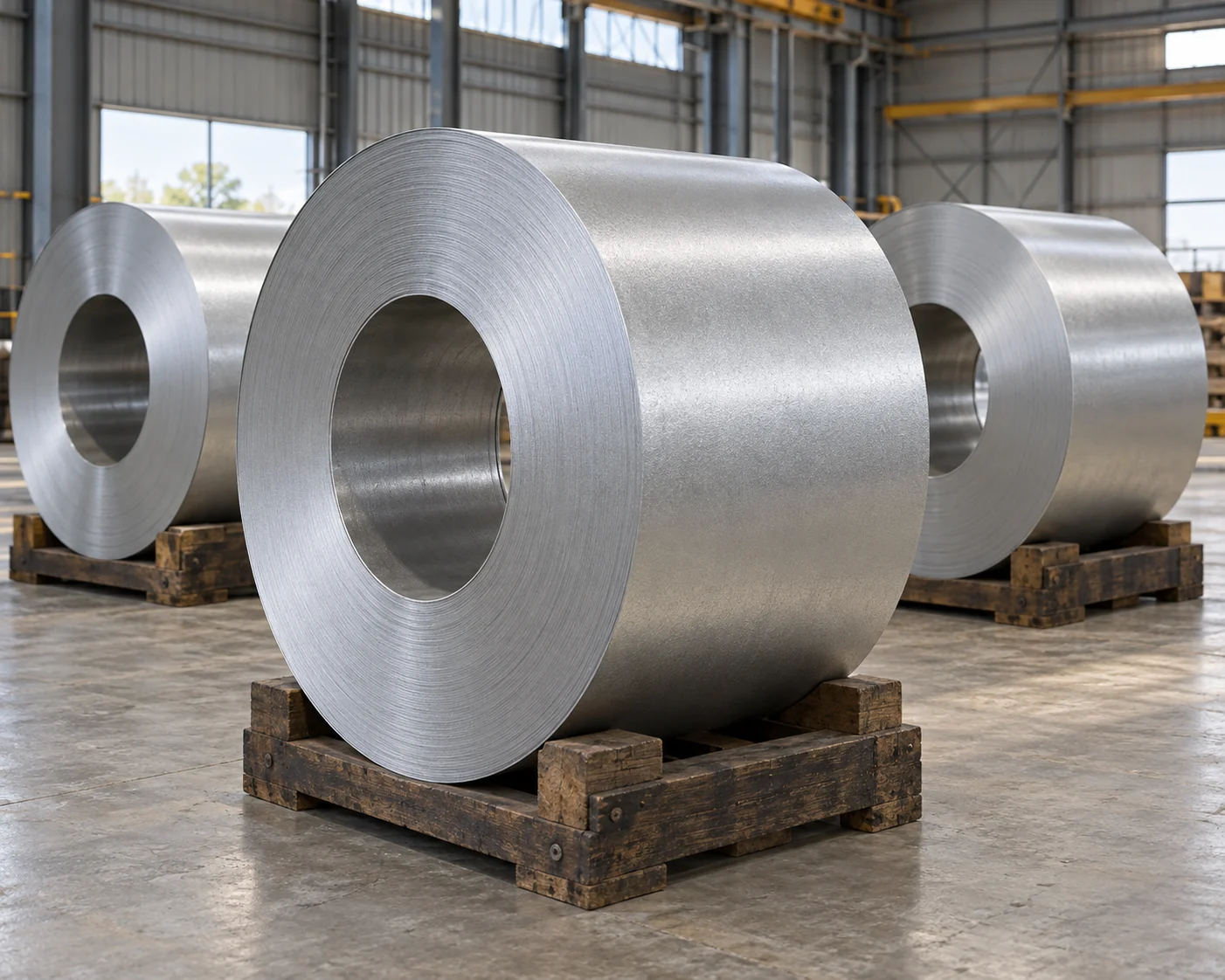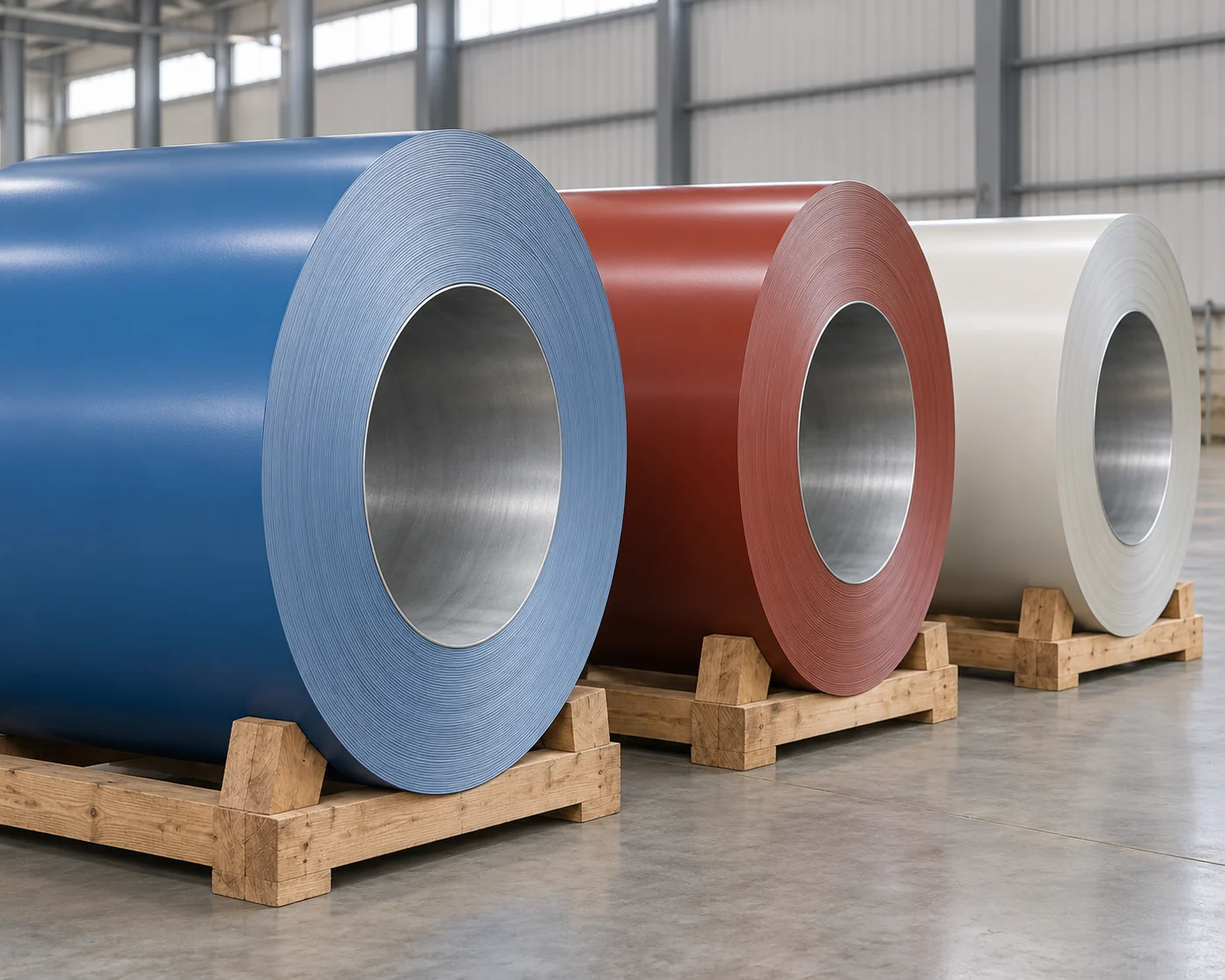
Set the exposure and the result the coating must retain
Describe both sides of the finished part before specifying the coil: weather and sunlight on the exposed face; humidity, condensation, cleaners or process emissions on the reverse. Add the intended forming, handling contacts, cut edges and assembled details. A sheltered inland wall, a wet process enclosure and a salt-exposed roof are different assignments for the same paint name.
Keep appearance and metal protection distinct
Separate acceptable appearance from protective integrity and the steel’s required performance. Fading or chalking, paint cracking or peeling, and corrosion through the steel are different endpoints. Set the relevant product requirements for the application; a warranty period is a contractual promise with its own conditions, not a service-life measurement.
The seven specifications below cover the steel, protective layers, their interfaces and two distinct mechanical acceptance tasks. They form one purchase description. They do not provide a formula for predicting years of service.
Seven specifications to carry into the coil order
Use the mechanism column to decide why the requirement belongs in the order, and the evidence column to identify what must support it. The purchase fields make that decision specific. Numerical limits and the accepted system must come from the selected product and project; the table does not prescribe one coating build for every environment.
Swipe to view the complete table.
| Specification | Performance or failure mechanism | Evidence to connect to the offered coil | Purchase-order field |
|---|---|---|---|
| 1. Base-steel grade and thickness | Steel that cannot tolerate the intended deformation can split; an unsuitable thickness changes the panel and bend behavior. Paint does not replace the required steel. | Project material schedule and the steel property/thickness records on the stated measurement basis. | Steel specification/edition and grade; decimal base-metal thickness (BMT); nominal-plus-tolerance or minimum basis; agreed measurement conditions. |
| 2. Metallic-coating type and mass | The metal layer protects the steel, including its role near exposed edges. Alloy identity and amount are separate from the organic paint film. | The selected metallic-coated product specification and coating-mass results using its applicable test basis. | Coating type/designation, specification/edition, units and total-both-sides or per-face basis; retain the applicable local and per-side requirements. |
| 3. Pretreatment identity and interface qualification | An incompatible or poorly prepared interface can lose adhesion beneath an otherwise suitable paint. Pretreatment is distinct from the primer. | Qualification for the proposed steel/metallic coating–pretreatment–primer combination, identified by the coater. | Approved pretreatment/system code and compatible substrate/primer; required qualification reference; approval of changes. There is no universal pretreatment number here. |
| 4. Complete organic coating system by face | Primer adhesion, exterior weathering and reverse-face protection serve different functions. The same resin-family label can cover different formulations and builds. | Product-specific system, color/gloss and exposure information for the actual primer, finish, any clear coat and reverse coating. | Named system/products by face; resin/formulation identity as applicable; color/gloss reference; intended exterior and interior exposure; no unapproved layer substitutions. |
| 5. Dry-film thickness by layer and face | An insufficient specified film leaves a different protective build from the qualified product. Extra topcoat does not compensate for missing primer, metallic coating or steel. | The selected system’s cured-film schedule and the agreed thickness/acceptance evidence. | Primer, topcoat/clear coat and face-total DFT where specified; separate reverse schedule; units, tolerance/minimum basis and measurement/acceptance method. |
| 6. Forming flexibility and adhesion acceptance | Bending can crack the film or cause coating removal. A flat, unstressed adhesion result does not establish behavior after forming. | A deformation-appropriate coating test plus acceptance of the actual profile/material combination. | Method/edition, face and specimen condition, bend severity, temperature/direction basis and separate cracking/tape-pickoff criteria; named profile acceptance. |
| 7. Defined damage-resistance acceptance | Scratching or abrasive wear can damage the protective surface during processing and use. Hardness, scratching and rubbing wear are different measurements. | A suitable test report with matched specimen, loading and endpoint—not only a pencil-hardness grade. | Agreed method/edition, conditioning and contact or abrasive conditions, load/duration or cycles, reported result and numerical or defined appearance limit. |
Specify the interface and the mechanical result
NCCA’s Toolkit 26, Factors Influencing the Long-Term Performance of Pre-Painted Metal Buildings (2016), pp. 1–2, distinguishes substrate, metallic coating, pretreatment, primer and topcoat. The primer and pretreatment have different roles at the adhesion interface. Specifying a compatible pretreatment is therefore a system-identity and qualification requirement; it is not a claim that every finished coil has one universal pretreatment test value.
NCCA Toolkit 43, Assessing Adhesion (March 7, 2025), pp. 6–8, distinguishes slow T-bend deformation from rapid impact testing and describes cracking and tape pickoff as separate observations. Choose the appropriate acceptance task for the forming demand. The bend test does not replace the complete part’s geometry and surface acceptance.
For rubbing wear, NCCA Toolkit 22, Assessing the Damage Resistance of a Coating (June 15, 2021), pp. 7–10, discusses measurable endpoints and Taber abrasion under ASTM D4060. Where that test is appropriate, identify the wheel, load, cycles and result limit. A pencil-hardness result cannot stand alone as coating quality, and an abrasion result is not a forecast of handling damage or field-service years.
Keep steel thickness, coating mass and paint film separate
Write BMT for the steel alone and identify any other thickness by the layers included. Suppliers’ terms need confirmation: Steelscape’s Single-Bill Service Offer Manual, July 2026, Rev 12, printed pp. 3–4, offers BMT/TCT order fields while its coated-sheet thickness measurement includes metallic coating. That does not establish that every supplier’s “TCT” includes organic paint. State the actual layer basis, nominal or minimum requirement and tolerance in the order.
For zinc-coated sheet, GalvInfoNote 1.1, Rev 4.0 (December 2020), p. 1, identifies G90 as a minimum triple-spot average of 0.90 oz/ft² total for both sides. It is not 0.90 on each side, and halving the total does not create a guaranteed per-face minimum. Keep the selected product’s designation and test requirements; do not convert coating mass into paint thickness or use a larger designation as a cross-alloy durability score.
Define the face total without mixing the reverse coat
DFT means cured dry-film thickness. Specify the front and reverse separately, and say whether a number describes one coat or the total organic film on that face. Steelscape’s Natural Matte PVDF Product Specification, April 16, 2025, §2.2.1.d, is one concrete example of separate primer/finish schedules for the top and back systems. Its product values are not general recommendations.
For example, a nominal 0.20 mil front primer plus a 0.80 mil front topcoat gives 1.00 mil front DFT: 1.00 × 25.4 = 25.4 µm. Specify the reverse-face coating separately. These values demonstrate the calculation; the suitable film build depends on the selected coating system and application.
A finished caliper reading minus typical zinc and paint values is not proof of compliant base steel. Retain evidence for the specific quantity being accepted.
Example: replace an ambiguous coil line with seven defined requirements
Inputs fixed before the specification is revised
Assume a fabricator needs one galvanized prepainted coil specification for ordinary inland exterior wall panels and folded trim. The reverse faces a dry, ventilated interior; no marine deposits, corrosive process atmosphere or persistent wet contact is identified. The project has already accepted the steel design, the complete coating system for this exposure, and the panel and trim drawings.
This is a hypothetical specification. M-7 names the material schedule; PT-7, PR-7, TC-7 and BK-7 identify its fictional pretreatment, primer, polyester topcoat and backer. Assume their combination and light-gray, low-gloss color R-7 have passed the project’s system qualification. The following sampling plans and limits are example contract terms.
M-7 selects ASTM A653/A653M-23 in inch-pound units, SS Grade 33 and G90. It adds a steel-only thickness requirement of 0.024 ±0.001 in. BMT (0.6096 ±0.0254 mm for reference). Linked steel-thickness records before metallic coating cover quarter-, half- and three-quarter-width positions at the head and tail. All six readings must meet 0.023–0.025 in.; this is the example’s agreed sampling plan.
The DFT plan selects ASTM D5796-24 for retained flat finished-coil specimens at the same head/tail and width positions. Assume the method can resolve the individual layers. Each layer must meet its own band even when the face total passes. The stated mil limits control; micrometer figures are conversion references. Use the named test editions for this example contract.
The initial line reads “polyester gray, 0.60 mm, G90, 25 micron paint, good bend, hard finish.” Replace it with the schedule below. Keep the accepted steel and zinc requirement; do not buy a different resin family or heavier coating merely to fill the missing definitions.

Swipe to view the complete table.
| Field | Revised requirement | What the revision resolves |
|---|---|---|
| 1. Steel | ASTM A653/A653M-23, inch-pound requirements, SS Grade 33; 0.024 ±0.001 in. BMT. Apply the steel-only evidence and 0.023–0.025 in. limits defined above. | The number controls base steel, not an unspecified total through zinc and paint. The grade/thickness are assumed accepted for these parts. |
| 2. Metallic coating | G90 zinc under the same ASTM A653/A653M-23 inch-pound requirements; retain its applicable coating tests and local/per-side criteria. The designation is total-both-sides, not a requirement for equal distribution. | The paint revision does not change the accepted metallic layer or turn its total into a per-face requirement. |
| 3. Pretreatment | PT-7 on the M-7 galvanized substrate, with PR-7, under the accepted system qualification; proposed changes require approval. | “Polyester” is no longer being used as evidence of the hidden adhesion interface. |
| 4. Organic system | Front PR-7/TC-7; reverse PR-7/BK-7. Retain the accepted R-7 light-gray/low-gloss reference and the stated two-side exposure. | The front and reverse products remain the qualified combination; no clear coat is added in this assumed build. |
| 5. Cured film | Front primer 0.20 ±0.05 mil and topcoat 0.80 ±0.05 mil; reverse primer and backer each 0.20 ±0.05 mil. Verify each layer under the stated DFT plan. Front total is 1.00 mil nominal (25.4 µm), bounded by 0.90–1.10; reverse is 0.40 nominal (10.16 µm), bounded by 0.30–0.50. | Front and reverse totals are separate. These are assumed project nominal values, not universal minimums. |
| 6. Forming acceptance | F-7: ASTM D4145-10(2018), at 2T and 23 ±2 °C, using separate specimens with each face on the outside of the bend and the bend axis parallel and perpendicular to rolling; no cracking under the agreed 10× inspection and no tape pickoff. Also require acceptance of the actual panel and folded-trim samples. | The assumed laboratory criterion is explicit. Whether the supplied material meets it and the actual parts remain to be established. |
| 7. Damage acceptance | D-7: ASTM D4060-19, after conditioning at 23 ±2 °C and 50 ±5% relative humidity for 24 hours; CS-10 wheels, 500 g applied load per wheel, 100 cycles; mass loss ≤15 mg and no breakthrough to the metallic-coated substrate. This is a front weather-face wear screen; it does not qualify reverse-face wear. Apply it only after the testing parties confirm the method suits the specimen and task. | A defined wear screen replaces “hard finish.” The wheel/load/cycles/limit are teaching project inputs, not NCCA or ASTM pass values. |
The revised order retains M-7 steel and G90 zinc, identifies the PT-7/PR-7/TC-7/BK-7 system, separates the two film schedules and includes F-7 and D-7. It now states the quantities and test endpoints that the original wording left open.
Production release still needs the required supplied-coil evidence and accepted panel/trim results. Do not record F-7 or D-7 as “passed” because their target values have been written. In this assumed case, those results have not yet been obtained; retain the defined order requirements while holding full production release.
If the trim changes to a tighter return outside the accepted geometry, reopen its forming requirement and system qualification without automatically changing the steel or zinc. If the interior becomes persistently wet or gains chemical exposure, reopen the reverse-side protection and complete system acceptance; adding front topcoat alone does not resolve that change. A revised material or test proposal is acceptable only after its affected requirements have been addressed.
Frequently asked questions
How should “front” be identified on a wound coil?
Identify the required exposed face, its coating schedule and how it is presented to the receiving line. State the winding or feed orientation separately instead of assuming that “front” means paint-in or paint-out. The processor must be able to connect the named face to the panel drawing and its corresponding film and appearance requirements.
Does removable protective film count toward paint DFT?
No. Keep any temporary protective film as a separate supply and processing item. The specified DFT concerns the cured organic coating build, not removable packaging or a temporary surface film. Agree the protective film’s compatibility and removal requirements with the selected coating and process; do not include it in a reported paint total.
What if the primer and topcoat cannot be distinguished in a D5796 cross-section?
ASTM D5796-24 §3.2 notes that individual layers can usually be measured when adhesion is sufficient, but similar layer appearances can make this difficult. Treat an unresolved layer thickness as unverified. Agree another validated measurement that can resolve the specified layers, or formally review the acceptance requirement before production release. A face-total result cannot close the unresolved layer requirement, and a result from another method should be identified as such.
Can unexposed adhesion results stand in for results after weathering?
They describe different specimen conditions. NCCA Toolkit 43, p. 4, distinguishes exposed/unexposed and stressed/unstressed adhesion testing. Match the report to the condition and deformation required by the project’s qualification program. Do not silently replace a specified post-exposure result with an unexposed flat-panel result.
Can a textured finish use the smooth finish’s qualification unchanged?
Treat the proposed texture as a defined product change. Confirm the actual formulation, gloss/texture, film build and required weathering, forming and damage-resistance evidence for that variant. A shared color reference or resin family does not demonstrate that the tested smooth build represents the textured material.
Does ordering by net coil weight establish the amount of base steel?
No. The commercial weight basis and the dimensional/material specification answer different questions. Agree what the invoiced net weight includes and how packaging or tare is treated, then accept base steel and the coatings against their own stated requirements. Do not infer BMT, zinc mass or paint DFT from the invoice tonnage.
Technical Basis and Source Scope
National Coil Coating Association, Toolkit 26, Factors Influencing the Long-Term Performance of Pre-Painted Metal Buildings, ©2016, pp. 1–2: material layers, interfaces and environment. Toolkit 43, Assessing Adhesion, March 7, 2025, p. 4 and pp. 6–8: specimen/exposure distinctions and slow versus rapid deformation.
NCCA, Toolkit 22, Assessing the Damage Resistance of a Coating, revised June 15, 2021: p. 7, result endpoints and pencil-hardness limitations; pp. 8–9, Taber abrasion; p. 10, laboratory/field limitations. These educational sources do not supply universal acceptance thresholds or full ASTM procedures.
GalvInfoNote 1.1, Understanding Coating Weight Designations for Zinc-Based Coatings on Steel Sheet, Rev 4.0, December 2020, p. 1: zinc coating designations and the total-both-sides test basis.
Steelscape, Single-Bill Service Offer Manual, July 2026, Rev 12, printed pp. 3–4: BMT/TCT order basis and coated-sheet thickness measurements. Natural Matte PVDF Product Specification, April 16, 2025, p. 3, §2.2.1.d: separately identified top and back primer/finish quantities. Named-product examples only; none of their film limits or warranties is adopted as a universal requirement.
ASTM A653/A653M-23, public Scope §§1.5 and 1.7: unit-system basis; the historical edition is an explicit teaching contract choice. ASTM D5796-24, public Scope §1.1 and Significance §§3.1–3.2: film measurement and individual-layer limitations. ASTM D4145-10(2018) and D4060-19 identify the example test editions. Public scopes were inspected, not full standard procedures; the example sampling plans and acceptance values are assumed project terms.