Start with one issued document set
A multi-discipline bill of materials can describe the same steel several times: as a structural member, an equipment support and a collection of plates or fasteners. Preserve those source references, then decide what the supplier will actually deliver. A supply package needs an item schedule, the documents that define those items, explicit inclusions and exclusions, and a short list of unresolved interfaces.
Create a document register covering each discipline’s BOM, drawings, material specifications and equipment data. Give each entry its document number, revision, issue date and permitted use, such as budget pricing or a project-authorized RFQ. Select the governing set through the project’s document process. A model export dated yesterday does not automatically supersede an issued drawing or authorize its quantities for purchase.
Keep the source row after the description changes
Keep the original source row beside the purchasing item ID. If the structural and mechanical lists conflict, identify the affected item and the exact mismatch—such as a support’s location or hole pattern—and obtain a documented resolution. Do not silently choose the larger quantity or the later file. The resolved reference becomes part of the next package issue.
Describe the item that will arrive
Write the delivered form first: a stock length, cut blank, finished member, loose component or complete assembly. “Steel, 2 tons” cannot distinguish a material purchase from finished steelwork. A finished column may include base plates, holes, welds and coating; supplying its approximate steel weight would leave those operations undefined.
Use the fields below to turn a source description into a purchasing line. Put detailed geometry and acceptance requirements in controlled attachments when that makes the schedule easier to read. The line still needs an exact attachment reference; “as per drawing” without a number and revision leaves the quotation basis open.
Swipe to view the complete table.
| Field | What belongs in it | What it prevents |
|---|---|---|
| Item and source identity | Stable purchasing ID; original discipline, source row, location and drawing mark. | A renamed or merged item losing its demand history. |
| Delivered form and specification | Stock, blank, finished part or assembly; product standard and edition, grade, dimensions, delivery condition, finish and controlled detail reference. | A bidder pricing raw steel where finished work is required. |
| Quantity and unit | Number to price; piece, defined set, length or mass basis; original quantity and conversion separately. | A length, carton or estimated mass being mistaken for a piece count. |
| Included contents and work | Attached and loose components, processing, coating, inspection documents and identification; name exclusions and buyer-supplied items. | Two packages buying the same contents or leaving an operation unpriced. |
| Supply package and owner | One package code and one purchasing owner for each supplied item; preserve its discipline and location allocations. | An interface item being assumed to belong to the other trade. |
| Interface and issue status | Mating item, controlling documents, unresolved question, response owner and RFQ or release restriction. | An unresolved connection appearing as a firm fabrication requirement. |
Convert measurements without changing the product
Normalize actual dimensions without changing product designations. Keep the source unit and conversion factor available for review. For example, a specified 20 ft cut length becomes 6.096 m using 1 ft = 0.3048 m; it does not become a nominal 6 m length. Preserve the specified dimensional tolerance. A unit conversion does not grant permission to shorten the item or substitute a nearby catalog size.
Choose one controlling quotation unit
Keep the quantity to price separate from reference totals. Eight finished columns remain eight columns even when their combined member length is 36 m. A complete support stays one assembly even if its contents are also counted for checking. When the input is only an installed pipe-run length, it is not yet a count of stock lengths: the fabrication or supply basis must establish lengths, end work and any allowance before those become firm purchasing quantities.
Assign assembly contents and shared interfaces
Buy the assembly or its components
For every assembly, choose whether the package buys the complete assembly or its separate components. If twenty supports include forty channel arms, twenty base plates and eighty fastening sets, keep those child counts as included contents. Do not also issue them as loose purchase lines. If fabrication is intentionally placed elsewhere, replace the assembly line with the agreed components and processing scope; changing the purchasing structure must not change the required finished result.
Merge rows only when the delivered items match in specification, geometry, handedness, finish, included contents and acceptance requirements. Keep separate source allocations even after merging. Two disciplines can request the same support detail, but two supports with the same section size and different holes are different finished items. A shared delivery or pricing arrangement can group unlike lines without pretending they are interchangeable.
Name both sides of the connection
List a cross-package interface as a relationship between two identified items. For a column base and anchor assembly, name the base-plate detail, anchor setting detail, hole pattern, rod projection and the parties responsible for their acceptance. Separately state who supplies the plate, rods, nuts, washers, setting template and installation. A matching drawing does not assign all of those tasks to the same supplier.
The same check applies to a pump and its adapter plate: the equipment drawing supplies the mating geometry, while the plate detail defines the steel part. If the equipment drawing is preliminary, keep the affected plate on hold. Trace its dependencies before releasing surrounding work; an independent pipe line need not wait, but a support whose holes or elevations rely on that plate may also be affected.
For structural steel governed by ANSI/AISC 303-22, Sections 2.1–2.2 distinguish structural-frame items from other metal work, and Section 3.3 addresses structural requirements supplemented by other disciplines’ documents. Those boundaries are a reason to write the purchased scope explicitly; the heading “steel package” does not define every trade’s supply.
Example: turn six source rows into five purchasing lines
The following plant-project example uses hypothetical quantities, document identifiers, component contents and acceptance decisions. Assume the listed drawings and material schedules contain the complete product standards, grades, dimensions, tolerances, finish and inspection requirements, and are authorized for RFQ use except where marked pending. The table demonstrates purchasing-data conversion; it is not a set of fabrication drawings or approval to buy these quantities.
The structural list calls for eight C1 columns, each 4.50 m long, with one shop-attached base plate. Mechanical and electrical lists request twelve and eight identical SP1 supports. The assumed SP1 detail includes two channel arms, one plate and four fastening sets per support; one fastening set contains one specified bolt, one nut and two washers. Their geometry, material, coating and acceptance requirements match.
The piping list specifies twelve finished, plain-ended 20 ft lengths—not a 240 ft installed run. The civil list calls for four anchor assemblies at each of the eight column bases. Each assumed anchor assembly contains one rod, two nuts and two washers; the setting template is explicitly bought by the civil contractor outside the steel-material package. The column and anchor details have been reconciled for this example.
Two pump adapter plates have a specified 0.020 m thickness but unresolved hole geometry because the equipment general arrangement is preliminary. Assume these plates have no unresolved dimensional dependency on the other four purchasing lines. The buyer wants finished plates, so supplying unperforated blanks would be a changed scope requiring a separate decision.
Swipe to view the complete table.
| Original BOM row | Normalized item and supplied description | Quantity basis | Package | RFQ result and reason |
|---|---|---|---|---|
| S-11 · Structural: “C1, 8 off, L4500”; S-201 Rev C | ST-01 · Finished C1 column, 4.50 m, including its shop-attached base plate, holes, welds and specified finish; S-201 Rev C. | 8 pieces; 8 × 4.50 = 36.00 m is a reference member-length total. | FAB | Price 8 finished columns. Anchor assemblies are excluded from this line and assigned to AN-01. |
| M-04 · Mechanical: “SP1 support, 12 sets”; M-301 Rev B, detail SP1 Rev 2 | SU-01 · Complete SP1 support including 2 channel arms, 1 plate and 4 fastening sets; SP1 Rev 2. | 12 assemblies from M-04; retain that allocation within SU-01. | FAB | Price within the combined SU-01 quantity of 20, because E-09 specifies the identical complete assembly. |
| E-09 · Electrical: “SP1 bracket, 8 ea”; E-112 Rev D, detail SP1 Rev 2 | SU-01 · Same complete SP1 support; “bracket” is corrected to the delivered assembly definition. | 8 assemblies from E-09; 12 + 8 = 20 complete supports. | FAB | Merge into SU-01; do not create a second 20-piece line or order the included child components separately. |
| P-17 · Piping: “P1, 12 × 20 ft, plain ends”; P-401 Rev B and material class P1 Rev 3 | PI-01 · 12 finished plain-ended pipe lengths, each 6.096 m; product size, wall, material and finish per P1 Rev 3. | 12 lengths; 20 × 0.3048 = 6.096 m each; total 73.152 m. | PIPE | Price the 12 specified lengths. A 6 m stock-length offer is a deviation, not an exact unit conversion. |
| C-08 · Civil: “AR1, 4 sets/base × 8”; C-501 Rev C with S-201 Rev C | AN-01 · Complete AR1 anchor assembly, including 1 rod, 2 nuts and 2 washers; C-501 Rev C. | 32 assemblies; included contents are 32 rods, 64 nuts and 64 washers. | ANCH | Price 32 complete assemblies. Column plates are in ST-01; setting templates and installation are outside this supply. |
| M-22 · Mechanical: “pump adapter PL1, 2 ea, t0.020 m”; M-410 Rev A, equipment GA preliminary | AD-01 · 2 finished PL1 adapter plates, 20 mm thick; final outline and hole detail await the equipment interface. | 2 pieces; thickness conversion is 0.020 × 1,000 = 20 mm. | ADAPT | Hold the finished-plate RFQ line. Equipment-data owner must issue the final GA; plate designer must complete the coordinated detail. |
The resulting RFQ schedule
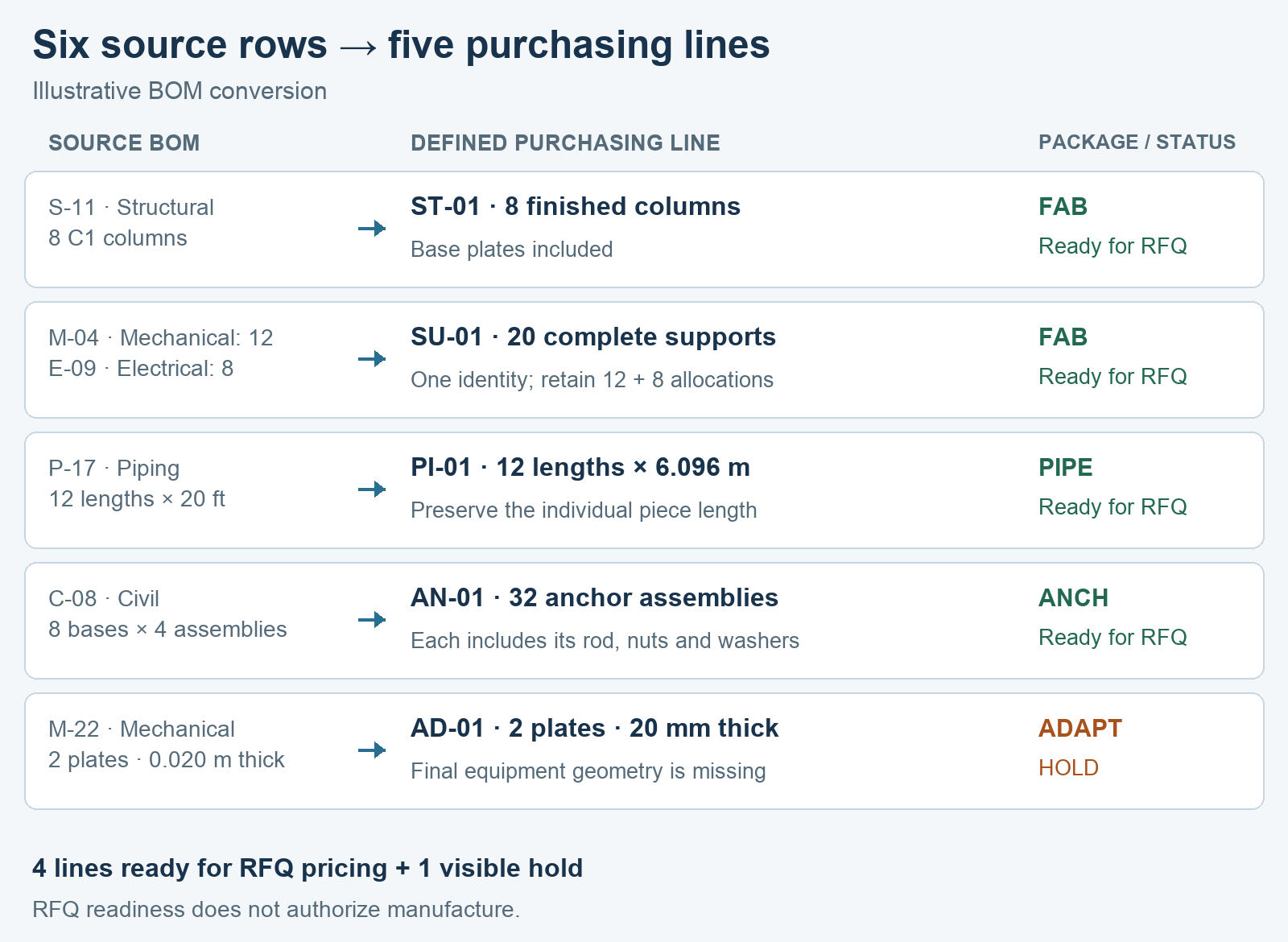
The RFQ schedule now has four lines ready for pricing: ST-01 for eight columns, SU-01 for twenty supports, PI-01 for twelve specified pipe lengths and AN-01 for thirty-two anchor assemblies. AD-01 remains a fifth, visible line on hold. The six source rows are all accounted for; merging M-04 and E-09 changes the number of purchasing lines, not the number of required supports.
Check the counts without adding assembly contents twice
For SU-01, twenty assemblies contain forty channel arms, twenty plates and eighty fastening sets. Under the stated set definition, those fastening sets contain eighty bolts, eighty nuts and one hundred sixty washers. These are contents of the twenty quoted supports, not additional loose quantities. Keep the mechanical allocation of twelve and the electrical allocation of eight so an E-09 revision can be traced back without reconstructing the combined list.
Preserve individual lengths and close the remaining interface
The pipe conversion preserves both count and finished length: twelve × 20 ft equals 240 ft, or 73.152 m. Replacing those pieces with twelve × 6 m would supply 72 m and shorten every piece by 0.096 m. Do not cure that mismatch by adding another short length to the total; the required item is twelve pieces of the specified individual length. Ask the bidder to price the requested cut lengths or identify a proposed alternative for project review.
For the anchor interface, attach C-501 Rev C and S-201 Rev C to the relevant package issues and identify their accepted relationship. Keep the setting-template purchase with the named civil owner. For AD-01, the remaining action is specific: obtain the final equipment GA, complete the plate geometry and release the revised detail for pricing. A thickness value alone does not define the finished plate.
Issue the schedule with its scope and attachments
Give each package issue a revision and a short cover sheet naming the purchasing lines, document register, pricing units, included work, exclusions, required records, destination and requested delivery basis. The supplier should respond against those same item IDs and identify any deviation. Keep the issue purpose explicit: a quotation request is not an instruction to begin manufacture.
Keep pending work visible without pricing it as complete
For the example, the FAB package includes ST-01 and SU-01 with S-201 Rev C, SP1 Rev 2 and their referenced material, finish and inspection requirements. PIPE contains PI-01 with P-401 Rev B and class P1 Rev 3. ANCH contains AN-01 and the coordinated column-base and anchor details. ADAPT is listed as pending and is excluded from the firm pricing total until its detail is complete. Do not hide it in a blank quantity cell or let it disappear from the overall project scope.
Before sending, reconcile in both directions: every source row must map to a purchasing line, an included component, a named other-party scope or an explicit hold; every purchasing line must lead back to its source and controlling documents. Then ask the recipient to acknowledge the package revision and return its itemized response. Choosing one supplier or several is the next decision, covered in single-source versus multiple-supplier EPC purchasing. If the project already has stock or outstanding orders, reconcile those separately before purchase release using the EPC surplus-material quantity guide.
Frequently asked questions
What if the original BOM has no reliable item numbers?
Assign stable purchasing IDs and retain the original file, sheet and row reference, plus the drawing mark and location. Do not use the row number alone as the identity: sorting the next spreadsheet can move it. If you cannot tell whether two descriptions refer to the same physical requirement, keep both sources linked to an unresolved identity question until the discipline owner resolves it.
Can a bill of quantities replace the detailed BOM?
Only where it defines the supplied items and scope sufficiently for the intended quote. A lump-sum “support steel” entry or an estimated tonnage may be useful for budgeting but does not identify every finished member, assembly or interface. Keep the bill-of-quantities reference for commercial reconciliation and attach the item schedule that defines what is included in that sum.
Can similar pipe and structural tubing be combined into one item?
Do not merge them merely because a nominal size or outside dimension matches. Compare the specified product form, standard, grade, wall, dimensional basis, delivery condition, end preparation and acceptance requirements. If they are different products or serve different controlled details, retain distinct item IDs even when one supplier quotes both.
How should equipment-supplier or owner-furnished parts appear?
Keep them in the interface schedule with their item and document references, responsible supplier and required information date. Mark them as supplied by that party and excluded from the purchasing package. If the equipment supplier provides anchor rods but another party supplies the setting template, state both scopes separately; “by others” alone does not identify who must deliver the missing item or drawing.
How should alternative materials or supply forms be requested?
Keep the specified item as the base line and create a clearly labeled alternative linked to it. State which requirement changes, such as a finished member becoming a raw length with separate fabrication. The supplier should identify its changed contents and exclusions. Treat the alternatives as mutually exclusive options, and obtain the project’s acceptance before replacing the specified base item.
Can procurement request prices before the quantities are approved?
Yes, for an expressly identified budget enquiry or provisional quantity schedule. State the purpose, quantity basis, unresolved inputs and what the price includes; ask the supplier to identify assumptions and the conditions for repricing. Keep that issue separate from the later authorized purchase quantity and manufacturing release. An attractive budget price does not turn an early model quantity into an approved order.
Technical Basis and Source Scope
ANSI/AISC 303-22, Code of Standard Practice for Steel Buildings and Bridges, May 9, 2022: Sections 2.1–2.2 distinguish structural steel from other metal items; Section 3.3 addresses supplementary architectural, electrical and mechanical information. Used here for scope and document relationships, not as a specification for every product in a mixed package.
NIST, U.S. Survey Foot: Revised Unit Conversion Factors, updated February 3, 2026, table row “foot (ft)”: the international foot equals exactly 0.3048 m. Checked October 22, 2026. This conversion changes the measurement unit, not the specified item length.
The purchasing workflow is an editorial method. All example quantities, drawing identifiers, assembly contents and interface acceptance decisions are hypothetical; actual project documents define the specification and permitted release.