
Which steel greenhouse form fits the nursery?
Start with the operating objective: independent crop climates, an uninterrupted production floor, or the ability to close unused houses. Then qualify each proposal for the same local wind, snow and rain basis, selected covering, foundations and attached equipment. Include the actual hanging baskets, irrigation booms, screens and fans. More steel weight or a taller roof does not establish the assembled house’s capacity.
A freestanding house can use an arched, gothic or gable roof. A gutter-connected range joins adjacent bays at their eaves. These are layout choices within steel construction; they are not humidity ratings. UMass Extension’s Overview of BMPs and Types of Greenhouses, prepared June 2010, identifies separate climate control and closing individual houses as useful features of freestanding layouts.
Swipe to view the complete table.
| Arrangement | Choose it when | Tradeoff to resolve |
|---|---|---|
| Freestanding houses with separate controls | Propagation and grow-on need different climates, or crops occupy houses in different seasons. | Transfers cross separate house entrances; each house needs its own effective ventilation and operating plan. |
| Gutter-connected range with independently controlled propagation compartment | The nursery values a consolidated indoor floor and common service access while mist propagation has a different climate. | The partition and each compartment need workable air paths; central bays and shared gutters need accessible drainage and maintenance. |
| One undivided growing hall | Crops and irrigation can share the same acceptable climate and operating schedule. | Reject it for a program that needs simultaneous mist propagation and distinctly drier grow-on conditions unless the climate strategy demonstrably meets both. |
Choose the roof profile to accommodate the actual covering, vents, crop clearance and structural design. A ridge vent, roof opening or straight sidewall can make a particular system easier to arrange. An arch or high gutter alone does not prove lower relative humidity, better crop uniformity or lower energy use.
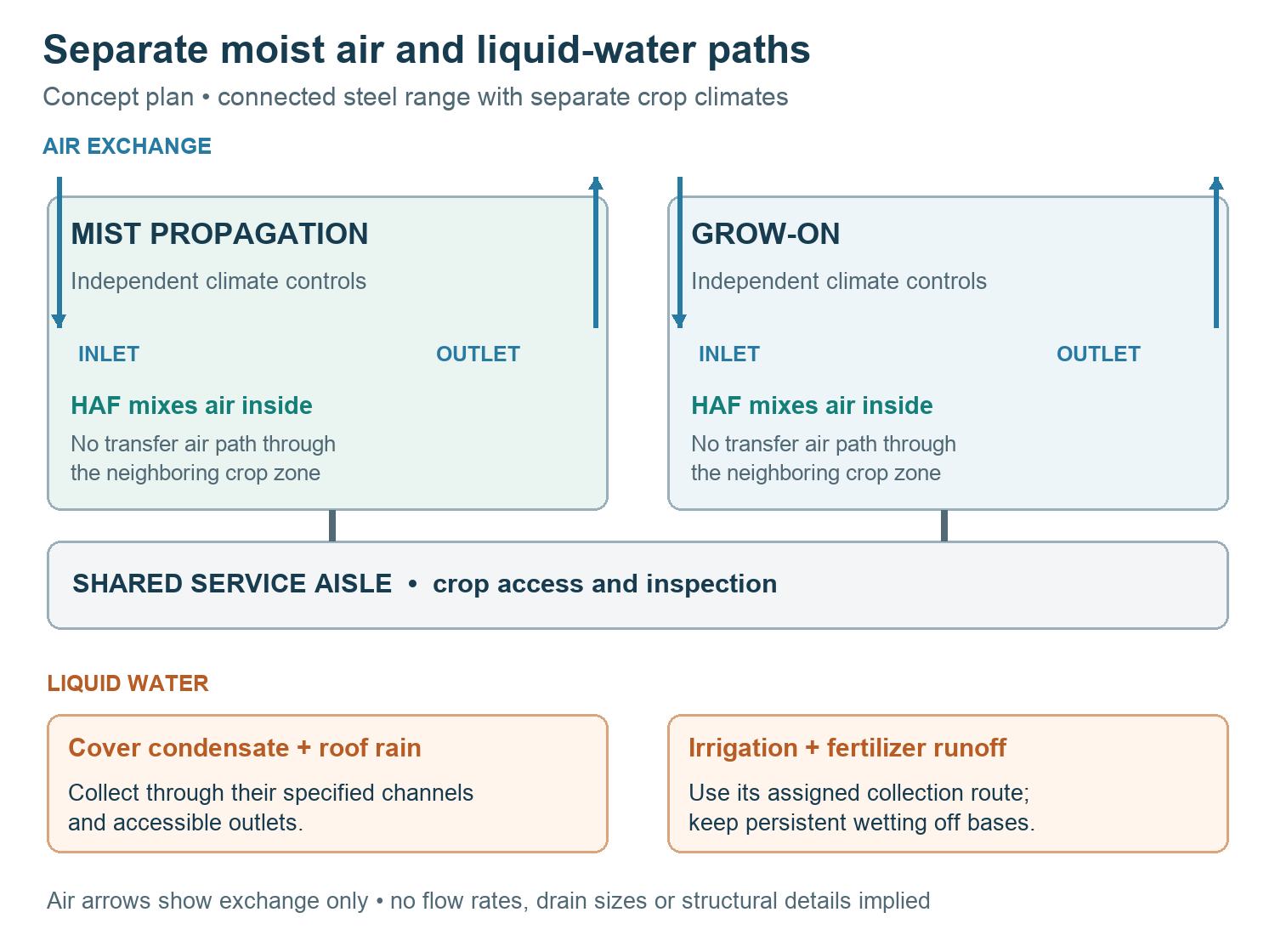
Give each crop zone an air path and a water path
Air exchange and circulation do different jobs
Draw how outside air enters and greenhouse air leaves each operating compartment. For natural ventilation, the openings must work with wind and buoyancy; for fan ventilation, match the inlet and exhaust arrangement to the occupied growing area. In a connected range, do not assume sidewall openings serve the interior bays adequately. A new partition, insect screen or closed energy curtain can alter the intended path.
Horizontal air flow (HAF) fans mix air within the house and help reduce cold, stagnant pockets around foliage. They do not, by themselves, carry the greenhouse’s water vapor outdoors. Keep circulation distinct from air exchange or dehumidification. Coordinate the operating sequence so circulation, vents, exhaust, heating and misting serve the crop rather than work against one another.
Ventilation removes moisture effectively when the incoming air has lower moisture content than the outgoing air. Outdoor relative humidity alone is insufficient: cold air at high relative humidity can contain less water vapor than warmer greenhouse air. When warm outdoor air is already moisture-laden, more vent opening may not produce the required drying. Evaluate the local conditions and whether heating with ventilation or active dehumidification is needed.
Control condensation at the surface and remove collected water
Condensation forms when a surface falls to or below the air’s dew point. Cold covering, steel members and foliage can therefore become wet even without irrigation spray. UMass Extension’s Reducing Humidity in the Greenhouse explains the roles of temperature, circulation, watering and drainage. Keep condensate from dripping onto propagation benches: use the selected cover’s drainage or anti-drip provisions and a continuous collection route where required. Anti-drip treatment redirects water; it does not remove the moisture source.
Keep roof rainwater, cover condensate and fertilizer-bearing floor runoff identifiable in the drainage plan. Place outlets so water does not pond around column bases or return beneath benches. Provide access to clear channels and downspouts. Floor puddles and leaking irrigation add moisture back to the house; correcting those sources is part of the operating choice, not a benefit that a frame coating can deliver.
Specify protection by wet area, not by the word “galvanized”
Make persistent wetting visible in the specification
Treat wet fertilizer deposits, clean condensate and a relatively dry aisle as different exposures. The protection choice includes the coating process, worked areas, fasteners and the way water reaches or leaves the connection. AGA’s Corrosive Chemicals & Substances in Contact with HDG Steel, dated May 6, 2013 and updated 2024, notes that moisture and heat can make fertilizer contact more aggressive to zinc. Its cleaning-chemical examples also show why a familiar product name or pH alone is not enough to establish compatibility.
Pre-galvanized members and galvanizing after fabrication can both be considered when their complete details meet the exposure requirements. Compare the actual coverage at cut ends, drilled holes, welds and connection parts. After-fabrication galvanizing addresses a different fabrication sequence; it is not proof of immunity to wet fertilizer. Where repeated chemical splash calls for an additional compatible coating or a replaceable splash guard, define that local system with its preparation, repair and inspection requirements.
Swipe to view the complete table.
| Area | Exposure to address | Practical specification and access |
|---|---|---|
| Mist and fertilizer-splash zone | Repeated wetting; nutrient deposits; leaking nozzles and washdown contact. | Identify actual chemicals and contact pattern. Specify compatible protection at members, brackets and bases; shield persistent splash where feasible and keep the shield removable for inspection. Drain irrigation runoff away from bases. |
| Grow-on area, roof and gutters | Humid air and condensate; occasional irrigation wetting; collected roof water. | Define coating and worked-area repairs, cover-condensate collection and clear outlets. Keep gutter joints, brackets and overhead connections reachable between crops. |
| Relatively dry service aisle | Lower routine spray exposure, but possible washdown, leaks and cart damage. | Retain the baseline protection. Keep valves, joints and fasteners visible; protect against actual splash or impact locations rather than treating the aisle as permanently dry. |
Keep the finish and attachments maintainable
Locate irrigation connections where leaks can be found and corrected without dismantling structural joints. Use the designed equipment supports instead of hanging a boom or basket line from whichever brace is convenient. Place clamps and guards so they do not create water-holding pockets or obstruct finish inspection. Any dissimilar-metal isolation must remain compatible with the connection’s structural function.
Choose between two otherwise qualified details by the work they leave the nursery. A reachable bolted bracket with a visible drained base is preferable for frequent inspection to a hidden joint behind fixed benches when both provide the required structural and exposure performance. If access is limited, revise the bench or connection arrangement before treating a more elaborate coating as the whole answer. Check the wettest areas during operation; use crop changeovers for cleaning and specified finish repairs.
Worked choice: a humid nursery with two viable steel proposals
Set the common requirements before comparing preferences
Consider a hypothetical 1,200 m² nursery: 300 m² for mist propagation, 700 m² for grow-on and 200 m² for circulation and service. The crops need different simultaneous climates. Assume both proposals meet the same crop-space, light and covering requirements, with suitable site-specific frames, foundations, equipment supports and complete climate systems.
Proposal A uses separate steel houses for propagation and grow-on, with service space arranged around their separate entrances. Proposal B uses a gutter-connected steel range with a sealed, independently controlled propagation compartment and a common internal service aisle. Assume the project review has found both climate arrangements workable, including controls, insect-screen resistance and operation during closed-vent periods. Both complete installed offers fit the budget and required opening date; neither has an assumed price or energy advantage.
Both proposals use the accepted baseline galvanizing and worked-area repair specification. In the mist compartment, both add the chemically compatible splash-zone protection at affected brackets and bases, removable guards where needed and a drained floor route. The grow-on area has accessible condensate collection and gutter outlets. The service aisle retains baseline protection, visible connections and access for leak repair. Both proposals allow the nursery to execute these inspection and maintenance plans.
Swipe to view the complete table.
| Owner’s priority | Proposal A: separate houses | Proposal B: connected range |
|---|---|---|
| Different simultaneous crop climates | Separate control by house meets the requirement. | Independent propagation compartment meets the requirement. |
| Frequent cart movement during a shared growing season | Transfers cross the separate house entrances in this offered layout. | Both crop areas connect to the common indoor service aisle. |
| Closing propagation independently between seasons | Separate house can be taken out of operation. | Compartment shutdown is possible only as designed; shared range systems still remain. |
| Wet-area protection and maintenance | Accepted zone-specific details; inspection access is feasible. | Same accepted exposure requirements; shared gutters also have planned cleaning access. |
Choose the connected range for frequent indoor transfers
Select Proposal B for this owner: the nursery operates both crops through the same season and values frequent indoor cart transfers more than independent house shutdown. The accepted partition and climate systems preserve the required separation, so the common service aisle is a useful operating benefit. Record the selection as a connected steel range with an independently controlled mist compartment and the three exposure-zone details—not merely as a galvanized greenhouse.
When separate houses become the better choice
Select Proposal A instead if seasonal isolation and closing the propagation house become more valuable than the shared aisle, while both offers remain technically acceptable. A change to the site layout or actual installed quotes can also change the preference. If the partition’s air exchange, closed-vent moisture control or wet-zone chemical compatibility becomes unresolved, pause the affected choice and resolve that specific gap before ordering; neither workflow nor price compensates for it.
Frequently asked questions
Is a gothic arch always better than a round hoop in a humid nursery?
No. Compare the actual vent openings, covering, working clearance and site loads. A profile that accommodates the intended roof opening may help the chosen ventilation arrangement, but the shape does not establish a humidity reduction. Review crop-zone conditions and air exchange for the complete system.
Can a shade or energy curtain create a humidity problem?
It can change circulation and air exchange when closed, particularly around a dense crop. Evaluate the closed-curtain condition as well as the open house, and coordinate fans, vents, heating and humidity control. A successful summer layout with the curtain open does not establish its winter performance.
Will anti-drip film keep the steel frame dry?
No. It helps condensate spread or drain according to the film’s intended installation rather than forming falling droplets. It does not stop condensation on every member, eliminate irrigation splash or remove water vapor. Keep the film orientation and drainage route consistent with its instructions, and retain frame inspection.
Should more circulation fans be added when leaves stay wet?
First identify whether the problem is stagnant air, persistent misting, a cold crop surface, dripping cover or inadequate moisture removal. Circulation can address local still air; it cannot export water vapor from a closed house. Check sensors near the crop and the actual vent or dehumidification operation before adding fans.
Does every fertilizer-splash area need the same extra coating?
No. Select protection for the actual fertilizer or cleaner, concentration, contact duration, temperature and wetting pattern. A splash zone may need a compatible additional system or a removable guard, while a less exposed location may use the accepted baseline finish. Correct leaks and accumulated deposits as well as selecting the finish.
What should be checked first if a new greenhouse remains too humid?
Compare crop-zone temperature and humidity readings with outside conditions and the intended crop settings. Then check mist duration, leaks and floor puddles, actual vent travel, clean screens, curtain position and fan or dehumidifier operation. If air exchange or moisture-control capacity is insufficient for those conditions, revise that system rather than changing frame shape or applying more coating.
Technical Basis and Source Scope
UMass Extension, Overview of BMPs and Types of Greenhouses, prepared June 2010: Types of Greenhouses and Free-standing Greenhouses.
John W. Bartok Jr., UMass Extension, Reducing Humidity in the Greenhouse, body dated 11/03, resources added 2015, page updated June 16, 2026: Relationship Between Temperature and Humidity, Anti-drip Plastic, Ventilation and Heating, and Air Movement. John W. Bartok Jr., UConn, Reduce Greenhouse Humidity, updated 2013: Air Movement and Reduce Evaporation Potential.
NGMA, Ventilation & Cooling, undated PDF supplied as VentandCool2010.pdf: printed p. 1, Definitions, and pp. 9–12, insect screens. R. A. Bucklin, UF/IFAS, Physical Greenhouse Design Considerations, HS776/CV254, undated live page checked October 19, 2026: Structural Considerations, normal-use and equipment loads.
American Galvanizers Association, Corrosive Chemicals & Substances in Contact with HDG Steel, May 6, 2013, updated 2024: fertilizers and cleaning chemicals.