
How do swing and dual-plate check valves move?
This comparison concerns a conventional upper-hinged swing check and a spring-assisted dual-plate, or dual-disc, check in a liquid pump discharge line. Forward flow opens the closure members; their return toward the seats limits reverse flow after pumping stops. These are automatic check valves, separate from the manually or power-operated isolation valve.
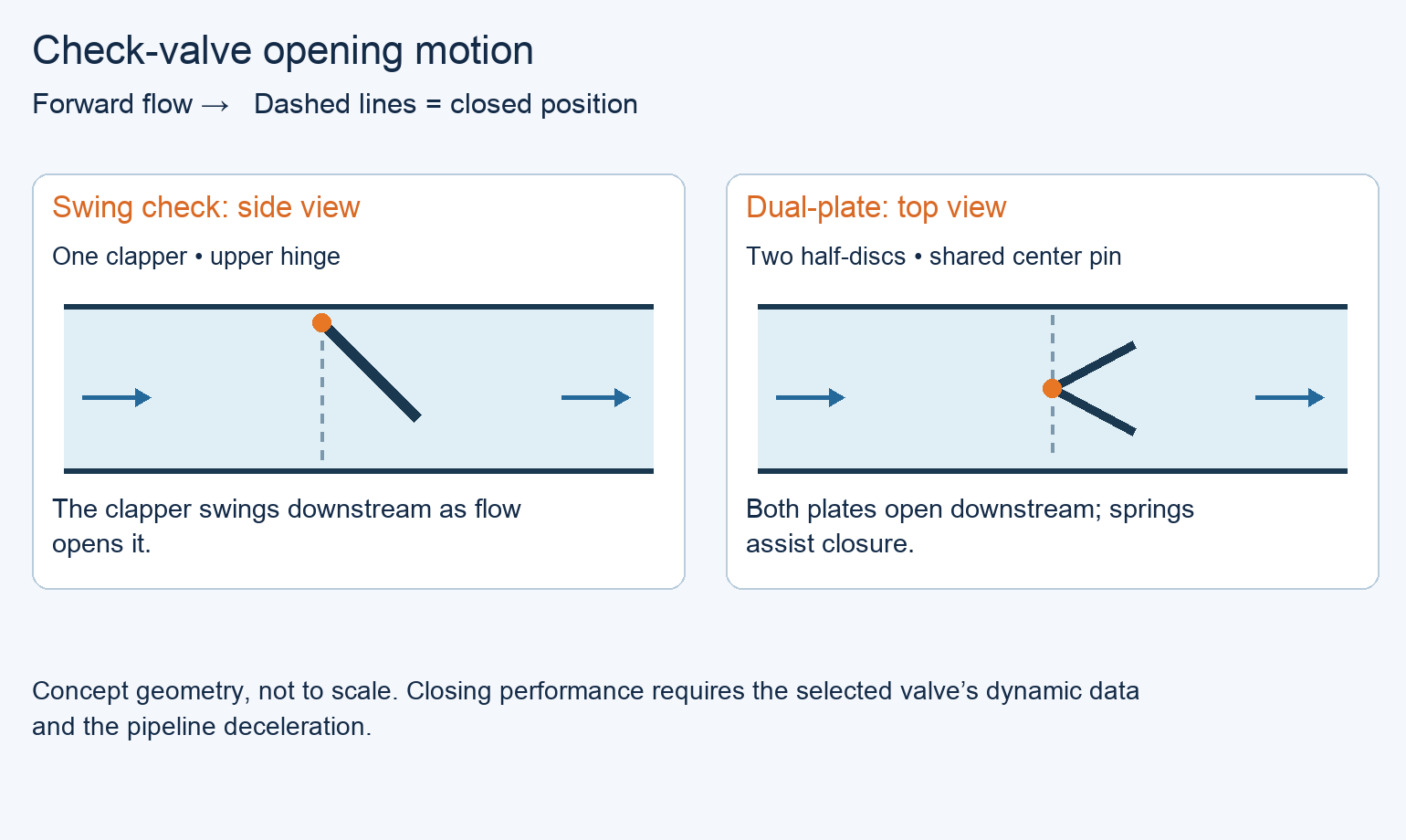
The swing design has one disc rotating around an upper hinge. A dual-plate design has two D-shaped plates rotating around a central hinge, with a torsion spring assisting return. The geometry affects travel, flow area and packaging, but a cutaway cannot establish closure performance. Swing designs with springs, weights or controlled-closing accessories must be compared in their actual supplied configuration.
Which check valve is less likely to slam after a pump trip?
Use reverse velocity and line deceleration
A sudden arrest of reverse flow can produce a pressure surge. The relevant comparison is how much reverse velocity develops before closure under the line’s deceleration, not a universal number of milliseconds. Liquid-column deceleration means the rate at which forward velocity falls after the pump stops.
Val-Matic’s Dynamic Characteristics of Check Valves, VM-DCCV/WP (2018), pp. 4–5, relates that deceleration to maximum reverse velocity through a valve-specific dynamic curve. Its laboratory comparison used 8-inch valves in horizontal piping. The results support considering spring-assisted designs for demanding shutdowns, but they do not prove that every dual-plate valve closes before any reverse flow develops.
Keep the installed configuration in the comparison
For selection, obtain the pump-trip conditions and the candidate’s applicable dynamic data. Evaluate the actual size, spring and orientation against the project’s transient limits. A spring-assisted dual plate may be the stronger candidate when forward flow decelerates rapidly; an accepted swing design remains a viable choice where its closure response meets the same limits. A generic “non-slam” description is not that comparison.
Will the valve stay open at the lowest operating flow?
First establish that each candidate suits the fluid, pressure and temperature, required seat leakage, pipe orientation and connections. Clean-water suitability does not establish suitability for abrasive solids or fibrous debris. The cited Val-Matic wafer dual-disc manual is specifically for clean water; a different service needs its own accepted design.
Cracking pressure is only the start of opening
Then distinguish cracking pressure from stable opening. Cracking pressure is the differential pressure at which flow first begins through the valve. It does not specify the flow needed to hold the discs fully open. Check the lowest continuous flow as well as normal and maximum flow, including reduced-speed and parallel-pump operation.
Compare loss after confirming stable opening
Insufficient velocity can leave a check valve partly open and chattering. Enlarging a valve to reduce its calculated full-open loss can therefore defeat the purpose. Compare the selected size’s loss curve at the actual operating points, with the manufacturer’s opening condition satisfied; do not assume a full-open Cv applies throughout a variable-speed range.
There is no reliable type-wide pressure-loss winner. Val-Matic’s Design and Selection of Check Valves, VM-DSCV/WP (2018), p. 10, Table 4, reports design-specific flow data rather than one coefficient for all check valves. Request comparable data for the offered valves instead of assigning either design a generic percentage advantage.
What changes when both valves meet the operating requirements?
Compare complete assemblies, not body length alone
Once both candidates pass the same fluid, flow and shutdown requirements, compare the space and work each installation actually needs. A short wafer body may save axial room, but required straight pipe, plate projection, flange clearances and a removal arrangement still belong in its installed envelope.
Check how the seat and moving parts are reached
Service access can favor a particular swing design. Val-Matic’s SWCV-OM1-4 manual describes a top cover giving access to the disc and seat. Its DDCV-OM3-3 wafer dual-disc manual requires removal from the line for disassembly. That is a useful comparison between these maintenance arrangements, not a claim that every swing valve is easier to maintain.
Swipe to view the complete table.
| Project priority | Swing check consideration | Dual-plate consideration | Basis for choosing |
|---|---|---|---|
| Preserve room in the valve bay | Include the body, cover access and any external lever travel | Include the wafer body, required pipe spacing and plate clearance | Prefer the assembly that leaves usable access on the approved layout |
| Inspect or repair internals | A specified cover-access design may keep the body in place | A specified wafer design may require removal from the line | Choose the service procedure that fits the outage and lifting plan |
| Reduce operating loss | Use the offered configuration’s loss curve | Use the offered configuration’s loss curve | Compare the actual flow range; geometry alone does not rank the loss |
| Control installed cost | Price supports, accessories and service access | Price mating hardware, spacing and removal provision | Compare complete quotations; no generic saving is assumed |
A worked choice for a horizontal pump discharge branch
Flow range and accepted configurations
This hypothetical comparison starts with two qualified candidates; it is not a claim that a named valve is approved for these inputs. Assume an NPS 8 horizontal clean-water branch has minimum, normal and maximum continuous flows of 1,000, 1,400 and 1,800 US gpm. The pump station has two parallel pumps, and one-pump trips are included in its shutdown review.
Assume the project engineer has accepted both candidate configurations for those flow points, fluid conditions, pressure and temperature, seat leakage and the applicable pump-trip transients. Both meet the same permitted pressure-loss budget.
Swipe to view the complete table.
| Input | Assumed condition | Consequence |
|---|---|---|
| Candidate arrangements | Swing: a top-cover service arrangement as described in SWCV-OM1-4. Dual plate: a wafer removal arrangement as described in DDCV-OM3-3. | Compare the actual access procedures, not a universal valve-type ranking. |
| Space and connection checks | Both complete assemblies fit; cover lift, lever movement, plate sweep, required pipe spacing and flange compatibility are accepted. | Neither candidate is eliminated by the layout. |
| Available service provision | Overhead access and lifting are available. A removable spool also makes wafer withdrawal feasible. | Both can be serviced; the preferred method can decide. |
| Initial project priority | During a planned annual inspection outage, avoid disturbing pipe flange joints when internal access is needed. | Prefer the accepted cover-access swing configuration. |
| Changed project priority | The accepted dual-plate layout leaves more usable axial room; the outage plan accepts line removal. | Prefer the accepted dual-plate configuration. |
Service access decides the first choice
With these assumptions, select the cover-access swing check. It satisfies the duty and matches the stated preference to inspect the disc and seat without opening the pipe flange joints. The decision accepts a larger installed envelope because space is available. It is not a claim of lower loss, lower price or better closure.
Compact layout versus cover access
Now keep both candidates qualified but change the priority: the station wants the greatest remaining axial room, and its outage plan accepts removing the wafer valve through the provided dismantling arrangement. Select the dual-plate candidate if the complete layout confirms that space benefit. If minimum flow, the spring configuration or pump-trip deceleration changes, reopen qualification before retaining either choice.
What should the pump discharge valve schedule include?
Record the selected check-valve model and size, fluid and solids, pressure and temperature, minimum/normal/maximum flows, installation orientation, spring or closing accessories, seat-leakage requirement, loss data and accepted shutdown basis. Attach the layout showing approach piping, moving-part clearance and the removal route. These details make the comparison reproducible when an alternative is offered.
List companion gate, ball or butterfly isolation valves separately from the automatic check valve. Coordinate the pipe-flange schedule with the approved assembly drawing, including the facing, bore and mating hardware.
Frequently asked questions
Should the check valve be sized for one pump or the whole station?
Use the flow through that valve. A check on an individual pump branch does not automatically carry the station’s combined flow. Evaluate the relevant pump combinations and the branch’s lowest operating flow; also include a branch pump trip while other pumps continue running in the shutdown assessment.
Does a successful pump start prove the check valve is correctly selected?
No. One startup does not establish stable behavior across the flow range or acceptable closure during a pump trip. The acceptance plan should confirm that the installed orientation, spring and accessories match the reviewed configuration and address the specified low-flow and shutdown conditions.
Can a compact check valve sit directly after a discharge elbow?
Do not infer that from its body length. Disturbed approach flow can cause unwanted disc motion. Follow the selected manufacturer’s spacing instructions and show them on the layout; there is no single straight-pipe distance established here for every swing or dual-plate design.
Can either type be installed in a vertical downward-flow line?
Do not assume so. The cited Val-Matic swing and wafer dual-disc manuals permit horizontal or upward flow for the described configurations. Downward flow needs explicit manufacturer acceptance. In a horizontal line, the cited dual-disc design requires its hinge pin to be vertical.
Can a stronger spring solve a slamming dual-plate valve?
A spring change may improve closing response, but it also changes the opening requirement. Obtain the manufacturer’s approved configuration and recheck both minimum-flow operation and shutdown performance. A field spring substitution is not a substitute for diagnosing the transient.
Can a wafer dual-plate valve directly replace a flanged swing check?
Only after checking the actual assembly. Face-to-face length, flange and bore compatibility, plate projection, required approach piping and a workable removal route can differ. The wafer body’s short length does not by itself make it a drop-in replacement.
Technical Basis and Source Scope
Val-Matic, Dynamic Characteristics of Check Valves, VM-DCCV/WP, copyright 2018: pp. 4–5 and 9–10; dynamic curves and test scope.
Val-Matic, Design and Selection of Check Valves, VM-DSCV/WP, copyright 2018: pp. 4–5, 7–8, 10 Table 4 and 15; mechanisms, minimum velocity, layout, flow data and fluid suitability.
Val-Matic, Swing Check Valve with Lever and Spring, Lever and Weight, and/or Side Mounted Air Cushion: Operation, Maintenance and Installation Manual, SWCV-OM1-4: pp. 3–4 and 6–7. No issue date established in the consulted copy.
Val-Matic, 2–12 in. (DN50–300 mm) Wafer Style Dual Disc Check Valve: Operation, Maintenance and Installation Manual, DDCV-OM3-3: pp. 1–2 and 4. No issue date established in the consulted copy.
DFT Inc., What Is Cracking Pressure?, last modified April 9, 2026: sections “What Is Check Valve Cracking Pressure?” and “Why Is Understanding Cracking Pressure Important?” Sources checked October 18, 2026.
