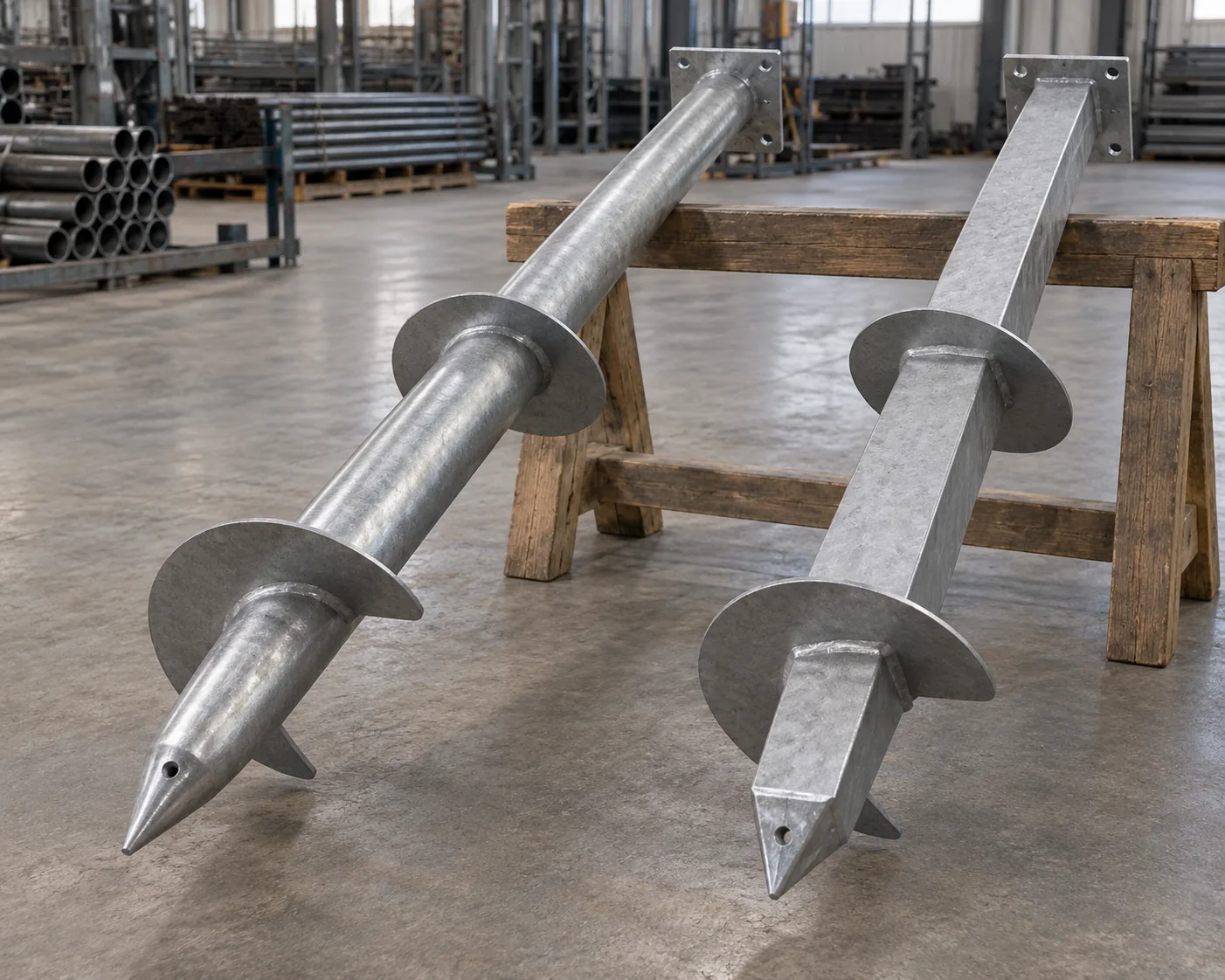
Compare complete helical pile systems for modular buildings
Manufacturer identity and report-defined systems
CHANCE, MacLean-Dixie and Techno Metal Post have identifiable evaluation-report holders, documented pile and connection systems, and U.S. supply or installation channels. This alphabetical comparison uses manufacturer documents and company information checked October 19, 2026.
This guide addresses factory-assembled steel building modules on a project-designed foundation, rather than manufactured-home pier-and-tie-down packages. Include the module framing, support reactions and approval requirements in the inquiry so the proposed pile head can be checked against the actual connection.
Swipe to view the complete table.
| Manufacturer / report holder | Shaft and extension connection | Reviewed new-build interface | Report read |
|---|---|---|---|
| CHANCE · Hubbell Power Systems, Inc. | SS5/SS175 square shafts and RS round-shaft families; matched mechanically coupled, through-bolted extensions. | Type B new-construction caps embed in concrete pile caps or grade beams. | ICC-ES ESR-2794, reissued May 2026. |
| MacLean-Dixie · MacLean Power TN, LLC | D6/D10/D17 square shafts; P28/P35 pipe shafts. Forged socket or pipe coupling details use the specified matching bolts. | NCB new-construction brackets cast into concrete grade beams, footings or pile caps. | ICC-ES ESR-3032, reissued August 2026. |
| Techno Metal Post · Techno-Pieux Inc. | Report-defined 3.5 in. round hollow structural steel (HSS) shafts; coupling, reinforced-coupling and expanded-coupling routes require field welding as specified. | PC concrete caps; PU wood-beam brackets; PSC steel-column bases; PIB steel I-beam brackets. | ICC-ES ESR-3418, reissued November 2024, revised March 2026. |
How the shaft, extension and building connection differ
CHANCE: model-matched extensions and concrete-embedded caps
CHANCE’s ESR-2794, May 2026, describes a lead, matching extensions and a bracket as one foundation system. It distinguishes square-shaft SS models, round-shaft RS models and a defined SS175/RS3500 combination. The combination uses its specified transition adapter; it does not authorize joining any square lead to any round extension. The coupling hardware and head must follow the actual selected model.
The report’s Type B new-construction heads transfer loads into cast-in-place concrete. For example, the C1500797/C1500797G head is associated with the RS2875 shaft family; its sleeve-to-shaft attachment does not turn the top plate into a general steel-module base connection. CHANCE publishes a distributor and certified-installer network. Request the actual installer, system proposal and construction responsibilities for the project location.
MacLean-Dixie: square or pipe shafts with defined NCB brackets
MacLean-Dixie’s ESR-3032, August 2026, identifies MacLean Power TN, LLC as the report holder. Its square-shaft extensions use the report’s integrally forged socket and bolt arrangement; its round pipe-shaft couplings use their specified paired bolts. Those differences affect the extension parts and installation plan. A pipe diameter alone cannot identify a compatible extension.
Its NCB family is a concrete-embedded new-construction connection. Table 1 identifies the covered head, shaft and load-direction combinations. The concrete grade beam or footing remains a designed structural element above the pile. MacLean Civil’s manufacturer and distributor channels provide a route to an actual supply and installation proposal; a loose NCB cap is not a direct steel-beam mounting kit.
Techno Metal Post: report-specific shafts and separate steel connections
Techno Metal Post’s ESR-3418, revised March 2026, covers specified 3.5 in. round HSS lead and extension shafts, with the coupling arrangements described in Section 3.2.3. Field-welded extension joints are part of those evaluated details. The manufacturer’s wider catalog contains other pile products; their existence does not extend this report’s model scope.
For steel I-beams, the report identifies PIB5, PIB6 and PIB8 heads whose plates are field-welded along the beam’s bottom-flange sides. The bracket plate must be wider than the beam’s bottom flange so welds can be placed along both sides. Check the actual flange width and welding access when selecting the head; the beam and connection still need project design. PSC5/PSC6/PSC8 are different heads for bolted pipe or round-HSS column base plates; they are not a bolt-on replacement under an arbitrary I-beam. Techno Metal Post offers its manufactured system through trained local dealers with dedicated installation equipment. Confirm the dealer’s project reach and the actual shaft, head, welding and inspection scope.
Match the manufacturer system to one steel-module base
A direct steel-beam interface with field welding under review
Consider a hypothetical U.S. commercial building made from four factory-built steel modules, with 16 preliminary support positions beneath steel wide-flange beams. The owner wants direct beam support without cast-in-place concrete grade beams or footings. The foundation design will determine how many piles each support position needs.
The module manufacturer and project engineer will consider specified field welding, subject to connection design, access and inspection. The inquiry includes framing and reactions, compression/uplift/lateral demands, bracing, ground information, exposure, final support levels and the installation window before the modules are set.
The completed initial inquiry result
On that basis, approach Techno Metal Post first for its report-defined round-shaft system with a PIB steel-beam connection. The documented interface matches the kind of supported member and permitted connection method closely enough to request a technical proposal. The exact beam, bracket, shaft, site performance and installation detail are still unresolved. CHANCE and MacLean-Dixie remain alternatives if they propose a suitable direct steel-head assembly and identify its evaluation and project-design basis; their reviewed concrete-embedded heads alone do not satisfy this brief.
Swipe to view the complete table.
| Manufacturer / reviewed route | Inquiry decision | What the technical response must resolve |
|---|---|---|
| Techno Metal Post · report-defined shaft + PIB head | First technical inquiry for direct I-beam support. | Exact beam and head match; shaft and extension detail; compression, uplift, bracing and lateral design; approved field welds, installation and inspection. |
| CHANCE · Type B concrete-embedded head | Conditional alternative; this reviewed head needs concrete absent from the brief. | A different steel-head/adapter proposal with its actual system evidence and module connection design, or an accepted change to a concrete-supported base. |
| MacLean-Dixie · NCB concrete-embedded head | Conditional alternative for the same concrete-interface reason. | A defined direct steel-head assembly and its basis, or a revised grade-beam/footing design with the matching NCB/shaft combination. |
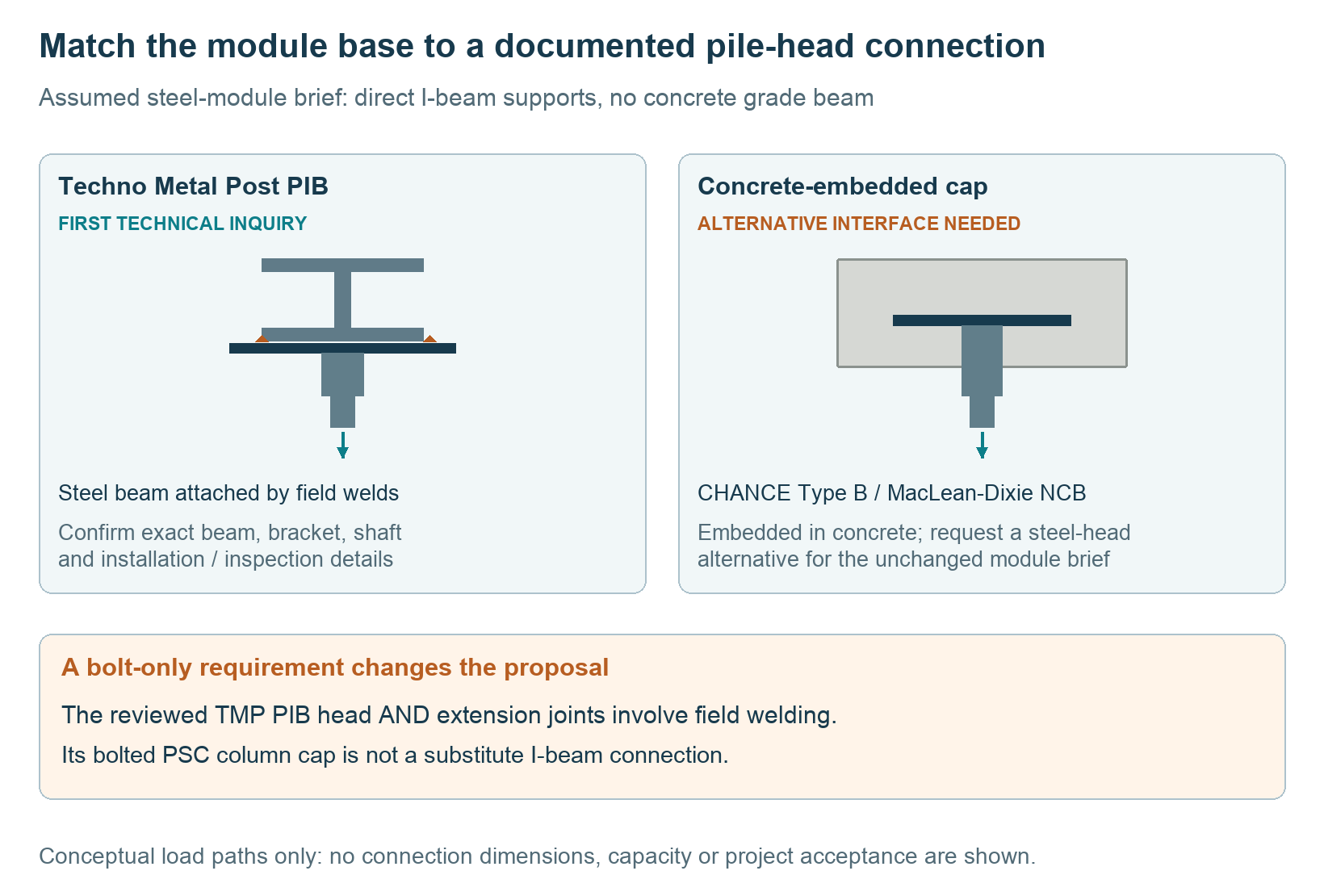
Now change one construction requirement: the owner prohibits all field welding. The reviewed Techno Metal Post PIB head and report-defined extension route can no longer be the assumed solution. Reopen the system inquiry for an accepted bolt-only assembly rather than moving a PSC column cap beneath the beam or swapping an unrelated bolted extension. None of the three reviewed head configurations completes that revised brief on its own.
If the owner accepts designed concrete grade beams, include CHANCE Type B, MacLean-Dixie NCB and Techno Metal Post’s PC head in the first inquiry. Compare concrete work, reinforcement and module anchorage alongside the pile, extension and installation scope before selecting a complete foundation proposal.
What the manufacturer and installer need before module delivery
A complete assembly and the relevant report scope
The foundation response should identify the actual manufacturer, shaft and helix configuration, extension lengths and joints, head model and the connection to the module. Keep the report number, revision and relevant component table with that assembly. A report cover or a torque figure by itself does not describe the building-to-soil load path.
The project designers need to resolve the module reactions, head and beam connection, foundation performance and bracing. Report ESR-3418, for example, treats bracket, shaft, helix and soil capacities separately; its steel-beam section evaluates localized connection limit states, not the complete module. The bracing assumptions and exposed shaft condition matter as well as the vertical load.
Installed positions, head levels and the module-setting sequence
Before the crane date, agree how installed positions and head levels will be checked against the module’s setting plan, which connections are completed before or after setting, and who records them. Obtain installation records tied to pile locations, including the selected components, installed depth, recorded torque, final elevation and required inspections or tests. Installation torque is one system-specific record; it is not a universal conversion to allowable building load.
Compare the actual contractor’s equipment, access and welding or bolting resources with the proposed joint method. A manufacturer can supply a documented system while a local installer carries out the site work. The quotation and work plan should name both, together with engineering, inspection, coating repair and module-connection responsibilities.
Frequently asked questions
Can a residential deck pile from the same manufacturer support a commercial module?
Not on the strength of the manufacturer’s name. Identify the actual pile, head and report scope for the commercial building, then check its project loads, ground conditions and connection. For example, the reviewed ESR-3418 shaft range is specific; it should not be applied to every smaller pile in Techno Metal Post’s catalog.
What if a module bearing point misses the installed pile centerline?
Return the measured position and module detail to the designers. An eccentric head, offset adapter, revised beam or additional support changes the load path and needs an accepted detail. Do not treat a larger cap plate as an automatic fix. Keep the resulting support mark and connection revision with the installation record.
Does a bolted pile head mean that no field welding is needed?
No. Check the complete path from the lead and extension joints to the supported member. A head may bolt to the shaft while its upper connection requires welding, and some systems require welded extension couplings. The reviewed Techno Metal Post PIB and extension details illustrate why the word “bolted” on one component is insufficient.
Can the pile installer set final head elevations before the modules arrive?
Yes, against the accepted setting plan and the head’s actual adjustment or fabrication detail. Agree the survey datum, required elevations and tolerances, how the results will be checked, and how discrepancies will be resolved before lifting starts. A slip-on sleeve does not by itself provide a permitted height-adjustment method.
Do four modules need four sets of identical pile heads?
Not necessarily. Support counts and head marks follow the building and foundation design. Module joints, transfer beams, corners and shared supports may use different arrangements. Build the takeoff from identified foundation positions, keeping shaft connection, upper-member detail and orientation with each head mark.
Can the piles be reused if the modular building is moved later?
Do not assume reuse from the building’s relocatable design. A future location changes the ground and design basis, and removal can affect pile and connection condition. Retain original component and installation records, then have the proposed reused system and new site assessed before making a reuse commitment.
Technical Basis and Source Scope
ICC-ES ESR-2794, Hubbell Power Systems, Inc., CHANCE Helical Foundation Systems, reissued May 2026: Sections 2–3.2.3, shaft and coupling scope; Section 3.2.4.3, new-construction cap/shaft combinations; Section 4.1 and Conditions of Use, project design and installation requirements.
ICC-ES ESR-3032, MacLean Power TN, LLC, MacLean-Dixie Helical Foundation Systems, reissued August 2026: Sections 3.1.1–3.1.2.2, leads/extensions and concrete-embedded NCB brackets; Table 1, p.9; Sections 4.2–4.3 and 5.17–5.18, installation/inspection and manufacturing.
ICC-ES ESR-3418, Techno-Pieux Inc., Techno Metal Post Helical Foundation Systems, reissued November 2024, revised March 2026: Sections 3.2.1–3.2.4.5, shaft/coupling and head scope; Section 4.1.2.5 and Figure 7/Table 7A, p.25, steel-beam connection; Sections 4.1.3–4.1.6, 4.2–4.3, shaft/soil, design, installation and inspection.
CHANCE Foundation Solutions, Hubbell Power Systems and CHANCE Certified Installers; MacLean Civil Products, About Us and Distributor Locations; Techno Metal Post, About Us, U.S. installer locator and Modular Buildings application. Current manufacturer pages checked October 19, 2026.