
Choose the roadside barrier before the supply arrangement
Define the hazard and vehicle demand
The objective is to reduce the consequence of a vehicle leaving the road. First consider whether the hazard can be removed, relocated or made traversable. Where shielding is needed, identify what the barrier protects: an embankment, a culvert, a bridge approach or an immovable roadside object. A warehouse aisle guard, a pedestrian railing and a roadside vehicle barrier perform different jobs.
Describe the actual traffic in both directions, including cars, pickups, delivery trucks and any articulated or unusually heavy vehicles. Give the designer the operating and design-speed basis, road alignment, approach slopes, available shoulder and any backing or turning movements. A posted low speed alone does not establish suitable impact conditions. FHWA’s Guardrail 101, under Purpose and Function of the Guardrail, explains that vehicle size, speed and impact orientation affect performance, and that the rail, posts, supporting soil, connections, terminal and anchorage act together.
Reserve clearance and match the installed configuration
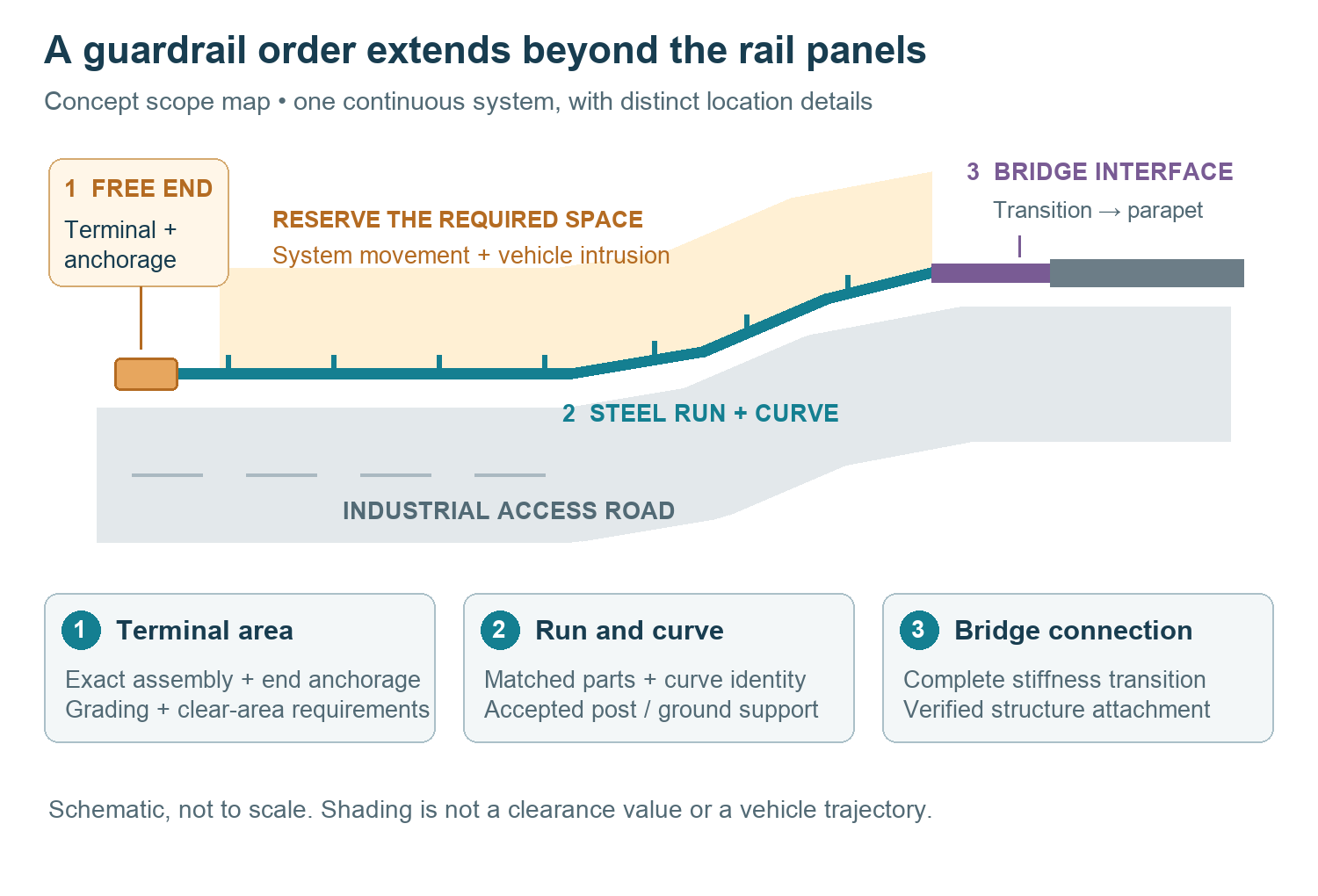
Compare the system’s required clearance with the surveyed space behind its traffic face. Working width is measured from that face to the furthest point reached behind it by the barrier or vehicle during an impact. Dynamic deflection concerns barrier movement; vehicle intrusion can require additional space. Even a rigid concrete barrier needs its applicable vehicle-intrusion area. A wall, tank, parked trailer or pedestrian route can occupy space the system needs. Use the selected configuration’s requirements rather than a generic clearance number.
A semi-rigid steel-beam system is a candidate where its accepted configuration, post support and movement space fit the site. A rigid concrete barrier is a candidate where barrier movement must be minimized and its foundation, drainage, approach and end treatment can be accommodated. When both qualify, steel retains individually replaceable rail-and-post components; concrete usually needs less impact repair, reducing roadside work, but a major concrete repair can be costly and time consuming. Iowa DOT’s Design Manual 8B-5, Choosing a Barrier, updated June 4, 2026, explains working width and these repair tradeoffs. Compare the actual installed offers and future repair access; the material name does not establish a suitable system.
The owner and responsible designer establish the applicable local, permit, contract and adopted road-design requirements, including the required crash-test basis and containment level. If heavy-truck containment is part of the objective, verify evidence for that vehicle demand rather than assuming a passenger-vehicle system covers it. A thicker panel or heavier zinc coating describes a component; neither establishes the assembled barrier’s impact performance.
Treat an FHWA eligibility letter as a document about Federal-aid reimbursement, with its stated configuration and conditions. It is not a site-design approval. FHWA’s current Federal-aid Reimbursement Eligibility Process also states that a letter is not required for a State DOT to install a device or receive reimbursement. AASHTO’s Manual for Assessing Safety Hardware (MASH) is a crash-test framework. Read a MASH designation with the actual test level, device configuration and project acceptance requirements; it is not a universal suitability guarantee.
Keep ends, curves and foundations inside the system scope
End treatments and bridge transitions do different jobs
A roadside barrier run does not stop at the last ordinary panel. Each free end needs the specified treatment and anchorage. Assess exposure from both traffic directions: a downstream end for one direction may face traffic from the other. Locate the terminal, its grading and any required clear area using the accepted layout. Some terminals allow a vehicle to pass behind the rail near the nose, so extending the ordinary rail face to the hazard is not enough.
Where steel guardrail joins a bridge parapet or another stiffer barrier, buy the specified transition assembly and its attachment. A transition gradually changes stiffness; it is more than a plate that makes the bolt holes meet. Rail nesting, post spacing, blockouts, curb details and connection hardware can differ from the ordinary run. Iowa DOT’s Design Manual 8C-2, Parts of a Steel Beam Guardrail Installation and Transition, explains the separate roles of end anchorages, standard rail and transitions.
Curve geometry and post support can change the configuration
For a curve, identify the radius, direction and reference line on the system layout, and confirm that the proposed curvature is within the accepted arrangement. A gently curved continuation and a short-radius treatment around an entrance are different configurations. A fabricator’s ability to bend a panel does not demonstrate crash performance. If an entrance leaves too little length for the specified run and terminal, the designer must resolve the layout or select another suitable treatment before the pieces are ordered.
Identify where posts enter soil, pavement, rock, a culvert or a concrete structure. Soil strength, slope proximity and post movement are part of the system behavior. A driven-post detail cannot be converted to a flanged base or a concrete-filled hole merely because the same rail fits it. Pavement cutouts, special posts, sockets or structure-mounted details need their own accepted configuration. Confirm buried utilities and drainage conflicts before releasing the affected location.
Keep the terminal’s exact model, hand where applicable, compatible rail and post arrangement, anchor parts and installation-manual revision together. Use the specified splice bolts, post bolts, nuts and washers at their own joints. Similar dimensions do not establish interchangeability. Caltrans Construction Manual Section 4-8303B requires its terminal installations to follow the manufacturer’s component and installation checklist; that is a useful model for assigning the project’s inspection scope.
When is a complete installed package better than separate orders?
Compare arrangements for the same accepted site layout and complete system. An integrated package puts material coordination and installation under one contract. Separate orders can retain the owner’s existing designer and installer while purchasing drawing-defined components and proprietary assemblies from their appropriate sources. Both still need one controlled system schedule.
The useful distinction is who owns each physical interface. The ordinary rail supplier may stop before a terminal’s special rail or anchorage; a terminal supplier may exclude grading; a bridge connection may require a separate structure contractor. Name the party that reconciles those boundaries before award. A single supplier name does not itself make the scope complete.
Swipe to view the complete table.
| Approach | Best fit | What the owner gains | Tradeoff |
|---|---|---|---|
| Integrated system supply and installation coordination | New or altered roadside layouts with several terminal, earthwork and bridge interfaces; the owner wants a single field coordination contact. | One contract can manage layout checks, matched deliveries, installation sequence and assembly records. | The owner buys through the package contractor and must define access, repair response and component records in that contract. |
| Design-controlled separate supply and installation orders | The complete design is fixed; an owner-appointed manager and competent installer can reconcile every component and site interface. | Direct control of component lots, delivery releases, the incumbent installer and identified repair stock. | The owner coordinates shortages, revisions and cross-order boundaries, including terminal-specific parts and any structure work. |
| Rail panels purchased as a standalone bargain | An identified replacement or stock line whose role in an existing accepted system is already established. | A clear component-only purchase. | It is not a procurement solution for a new complete roadside barrier. |
Do not split a proprietary terminal into generic posts, an impact head and loose fasteners simply to obtain separate prices. Separate contracts may divide commercial supply while preserving the specified assembly. Similarly, a common shipment can contain several segment kits without making their different posts, curved panels or transition parts interchangeable.
A completed choice for one industrial access road
Consider a hypothetical private two-way access road with a straight embankment, a bend and a bridge approach. Assume the responsible designer has selected a suitable steel-beam barrier for its traffic and speeds, including delivery vehicles. The system’s clearances, terminal areas, curve geometry and ground or structure supports fit the surveyed site.
Two complete offers meet that same design, origin requirements, completion date and budget. Offer A supplies and coordinates installation of all three locations, including terminal grading and the bridge attachment. Offer B uses an owner-appointed interface manager, separate drawing-defined rail/post/hardware lots, a complete proprietary terminal order and the owner’s incumbent installation contractor. Both include the same specified terminal and transition arrangements and complete handover records.
Choose A for this owner, whose priority is a single contact to coordinate the bridge contractor, earthworks and guardrail crew during a short road closure. B remains technically qualified, but its separate purchase and work orders leave those handoffs with the owner. This is an organizational choice between two complete offers, not evidence that one steel system performs better in a crash.
Swipe to view the complete table.
| Road location | Complete system scope | End or interface | Installation condition | Accountable handoff |
|---|---|---|---|---|
| S — straight embankment | Specified straight rail, posts, blockouts and joint-specific hardware; run length from the layout. | Specified free-end terminal/anchorage at the exposed start; continuous rail into C. | Accepted soil support, grading and reserved clearance; no storage in the space behind the rail. | Designer fixes the layout; A’s coordinator or B’s owner manager reconciles terminal-to-standard-rail parts and installer receipt. |
| C — bend | Same accepted system with separately marked curved rails and its specified posts, blocks and fasteners. | Continuous connection to S and the bridge-approach run; no unplanned free end at the delivery boundary. | Accepted curve direction/radius and post support; installation follows the selected alignment. | Rail supplier retains curved-item identity; installer verifies the location and connection before closing the lot. |
| BR — bridge approach | Specified approach run plus the complete stiffening transition, attachment and all special hardware. | Transition connects to the identified bridge parapet detail; any remaining exposed ends retain their own treatments. | Verified parapet geometry and attachment condition; special support detail where ordinary driven posts cannot be used. | Structure contractor and guardrail installer reconcile the actual connection through A’s coordinator or B’s owner manager. |
The purchase result is A’s complete installed package, with S, C and BR retained as separate component and inspection groups. The delivery break between two groups does not create a physical break in the finished barrier. Terminal parts stay with their complete assembly, and the transition kit stays with the bridge connection.
Reverse the choice to B when the owner’s priority changes to direct control of staged component deliveries and repair inventory, and the owner retains the staffed interface manager and incumbent installer described in B. Both offers are still qualified; the preferred allocation of purchasing and field coordination has changed. No cost saving is assumed.
Pause the affected location if the survey later finds insufficient clearance, an unverified bridge attachment, a terminal grading conflict or a curve outside the accepted configuration. Reopen its system selection and connected interfaces before changing the order. Moving a post, substituting a base plate or deleting a terminal is not a procurement workaround.
Carry system identity through installation and repairs
Release each segment with its system and drawing revisions, terminal manual, component marks and installation details. The material list should distinguish standard and curved rails; ordinary, terminal and transition posts; blockouts; splice and post fasteners; anchor parts; and structure attachments. Use an explicit supplier boundary at each joint so a bolt set, special rail or anchor is neither omitted nor counted twice.
Before installation, compare the planned line and terminal areas with the finished grade, utilities, curb, pavement and bridge geometry. On receipt, reconcile marks and quantities with the segment schedule and check the required material, finish and origin records. During installation, inspect the specified height, alignment, post support, anchorage and connections against the actual drawings. Use the selected terminal’s checklist for its assembly. Caltrans Construction Manual Sections 4-8302, 4-8303A and 4-8303B provide a public example of this sequence.
Keep an as-built location record linking each segment to its installed configuration, terminal identity, special support details, component schedule and inspection record. After an impact, inspect the affected system and surrounding support before defining the repair; visible rail damage alone does not establish the replacement scope. Maintain repair-stock identities so a similar-looking panel, post or terminal part is not fitted to a different configuration.
For a steel-component order, METDAX’s Highway Guardrails page identifies panels, posts, blocks and hardware as drawing-defined supply items. Energy-absorbing terminals and transitions retain separate specified-assembly scopes. Check the contract’s permitted origin and accepted sources before buying: the page identifies METDAX’s manufacturing origin as China. Component supply should be placed inside the selected system package and responsibility map.
Frequently asked questions
Can a low-speed private road use warehouse guardrail instead of roadside guardrail?
Do not treat them as interchangeable. Define whether the task is containing a road-departure vehicle, separating indoor lift-truck traffic or protecting pedestrians. Match the proposed system’s evidence to the actual vehicles, speeds, impact directions, installation and consequence of failure. A private-road label or low posted speed does not establish that a warehouse product meets that task.
Does MASH compliance mean the system will contain every truck using the site?
No. MASH is a crash-test framework with different test levels and specified impact conditions. Review the level and exact tested or accepted configuration against the project’s vehicle demand. A road used by heavy or articulated trucks needs that demand assessed; thicker W-beam panels do not create a higher containment rating.
Can a guardrail end anchor be used where vehicles could strike the end head-on?
Only if the selected treatment is accepted for that exposure. An anchorage can develop rail tension without being suitable for an end-on vehicle impact. On a two-way access road, assess both directions and use the end treatment specified for each exposed location, including its grading and clear-area requirements.
What if a culvert or buried utility prevents a standard post from being driven?
Hold that location and resolve a configuration suited to the obstruction. Possible designs may use special spans, posts or structure-mounted details, but each has its own system conditions. Do not omit a post, shorten it or add a generic flanged base in the field. Update the affected segment’s drawings, parts and installation instructions before supply or installation proceeds.
Can replacement panels and fasteners be bought from another supplier?
They can be considered when the project’s acceptance process establishes that the exact parts conform to the installed system and its sourcing requirements. Match rail section, material, holes, overlap, finish and joint-specific hardware as well as the post/block arrangement. Proprietary terminal parts retain their own identity and permitted source; similar dimensions alone are insufficient.
How should competing guardrail prices be compared?
Compare the same finished segment scope: ordinary and curved rail, posts, blocks, all fasteners, complete terminals and transitions, ground or structure work, installation, traffic access arrangements and handover records. Identify who pays for grading, special support, freight, shortages and later repair response. A price per foot for panels cannot be compared directly with a complete installed barrier price.
Technical Basis and Source Scope
FHWA, Guardrail 101, page last modified August 11, 2020: Purpose of a Guardrail and Function of the Guardrail.
Iowa DOT, Design Manual 8B-5, Choosing a Barrier, June 4, 2026 update: Primary Factors that Influence Barrier Choice, Ease of Maintenance/Repairs, and Choosing an Appropriate Barrier.
FHWA, Federal-aid Reimbursement Eligibility Process, updated February 10, 2026: opening statement on eligibility letters.
Iowa DOT, Design Manual 8C-2, Steel Beam Guardrail, June 30, 2026 update: Parts of a Steel Beam Guardrail Installation, Transition, Placement Requirements, Grading and Paving Requirements, and Unique Situations.
Iowa DOT, Design Manual 8A-7, Introduction to MASH Crash Testing, June 2, 2026 update: Crash Test Development and Crash Tests.
Caltrans, Construction Manual, Chapter 4, Section 83, Railings and Barriers, published July 2019: Sections 4-8302, 4-8303A and 4-8303B.