Define the Roof Penetration Restriction First
Absolute Prohibition or Limited Approved Anchors?
“No roof penetrations” may mean no holes through the weathering surface, no new anchors into the structure, or no work that changes an existing warranty. Those are different requirements. Get the owner’s restriction in writing, including whether existing approved attachment points or a small number of new flashed anchors are permitted.
Roof Covering and Remaining Service Life
Identify the roof covering and the structure below it. A standing seam offers a potential clamping interface; a low-slope membrane does not offer that same interface. Remaining roof life also matters: installing an array over a roof due for replacement can create a removal and reinstatement task that dominates the mounting decision.
Keep attachment method separate from rail arrangement. Railed and rail-free systems still need a qualified connection to the roof. Changing the rails does not remove the need to transfer wind and other loads into an adequate load path.
Compare Seam Clamps, Ballast and Hybrid Solar Mounting
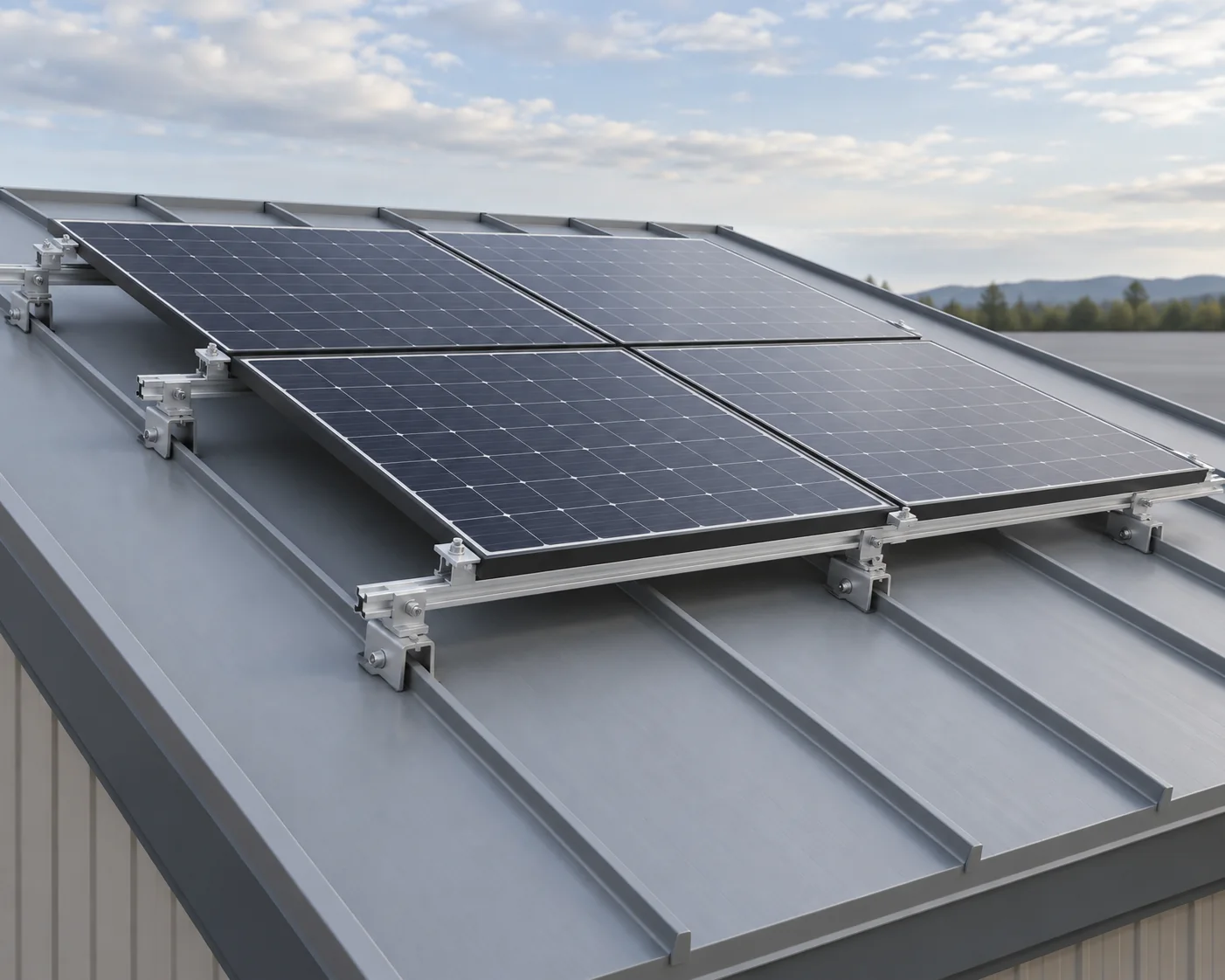
Standing-Seam Clamps Need a Complete Load Path
A seam clamp can attach to a compatible standing seam without drilling the weathering surface. The exact seam profile, panel material and thickness, clamp and installation requirements matter. The panel, clips and supporting structure must also transfer the applied loads; the clamp’s capacity alone cannot qualify the roof.

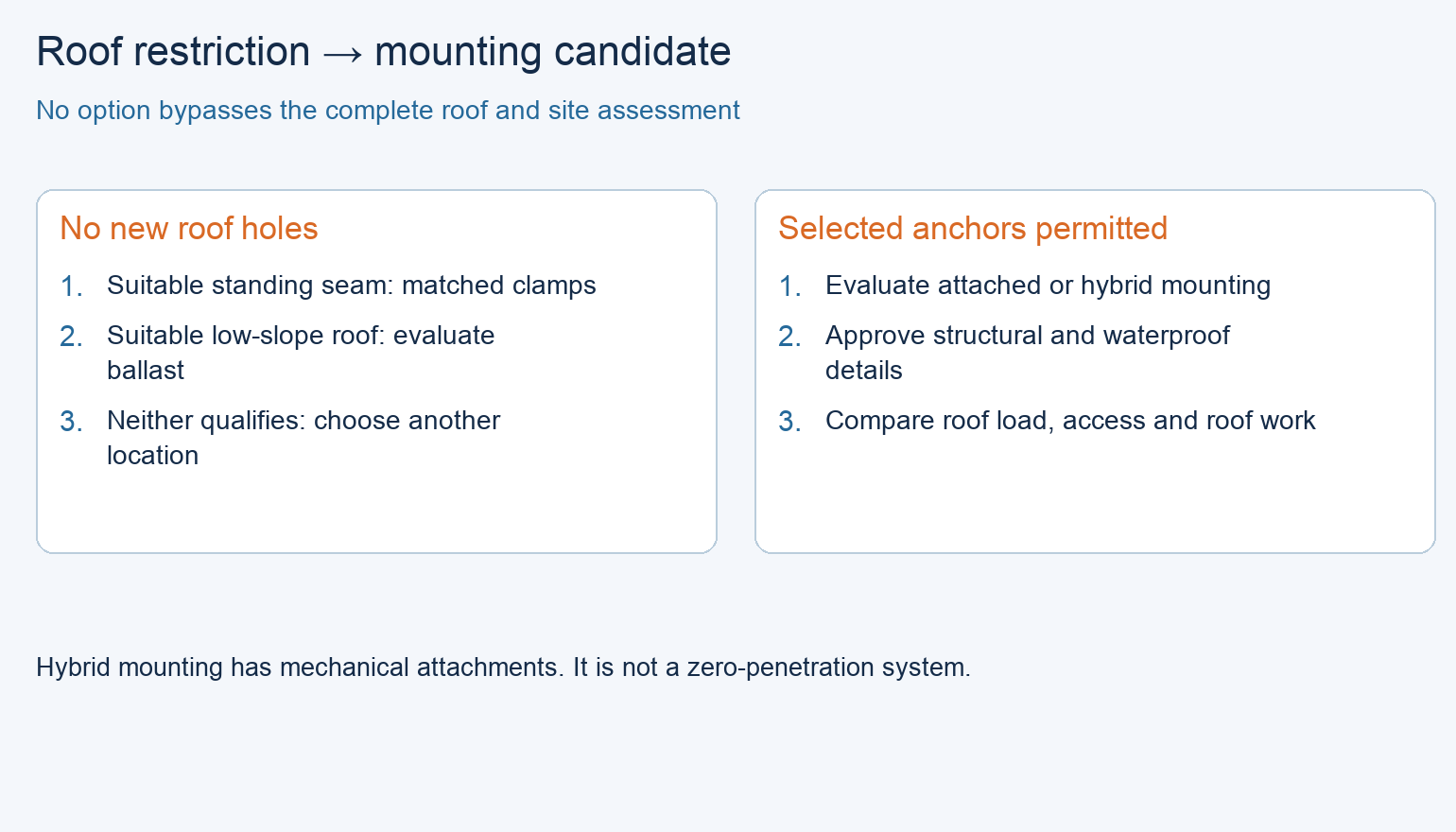
Ballast Adds Roof Load; Hybrid Mounting Still Has Anchors
A fully ballasted system uses weight and its engineered arrangement to resist the specified actions without roof anchors. Its suitability depends on the actual roof, site and mounting system. Check the load at supports as well as the overall added weight, membrane compatibility, drainage and the design treatment of uplift and sliding. A roof-wide average load cannot describe every contact pressure.
A hybrid system combines ballast with mechanical attachments. It can be considered where selected anchors are allowed, but it is not a zero-penetration solution. Compare its actual ballast schedule, anchor layout and waterproofing details with the fully ballasted alternative.
The U.S. Department of Energy’s FEMP severe-weather design guidance recommends mechanical roof attachments rather than fully ballasted systems in its wind-resilience recommendations. Treat that as a reason to investigate the site’s wind exposure and attachment strategy early, not as a claim that every ballasted system is prohibited everywhere.
Swipe to view the complete table.
| Roof and permission | Approach to evaluate | Decisive check |
|---|---|---|
| Compatible standing-seam roof; no new holes through the covering | Matched seam-clamp mounting | Seam, panel, clips and structure form an adequate load path |
| Low-slope roof; all new roof anchors prohibited | Fully ballasted mounting | Complete site design qualifies roof loads, stability and roof compatibility |
| Low-slope roof; selected flashed anchors permitted | Mechanically attached or hybrid mounting | Approved anchor locations, waterproofing and site-specific load distribution |
| No permitted mounting method qualifies | Alternative roof, carport or ground location | Do not treat owner preference as structural suitability |
Compare Qualified Roof Mounting Proposals on the Same Basis
Support Reactions Matter More Than an Average Weight
Use the same module layout, site loads, roof condition and access requirements for each proposal. For ballast, compare the distribution of blocks and support reactions, including edge and corner zones. For anchored options, compare the forces and locations at the actual structural connections. Include seismic requirements where applicable.

Ask the roof designer to assess concentrated loads and the relevant load combinations. “The roof can take the average weight” is not enough if a support overstresses insulation, deck or a local structural member. Conversely, lower ballast weight does not prove that a proposed anchor can transfer its load into the building.
Roof Warranty and Maintenance Access
Agree on the interface with the roof manufacturer and warranty provider before ordering. For a clamped system, that includes the permitted attachment and movement of the roof panels. For a penetrating detail, it includes the accepted flashing and installation process. Preserve access to drains and roof equipment whichever approach is chosen.
Once proposals meet those requirements, choose according to the owner’s actual priority: avoiding new penetrations, preserving roof load capacity, maintaining access, or simplifying a future reroof. These priorities can point to different qualified solutions. Compare the installed scope and future roof work before declaring one cheaper.
Example: Choose a Hybrid System for an Approved Low-Slope Roof
Two Accepted Proposals, One Clear Priority
Consider a hypothetical warehouse with a low-slope membrane roof in serviceable condition. The owner permits a limited set of flashed anchors at approved structural locations and wants to preserve roof load capacity for planned maintenance work. Two proposals use the same module layout and access routes. Assume the project designers have accepted both for the site loads, support reactions, membrane interface and drainage, and the roof warranty provider has accepted both details.
Proposal A is fully ballasted and needs no new roof anchors. Proposal B is hybrid: its approved anchors reduce the ballast required by its specific design. The submitted schedules show that B leaves more of the roof’s available load capacity unused. Its anchor positions are accessible for inspection, and the agreed maintenance plan includes them. These are assumed proposal findings, not generic performance claims about all hybrid systems.
Why the Hybrid Proposal Wins This Comparison
Choose B for this owner. Both proposals qualify, but B better serves the stated priority of retaining roof load capacity while remaining within the permitted attachment policy. A’s advantage—no new roof penetrations—is real, but the owner has already accepted the defined anchors. No price winner can be named without comparable installation and maintenance quotations.
The conclusion changes if the owner prohibits every new penetration: B is then excluded, and A remains a candidate only while its design still qualifies. If revised roof information invalidates A’s loading assessment as well, neither proposal should proceed. If the owner instead prioritizes avoiding all new waterproofing details and no longer needs the extra load reserve, A may become preferable.
Turn the Mounting Choice into a Comparable Supply Scope
Match the Hardware List to the Accepted Attachment Layout
Freeze the accepted attachment layout before comparing hardware totals. List the exact roof interface, rails or other module supports, clamps, fasteners, ballast trays or blocks, anchors and protection pads. Identify who supplies flashing and who performs roof work; neither should disappear between a racking quotation and the roofing contract.
Keep the accepted roof profile and module dimensions with the mounting schedule. A substituted seam clamp, module frame or ballast arrangement can change the design even when it appears to fit. Record the revised component and obtain the necessary design and roof approvals before treating it as interchangeable.
Include Future Roof Work in the Choice
For an eventual roof replacement, describe how modules and racking will be removed, protected and reinstated. That practical task may favor a different arrangement from the one with the fewest parts today.
Frequently asked questions
Does nonpenetrating solar mounting preserve every roof warranty?
No. A warranty can restrict loads, contact materials, roof work or attachment methods even if no hole is drilled. Obtain acceptance for the actual system and installation scope from the relevant roof parties.
Can any metal roof use standing-seam clamps?
No. Exposed-fastener and other roof profiles do not automatically provide a compatible standing seam. Even on a standing-seam roof, the exact clamp, seam and panel support system need to be assessed together.
Is hybrid mounting allowed under a no-penetration rule?
Only if the rule expressly permits the proposed mechanical attachments. A hybrid system with roof anchors cannot be described as fully nonpenetrating. Resolve that permission before comparing its price.
Can extra ballast replace anchors on a high-wind roof?
Do not assume it can. Stability, local roof loads and the mounting system’s design limits must all remain acceptable. Adding blocks is not a substitute for a site-specific design, and FEMP wind-resilience guidance favors mechanical roof attachments.
Should the roof be replaced before installing solar?
Evaluate the remaining roof life against the intended array service period and the cost and disruption of removing the array later. Where reroofing is already due, coordinating that work first can avoid an early removal task. The answer depends on the actual roof assessment.
What if the preferred nonpenetrating system does not qualify?
Evaluate another permitted mounting method, revise the array location or seek a clearly defined change to the owner’s restriction. Do not use missing design approval as a reason to assume ballast, clamps or adhesive attachment will work.
Technical Basis and Source Scope
U.S. Department of Energy, Severe Weather Resilience in Solar Photovoltaic System Design, wind-resilience recommendations for roof-system mechanical attachments, checked October 19, 2026. This is resilience guidance, not a statement that all jurisdictions prohibit ballast.
Pacific Northwest National Laboratory, Building America Solution Center, Roof Anchor System for Solar Panels, structural-load, roof-warranty and standing-seam discussions; U.S. Department of Energy, Life Cycle of Photovoltaic Systems: Install and Commission a Photovoltaic System, “Rooftop PV Systems,” checked October 19, 2026. Residential example loads and historic code references are not used as industrial design values here. The warehouse comparison is hypothetical.