Start with the roof profile and the production task
Keep roof performance and forming performance separate
Fix the panel drawing before comparing coils: rib and pan geometry, inside bend radii, side laps or seams, finished cover width and cut length. The roof specification also establishes the applicable material strength, thickness, support and fastening arrangement, and exposure protection. A coil that forms easily can still be unsuitable for the roof. A higher strength label alone does not establish panel load capacity.
Identify the complete line
Next define the installed line and tooling that will make that panel. Include the roll set, thickness and strength range, entry and leveling arrangement, cut-off and stacking process. Keep physical coil-fit limits in the order, but do not confuse a coil that fits the uncoiler with a material that forms the profile.
Define useful output
Set a production objective in accepted panels or accepted length per elapsed time. The running speed is only one input. Stops, cut-off cycles, adjustments and rejected panels determine how much usable roofing leaves the line. Compare candidate materials at the same panel length and clearly defined observation period.
Which strength and forming properties should the coil have?
Match springback and forming force to the tooling
Start with the grades permitted by the roof design, then compare their actual mechanical properties with the tooling’s working range. Higher yield strength generally increases springback at comparable bend geometry: the steel recovers more after the forming load is removed. That can change rib angles, lap fit and the adjustments needed to hold the profile. Roll-Kraft’s Profit Pointer for Roll Forming High-Strength Materials explains this mechanism in Sections 1–2.
The same guidance explains why tighter radii increase bend strain and why higher strength can increase forming force. This is a reason to match the material to the roll design, not a rule that high-strength roofing steel cannot be roll formed. Changing the grade may require a different forming progression or tooling setup; increasing pressure is not a universal correction.
Use elongation and property ranges correctly
Elongation helps describe ductility, but compare results with the same test direction and gauge length. A tensile elongation value is not a minimum bend-radius approval or a production-speed rating. Steelscape’s Single-Bill Service Offer Manual, July 2026, Rev 12, pp. 35 and 37, lists TruZinc Grades 33 and 40 for roll-formed roofing. Its guaranteed longitudinal elongation minima over 2 inches are 20% and 16%, respectively. Those are named producer data, not results for the two hypothetical coils below.
Ask for a mechanical-property range that the supplier can support and the line can use, rather than relying only on a minimum yield strength. The same Steelscape tables show overlapping typical yield ranges for the two grades. A Grade 33 label therefore does not prove that every delivered coil has a lower actual yield strength than every Grade 40 coil. Keep guaranteed limits, typical data and measured lot results distinct.
Control thickness and strip shape, not just nominal gauge
Name the thickness being controlled
Specify decimal base-metal thickness—the steel alone—and its permitted variation. Also identify the thickness including the metallic coating and the final thickness including paint, where relevant to tooling clearance. A total reading through the painted sheet cannot establish the amount of structural steel. Steelscape’s July 2026 manual distinguishes BMT and TCT in its order fields; its glossary’s strip-thickness definition includes the metallic coating, so the paint contribution still needs to be identified separately.
Control the range and its measurement
Nominal thickness with a tolerance band and a minimum-thickness order are different requirements. U.S. Steel’s Coated Sheet Products guidance treats them separately and gives measurement conditions. Use the agreed product and measurement basis rather than transferring another producer’s tolerance table to the order. Variation along and across the strip matters because the material must continue to suit the roll gaps and the finished panel dimensions.
Roll-Kraft’s Customer Tooling Setup Manual, Standard Operating Procedures, calls for measuring actual strip thickness and width before setup and checking thickness during production. Use the line’s approved procedure to decide the measurement locations and frequency. One certificate average does not show how the strip varies through the run.
Swipe to view the complete table.
| Strip condition | Why it matters to the panel run | Define or observe |
|---|---|---|
| Thickness variation | A fixed setup may not maintain the same contact and profile as thickness changes. | Base-metal and finished-thickness basis; measurement locations; permitted band; variation through the coil. |
| Camber—sideways curvature of the strip | Entry alignment and the straightness of the finished panel need evaluation together. | Deviation over an agreed length; strip support/tension condition; incoming versus formed measurements. |
| Edge wave or other out-of-plane shape | The input shape and the forming sequence can both affect flat pans and edges. | Agreed flatness method; incoming samples; appearance and fit of the finished panel. |
| Slit-edge burrs or damaged edges | A raised edge can mark an adjacent painted surface or interfere with the required edge finish. | Burr height and direction under an agreed method; edge damage; required panel-edge condition. |
Separate incoming shape from forming distortion
Do not diagnose every wavy panel as defective coil. BlueScope’s Roll-Forming Steel Strip, TB-F5, Rev 2, November 2003, Sections 4.1.1 and 6.1, describes the interaction of profile shape, forming conditions and material. Use it for those mechanisms, not as a current machine limit. Compare incoming strip and formed output before deciding whether the correction belongs in the coil specification or the line.
Prove the complete coated material on the profile
Keep the coating system intact
Select the metallic coating and paint system for the roof’s exposure, then retain the exact substrate, pretreatment, primer, face coat and backer in the forming comparison. The paint-family name alone does not establish flexibility or resistance to marking. NCCA’s Can Prepainted Metals Be Formed Successfully? identifies substrate/coating flexibility, mar resistance and equipment fit as separate concerns.
Use laboratory tests for their stated purpose
A laboratory coating test is useful screening evidence. Its method, specimen conditions and required result belong with the specification. NCCA’s Toolkit 43, Assessing Adhesion, March 7, 2025, distinguishes slow T-bend deformation from rapid impact testing and discusses stressed versus unstressed adhesion. A passing result does not certify the full roof profile, cut-off or stacking operation at a chosen line speed.
Compare production under controlled conditions
For a production comparison, keep the profile drawing, roll set, panel length, material temperature range, coating inspection and acceptance criteria consistent. Establish suitable setup conditions for each candidate within the tooling instructions; identical arbitrary roll pressure would not necessarily be a fair comparison. Record any candidate-specific settings and the time needed to establish them.
Evaluate profile dimensions and straightness, lap or seam fit, cut length, edge condition and the specified surface and coating requirements. Count only panels meeting all applicable criteria as accepted output. Record stops and their causes, and preserve samples from before forming and from the critical features. A slower accepted run can outperform a faster run that generates more rejects. A change in profile, grade, finish, thickness range or tooling reopens the affected comparison.
Worked choice: Grade 33 or Grade 40 for one roof profile?
Common requirements and trial rules
This is a hypothetical selection exercise, not a reported factory test. Assume a fixed through-fastened trapezoidal roof-panel drawing, RP-1, producing six-meter panels. The roof designer permits both ASTM A653 SS Grade 33 and SS Grade 40 at 0.50 ±0.02 mm base-metal thickness for the same support and fastening arrangement. Both use G90 zinc coating and the same complete polyester paint system, designated P1 here, selected for the roof’s exposure and forming requirements.
Assume the installed line, roll set, cut-off and stacking equipment can run either candidate at the trial’s 60 m/min setpoint within their approved operating conditions. Both coils meet the same agreed thickness, width, shape and edge requirements, and their final painted thickness suits the tooling. Initial setup is completed for each material. Each timed trial lasts 60 minutes, includes in-window stops and rejected output, and excludes the same coil-loading and setup activities. No coil change occurs within either window.
For this example, an accepted panel meets RP-1 dimensions, side-lap fit, cut length, burr and visible-surface criteria; the retained formed specimens also satisfy the agreed coating-flexibility and adhesion criteria. All rejected panels are segregated. The production requirement is at least 450 accepted six-meter panels per hour—45 accepted m/min—and an accepted-panel share of at least 95% of all cut panels. These are assumed plant targets, not industry limits. The plant prioritizes accepted output; no purchase-price difference is assumed.
Swipe to view the complete table.
| Measured or calculated result | SS Grade 33 candidate | SS Grade 40 candidate |
|---|---|---|
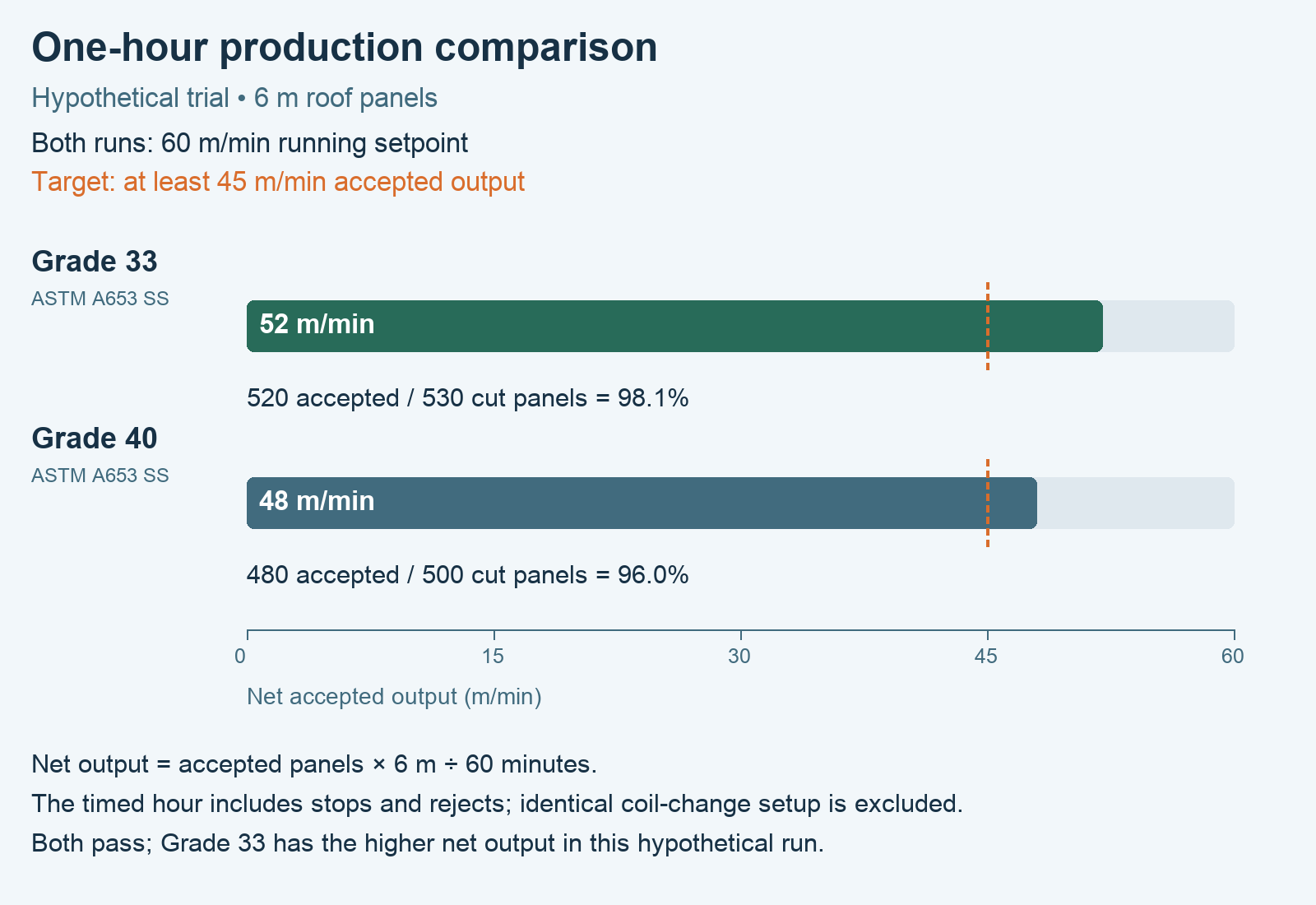
| Panels cut in the window | 530 | 500 |
| Accepted six-meter panels | 520 | 480 |
| Rejected panels | 10 | 20 |
| Accepted-panel share | 520 ÷ 530 = 98.1% | 480 ÷ 500 = 96.0% |
| Accepted length per elapsed minute | 520 × 6 ÷ 60 = 52 m/min | 480 × 6 ÷ 60 = 48 m/min |
| Meets both example production targets? | Yes: ≥45 m/min and ≥95%. | Yes: ≥45 m/min and ≥95%. |
Selection: Grade 33 for higher accepted output
Choose Grade 33 for this task. Both candidates meet the roof requirements and both exceed the trial’s production thresholds, but Grade 33 delivers 52 rather than 48 accepted m/min. Its higher accepted-panel share also leaves less rejected output in this window. The observed difference belongs to these material-and-setup trials; it does not prove that the grade alone caused every stop or reject.
When to reverse or hold the choice
Change the roof requirement so that Grade 33 no longer provides the required design properties, and it drops out regardless of its output advantage. Grade 40 then becomes the candidate to qualify for the revised roof. If both remain suitable and an optimized Grade 40 trial later produces more accepted output under the same comparison rules, the production preference reverses. Hold the selection if neither meets the required quality or output, or if the applicable roof qualification is unresolved.
What belongs in the selected coil specification?
Carry the successful combination into the order
For the worked example, select the Grade 33 combination at 0.50 ±0.02 mm BMT, with G90 zinc and the complete P1 paint system, for RP-1 on the trialed tooling and settings. Carry forward the agreed strip-shape and edge limits, the final painted-thickness range and the finished-panel criteria.
Keep metallic coating and paint distinct
G90 identifies the metallic coating separately from the paint. Steelscape’s July 2026 manual, p. 19, describes it as a minimum total coating weight of 0.90 oz/ft² over both sides combined. That is not a promise of half on each face or a substitute for the applicable coating test and acceptance requirements. In the example, the roof’s coating requirement is already established; production speed does not choose it.
Preserve the material and process boundaries
Record the product-standard editions, guaranteed mechanical requirements, thickness basis and tolerance, metallic coating, complete paint schedule, and the profile/line conditions used for selection. ASTM A653/A653M-25a covers the galvanized substrate family; ASTM A755/A755M-18(2024) covers relevant prepainted exterior building sheet. The specification still needs its particular grade, coating and agreed acceptance requirements. A standard number alone does not describe the selected coil.
Use the successful run as a basis for the agreed production qualification and ongoing control plan. Confirm consistency over the material range and production duration that matter to the order. A single one-hour example cannot establish variation between lots, across shifts or over a full campaign. If repeat runs or a later material change alter accepted output or panel quality, reassess the choice using the same criteria.
Frequently asked questions
Can a higher strength grade justify buying thinner coil?
Only through the roof-panel design and a new forming assessment. Strength does not replace thickness in every aspect of panel behavior, and a thinner strip changes the thickness-to-radius relationship and tooling contact. Recheck the finished panel, fastening arrangement, coating and line conditions before using a thinner alternative.
Is the grade with the highest elongation always the easiest to run?
No. Elongation is one tensile-test result, measured under stated conditions. The profile also depends on yield behavior, thickness, strip shape, bend geometry and tooling. Compare like-for-like test results and use them to select trial candidates; do not rank production speed from elongation alone.
Can a passing T-bend result replace the full-speed profile trial?
No. It addresses a defined coating-bend condition, not every rib, lap, cut edge and handling contact in the line. Keep its specimen conditions and acceptance criterion, then examine the actual finished panel at the intended production conditions. A coating test cannot establish roof structural capacity either.
Does slower production always prevent scratches or cracking?
No. Slowing down does not correct an unsuitable bend radius, damaged roll, trapped debris or incompatible coating. Compare the defect location and changed conditions before selecting a remedy. If only the speed changes, record whether panel quality and accepted output actually improve.
Can two coils with the same grade require different setup adjustments?
Yes. Grade requirements can allow a range of actual properties, and the delivered thickness and shape can also vary within their agreed limits. Record the actual coil measurements and settings. Repeated large adjustments are a reason to examine the material range and tooling suitability rather than treating the grade name as a complete process specification.
Does passing the 60-minute example prove the same hourly output for a whole shift?
No. The example excludes loading and initial setup and has no coil change within the timed window. A shift estimate must include the actual changeovers, setup, planned interruptions and product mix. Use repeated, representative production records before turning a short trial into a delivery-capacity commitment.
Technical Basis and Source Scope
Steelscape, Single-Bill Service Offer Manual, July 2026, Rev 12: p. 3, thickness order basis; pp. 19 and 21, coating and thickness definitions; pp. 35 and 37, TruZinc Grade 33 and Grade 40. Named producer data, not METDAX trial results.
Roll-Kraft, Baicheng Wen, Profit Pointer for Roll Forming High-Strength Materials, undated technical article, Sections 1–5; Customer Tooling Setup Manual, undated, Standard Operating Procedures, PDF pp. 4–10. Both checked October 19, 2026.
National Coil Coating Association, Can Prepainted Metals Be Formed Successfully?, undated, flexibility, marking and equipment-fit discussion; Toolkit 43, Assessing Adhesion, March 7, 2025, pp. 4 and 6–7, coating-test distinctions.
U.S. Steel, Coated Sheet Products, undated web guidance, Hot-Dip Galvanized Tolerances, Tables I–IV and measurement notes; checked October 19, 2026.
BlueScope Steel, Roll-Forming Steel Strip, Technical Bulletin TB-F5, Rev 2, November 2003, Sections 4.1.1 and 6.1. Historical process-mechanism guidance; no current operating limit taken from it.
ASTM A653/A653M-25a: steel sheet with zinc or zinc-iron alloy coatings. ASTM A755/A755M-18(2024): prepainted steel sheet for exterior building products.