What Is Different About the Two Metallic Coatings?
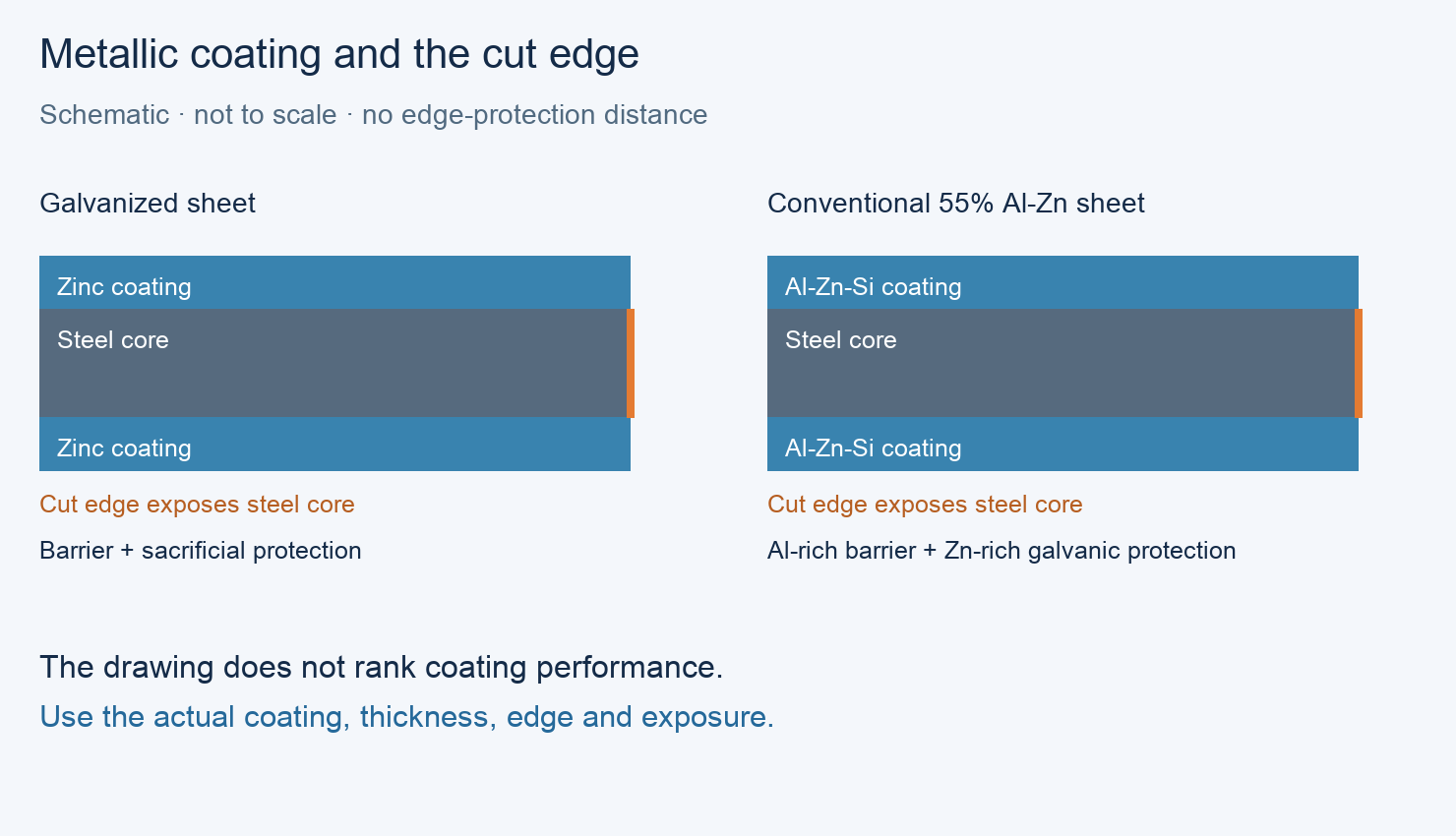
Both products have a steel core. Continuous hot-dip galvanized sheet carries a zinc coating; conventional 55% aluminum-zinc sheet carries an aluminum-zinc-silicon alloy coating. This comparison addresses those two sheet products. It does not compare solid aluminum roofing, galvannealed sheet or magnesium-modified coating variants.
Barrier Protection and Sacrificial Protection
Zinc provides a barrier and sacrificial protection: it can corrode preferentially to nearby exposed steel. In conventional 55% aluminum-zinc coating, aluminum-rich regions contribute barrier protection while zinc-rich regions contribute galvanic protection. That combination supports its use for atmospheric-exposed roofing. It does not make the coating immune to every industrial environment.
The Steel Core Still Controls the Structural Specification
The coating does not replace the structural steel specification. Keep steel grade, base-metal thickness, panel profile, support spacing and fixings tied to the roof design. Changing the metallic coating alone does not establish a stronger panel or a longer allowable span.
Which Conditions Favor Each Roofing Option?
Ordinary Atmospheric Exposure
For a conventional roof in ordinary atmospheric exposure, prioritize a suitable 55% aluminum-zinc option when the proposed coating, profile and assembly have been accepted. Favor galvanized steel when the project’s accepted panel specification requires it, or when the proposed galvanized material has established forming and assembly suitability that an alternative has not demonstrated. If both meet the requirements, compare complete price, availability and the applicable product terms.
Salt, Chemicals and Persistent Wetness
“Industrial building” is not a corrosion category. Describe what reaches the roof: ordinary weather, marine salt, chemical emissions or dust, interior fumes or condensate, and runoff from adjacent materials. Persistent wetness and contact with wet insulation or incompatible materials deserve specific review. Do not assume galvanized steel is automatically suitable when an aluminum-zinc product is excluded from a particular condition.
Cut Edges, Contacts and Forming
Check fasteners, washers, sealants, flashings and their contacts against the selected panel instructions. Keep runoff from incompatible materials out of the roof arrangement. Compare the actual cut edges and overlaps too; a general coating-performance statement does not settle every local corrosion detail.
Both products can be formed for roofing, but acceptance depends on the grade, coating, surface treatment and actual bends. A roofing profile and a deep-drawn part impose different deformation demands. For a new material or changed profile, establish coating condition on a representative formed sample and check the permitted forming and handling conditions.
Swipe to view the complete table.
| Project condition | Preferred next step | What must be established |
|---|---|---|
| Ordinary weather, both panels accepted | Compare the suitable 55% Al-Zn and galvanized offers | Same structural requirements, finished area, compatible details and full cost |
| Existing approved galvanized specification | Retain galvanized unless a substitution is approved | Alternative grade, coating and complete assembly suitability |
| Marine exposure or industrial fallout | Pause label-based selection | Acceptance of the exact product for the stated exposure |
| Wet contact, poor drainage or incompatible runoff | Resolve the local detail before selection | A compatible, drainable arrangement under the panel instructions |
| Unverified forming or sharp profile changes | Obtain a representative material/profile assessment | Accepted coating condition after the proposed forming |

Read G90, AZ50 and SI Coating Marks
G90 and AZ50 Are Product Designations
For the inch-pound ASTM-style examples here, G90 denotes a minimum average zinc coating mass of 0.90 oz/ft² total for both sides in the prescribed triple-spot test. AZ50 denotes 0.50 oz/ft² total for both sides for the conventional 55% aluminum-zinc product in that test. The numbers express coating mass requirements within different product systems; they are not corrosion-performance scores.
Mass, Thickness and the Two-Side Basis
Coating mass and coating thickness are different quantities. Zinc and 55% aluminum-zinc have different densities, so the same mass per area does not give the same coating thickness. Even an approximately similar thickness does not prove equal corrosion performance. Ask for the specified coating designation, units, test basis and whether the reported mass is total for both sides or per side.
A Double-Sided Total Is Not a Per-Face Guarantee
G90 does not promise 0.90 oz/ft² on each face, and dividing by two does not establish a guaranteed minimum on either individual face. The same distinction applies to AZ50. Retain the specified edition’s single-spot and other applicable requirements when checking actual test records.
SI Designations and Approximate Conversions
Z275 and AZM150 are examples of corresponding SI designation families, with coating mass stated in g/m². They are separately specified grades; AZ50’s 0.50 oz/ft² converts approximately to 153 g/m², so do not silently rename an AZ50 order AZM150. Neither equal mass nor a rounded conversion establishes equal thickness or corrosion behavior.
Product Type and Surface Treatment
When the order uses ASTM references, distinguish zinc-coated sheet under A653/A653M from 55% aluminum-zinc sheet under A792/A792M, and identify the product type and contract edition. The current A792 family also includes a magnesium-bearing type; “A792 steel” alone is not a complete description of the conventional alloy compared here. A public standard title or scope does not establish every requirement for a delivered coil.
Keep the metallic coating separate from a clear surface treatment or a decorative paint system. State the delivered condition and painting requirements explicitly. If the roof needs a colored finish, the resin, primer and backer are a further choice; the PVDF versus SMP comparison explains that separate decision.
Once Both Roofing Products Are Suitable
Compare the Protection Mechanism With the Roof Details
For accepted bare-metal products in ordinary atmospheric service, the aluminum-rich barrier in conventional aluminum-zinc coating makes it a useful first candidate for broad-face weathering resistance. Galvanized zinc supplies sacrificial protection; cut edges, formed areas, fastener contacts and any painting process can change which actual product and detail is the better fit. Compare those locations and the intended finish, rather than selecting by the larger coating-mark number.
If both complete roof systems meet the project’s exposure and durability target, compare the actual finish, handling/repair details, availability and complete delivered cost. A product-specific exposure result can justify a preference; without comparable quotations there is no cost winner. The following A/B table screens supplier confirmations, not the inherent merit of every galvanized and aluminum-zinc product.
Supplier Qualification for One Industrial Roof
Project Conditions and Supplier Information
Assume a new inland warehouse roof in ordinary atmospheric exposure, without marine salt or identified process emissions. The engineer has set the steel grade, base-metal thickness, profile, supports and fixings. The required drainage and compatible accessory details are established. The owner accepts a metallic finish. These are illustrative project conditions, not a METDAX project or an engineering approval.
Two hypothetical suppliers offer the same accepted steel and profile, required finished coverage and delivery date. Offer A is galvanized: its grade and coating are identified, but the supplier has not confirmed the proposed roof use and forming conditions. Offer B is conventional 55% aluminum-zinc: its coating and surface condition are identified, and the proposed roofing use, forming and compatible details are documented as accepted for the stated conditions. No comparable complete prices have been obtained.
The Result and What Could Change It
Swipe to view the complete table.
| Requirement | Offer A: galvanized | Offer B: conventional 55% Al-Zn |
|---|---|---|
| Steel grade, thickness and profile | Assumed to match design | Assumed to match design |
| Metallic coating and supplied surface | Identified | Identified |
| Roof use, forming and assembly acceptance | Not yet confirmed | Assumed documented for this exposure |
| Complete price comparison | Not available | Not available |
| Result | Hold pending the missing confirmation | Preferred technical candidate; no price winner established |
Proceed with Offer B as the preferred technical candidate. It fits the assumed roof conditions and has the missing application information supplied. Complete the price and purchase-term comparison before awarding the order. The result does not mean every aluminum-zinc offer is better than galvanized steel, and it does not establish a corrosion lifespan.
If Offer A supplies the missing acceptance information, compare both qualified offers at the same scope. If the building use changes to release corrosive fumes, or the site is found to have material marine exposure, reopen the suitability assessment for both. Do not carry the ordinary-atmosphere conclusion into a changed environment.
What Should the Roofing Order Include?
Material and Quantity Basis
Specify the steel grade and base-metal thickness, metallic-coating product type and designation, surface condition, formed profile and finished quantities. Attach the accepted assembly and accessory requirements rather than specifying only “galvanized roof” or “aluminum-zinc roof.”
Compare the quantity purchased with the finished roof coverage. Include agreed overlaps, fabrication allowances, flashings, fasteners, freight and installation where they belong to the offer. A coil price per tonne and an installed panel price per square meter are not directly comparable. With no complete quotes, record the remaining costs as unknown and do not announce a price or lifecycle-cost winner.
Product Terms and Receiving Condition
Check the applicable warranty’s covered failures, location and exposure conditions, forming and drainage requirements, remedy and eligible buyer. A producer’s published warranty for its own coils does not become a METDAX warranty or apply to another producer by using the same coating name.
At delivery, match coil or panel identities to the material and coating records. Follow the selected product’s transport, storage and installation instructions to keep bundles and coils from prolonged trapped moisture, and inspect damage before use. Record any affected material separately; a correct coating designation cannot undo storage damage.

For colored cladding or roofing, continue with the PVDF versus SMP resin comparison.
Frequently asked questions
Is aluminum-zinc-coated steel roofing the same as solid aluminum roofing?
No. Aluminum-zinc-coated roofing still has a steel core. Solid aluminum sheet is a different base material with different design and compatibility requirements. State the substrate as well as the coating when ordering.
Can a galvanized panel be replaced with aluminum-zinc steel of the same gauge?
Only after the proposed substitution is accepted for the steel grade, base-metal thickness, profile, coating, forming, fixings and exposure. Matching a gauge label alone does not establish the structural or corrosion requirements of the roof assembly.
Are magnesium-bearing coatings included in this comparison?
No. This article compares conventional zinc-coated sheet with conventional 55% aluminum-zinc-silicon sheet. A magnesium-bearing variant needs its own product identification and application assessment; do not apply the conventional product’s performance or warranty to it by assumption.
Does visible spangle prove the coating type or amount?
Use the supply specification and traceable material records to establish those requirements. Surface appearance is useful for checking an agreed finish, but it is not adequate purchase evidence for alloy identity or coating mass.
Should every field-cut edge be painted?
Follow the selected panel producer’s cutting and edge-treatment instructions. The need and method depend on the product, edge condition and exposure. Do not apply a universal repair coating or infer acceptance from a photograph; assess damaged coating separately from normal approved cut edges.
Will adding PVDF paint make any metallic coating suitable for a coastal roof?
No automatic upgrade follows from the paint name. The complete substrate, metallic coating, pretreatment, primer, finish, panel details and actual exposure need acceptance together. A decorative finish cannot substitute for the missing application assessment.
Technical Basis and Source Scope
Technical basis: GalvInfoNote 1.1, Rev 4.0, December 2020, pages 1, 8–9, coating designations and double-sided test totals; GalvInfoNote 1.4, Rev 1.2, December 2017, atmospheric protection and use limits. Product type and the applicable contract edition remain separate.