PVDF and SMP: What Is the Practical Difference?
PVDF stands for polyvinylidene fluoride; SMP means silicone-modified polyester. In commonly offered architectural coil-coating systems, 70% PVDF architectural systems can be the stronger starting point for demanding resistance to fading and chalking. SMP is used for exterior roof and wall panels too, and can suit projects with different appearance and budget priorities. Compare the named products and colors, not an assumed service life for either resin family.
Color Retention and Steel Corrosion Are Different Requirements
Fading is a change in color. Chalking is a powdery surface change that affects appearance. Corrosion of the metal underneath is a separate problem. A finish can retain its color while a vulnerable edge, fastener location or reverse face needs attention; conversely, visible weathering does not by itself show that a panel has perforated.
For a warehouse, identify which result matters: keeping a prominent facade consistent, preventing substrate corrosion in the actual exposure, or meeting both goals. “Best coating” has little meaning until these requirements are separate and measurable.
Compare Qualified Products at the Same Scope
Swipe to view the complete table.
| Question | 70% PVDF candidate | SMP candidate |
|---|---|---|
| Long-term appearance | Priority candidate for demanding fade/chalk performance; verify the color-specific data | Check whether the exact finish meets the owner’s appearance criteria |
| Coastal use | Requires acceptance for the complete product and site exposure | Requires the same site-specific acceptance; lower price does not waive it |
| Metal protection | Check substrate, metallic coating, pretreatment, primer and details | Check the same items rather than assuming equivalence from the paint name |
| Forming | Verify the finish on the proposed substrate, thickness and profile | Verify that exact combination too |
| Price | Compare a complete qualified offer | Compare the same quantity, delivery and installation scope |
What Does “70% PVDF” Measure?
The Binder Is the Reference Quantity
For coatings licensed under Arkema’s Kynar 500 program, the stated minimum is 70% Kynar 500 PVDF resin by total binder weight. It is a resin/binder formulation requirement, not 70% of the full wet paint or the finished steel panel. Ask for the named coating system and its definition rather than extending this licensing rule to every PVDF product.
The percentage alone does not establish the color’s fade/chalk performance, coastal acceptance, film build or compatibility with a profile. Those remain properties and conditions of the exact coating, substrate and panel combination.
What Makes the Complete System Suitable for the Coast?
Look Beyond the Topcoat
The visible topcoat is one layer of a coated steel product. The steel grade and thickness serve the panel’s structural requirements; the metallic coating, pretreatment, primer and paint layers contribute to the protection system. A label such as “PVDF” does not identify all those layers. Request the exact substrate, metallic-coating designation, primer and topcoat products, their specified dry film thicknesses, and the reverse-side finish.

Describe the Actual Exposure
Coastal-specific PVDF systems with enhanced primer protection are offered, but that does not make every PVDF finish a coastal system. Use the coating producer’s written application conditions for the product proposed. Check the actual site, including salt spray or deposited salt, wind exposure, sheltered surfaces, condensation and any industrial emissions. Distance from the sea is an input to that assessment, not a universal pass/fail limit.
Edges, Fixings and the Reverse Face
Review cut edges, laps, fasteners, sealants and dissimilar material contacts as part of the panel design and installation instructions. Require a suitable arrangement for drainage and for areas where salts or moisture may remain. A premium topcoat does not replace these details. Use the fasteners and cut-edge treatment approved for the selected panel system and exposure.
The outside and inside of the wall can experience different conditions. The reverse face may be a backer rather than the same decorative topcoat. Tell the supplier whether the warehouse has condensation, humidity or process chemicals on that side, and obtain acceptance of the reverse-side coating for those conditions.
Which Data and Warranty Terms Should You Compare?
Appearance Data for the Proposed Color
For appearance, request the fade, chalk and film-integrity criteria for the proposed color and gloss. Compare results only with their exposure duration, test method, substrate, preparation and acceptance criteria. A larger number of test hours is not automatically stronger evidence if the specimens or failure criteria differ.
Finish Coverage and Corrosion Coverage
For coastal use, obtain written acceptance of the product at the described location and exposure. Read the warranty’s coverage, exclusions, maintenance duties, remedy, registration requirements and responsible issuer. A finish warranty and a warranty against metal perforation are different promises. A long finish period does not automatically cover substrate corrosion or the cost of replacing installed wall panels.

Test Hours Are Not Calendar Years
Natural exposure data and laboratory corrosion tests answer different questions. Salt-fog results alone do not provide a reliable conversion into years of service on the warehouse. Ask which field exposure or other evidence supports the recommendation for your conditions; do not accept “test hours ÷ a factor = coastal life.”
Where a product’s stated coastal conditions, forming limits or warranty scope remain unknown, keep it out of the price comparison until those gaps are answered. The right outcome can be a revised coating proposal or a different substrate, rather than choosing the more expensive label.
A Warehouse Example: Appearance Qualification Before Price
Project Conditions Before Price
Consider a hypothetical warehouse with 5,000 m² of installed wall coverage and a blue facade central to the owner’s brand. The owner’s appearance schedule sets the color, permitted color change and measurement method, chalk rating and test method, and exposure or warranty period. Both offers use the same accepted steel substrate, metallic coating, panel profile and structural design. Both have written acceptance for the coastal exposure, compatible forming and installation details, the same delivery date and an agreed maintenance plan.
In this example, the PVDF offer documents compliance with the owner’s appearance criteria. The SMP offer has acceptable coastal application conditions, but has not demonstrated those appearance criteria. Its lower initial price does not resolve that gap. The figures below assume the same supplied quantity needed for the 5,000 m² coverage, including agreed laps and allowances; packing, freight, installation, flashings and fasteners are included in both totals. Taxes and future maintenance spending are excluded equally.
The Premium for the Same Installed Coverage
Swipe to view the complete table.
| Item | PVDF offer | SMP offer |
|---|---|---|
| Coastal application and panel compatibility | Accepted under the example assumptions | Accepted under the example assumptions |
| Owner’s specified fade/chalk criteria | Documented as met | Not demonstrated |
| Initial installed total | $150,000 | $135,000 |
| Initial cost per installed m² | $30.00/m² | $27.00/m² |
| Selection | Preferred for this owner’s requirements | Hold unless the criteria are met or the owner revises them |
Choose the qualified PVDF offer for this project. The additional $15,000, or $3.00 per installed m², secures the required appearance performance that the SMP offer has not yet demonstrated. The comparison covers initial cost only.
The conclusion changes if the SMP supplier demonstrates the same appearance criteria, or if the owner approves a less demanding appearance requirement and the SMP product satisfies it. SMP could then be selected on the lower complete initial cost. If either product loses coastal acceptance—for example, because the actual exposure differs from the described site—pause selection and revise the system. A price premium cannot repair an unsuitable application.
If Both Coatings Meet the Same Requirements
Compare the Same Accepted Appearance and Coastal Scope
If both offers meet the same color-specific appearance criteria and coastal application conditions, SMP is the lower initial-cost choice: USD 135,000 versus USD 150,000 for PVDF. For the same 5,000 m², it saves USD 15,000, or USD 3.00/m².
Paying the PVDF premium then needs a reason beyond its resin name: for example, substantiated additional appearance performance that the owner values for the prominent facade. For a less appearance-sensitive wall, an SMP product that meets the accepted requirements can be the more economical initial purchase. Future repainting or life-cycle savings require their own evidence and costs.
How to Turn the Choice into a Cladding Specification
The Exact Product and Formed Sample
Name the chosen coating product and color, gloss or texture, substrate and metallic coating, primer, topcoat and reverse-side coating. State the required film thicknesses from that product’s approved specification and how supplied material will be identified. Do not replace the full description with “PVDF paint” or “SMP paint.”
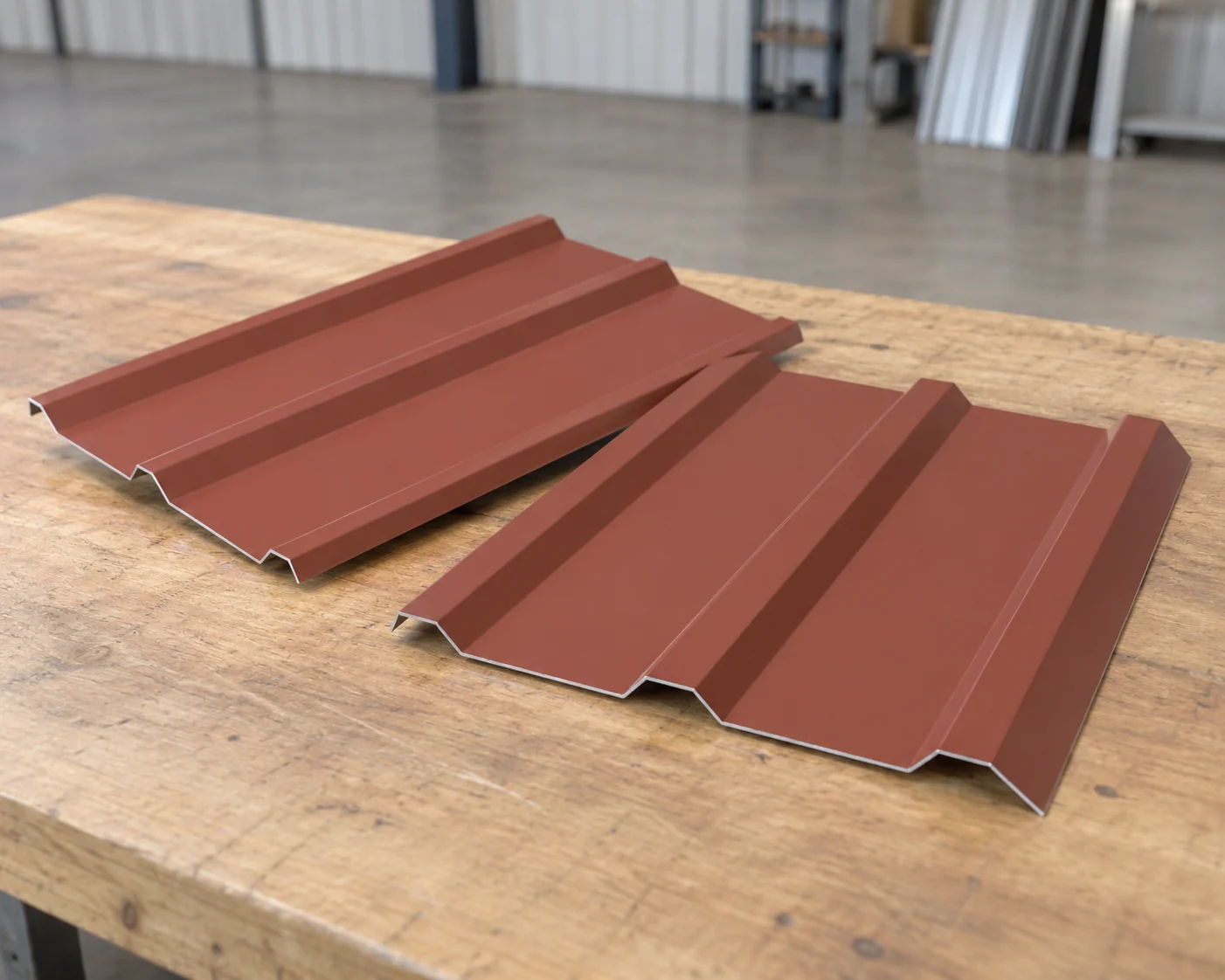
Tie the order to the actual panel profile, bends, cut edges, fixings and installation instructions. Where forming suitability has not been established, agree a representative formed sample and its acceptance criteria before production. Keep a reference finish sample for the intended appearance; a color chip does not establish the performance of the formed panel.
Matching Quantities and Complete Quote Scope
For cost, keep the finished wall coverage separate from the coil or sheet quantity purchased. Compare matching scope for overlaps, offcuts, trim, fasteners, freight and installation. Custom color minimums, an enhanced primer, a clear coat, the backer system and order timing can all change an offer. Obtain the actual quoted premium instead of applying a standard percentage to every PVDF/SMP comparison.
Carry the accepted coastal conditions and maintenance instructions into the handover record. Record the supplied batch identity and the issuer of each warranty. This gives the owner a defined product and a workable care plan, rather than an unqualified promise based on a resin name.
Choose the underlying metallic coating separately from the paint resin.
Frequently asked questions
Does the same color code guarantee a match between PVDF and SMP panels?
No. Agree a physical reference sample and the acceptable color, gloss and texture for the products being supplied. Different finish formulations or production batches can affect the visual match, so the order should identify more than the color code.
Can a photograph or a sample panel identify the paint resin?
Appearance alone does not establish whether the coating is PVDF or SMP. Use the coating product identity, supply documentation and batch traceability. A sample is useful for appearance and forming review, but it is not a substitute for the material specification.
Can PVDF trim be used with SMP wall panels?
Consider it only with approval of the visual match, product compatibility and maintenance requirements for the actual assembly. Specify flashings and trim explicitly. Do not assume that a higher-performance finish on one component upgrades the surrounding panels or their warranty.
Does a longer finish warranty always mean a better coastal product?
No. Compare the covered failure modes, exposure exclusions, required maintenance and remedy, as well as the period. A longer color or film warranty may still leave substrate corrosion or installed replacement costs outside its scope.
Can salt-spray test hours be converted into years on the building?
Not with a general conversion factor. Laboratory salt-fog results depend on the specimen and test conditions; they are not a stand-alone forecast of natural exposure. Use comparable tests together with suitable field evidence and the proposed product’s application conditions.
Is SMP automatically unsuitable because a warehouse is near the sea?
No universal distance rule follows from the resin name. The exact SMP system must be accepted for the actual exposure and meet the owner’s appearance requirements. Where that acceptance or performance is missing, hold the proposal rather than assuming suitability or rejecting every SMP product by label alone.
Technical Basis and Source Scope
Technical basis: Arkema Kynar 500, Consistency through licensing, total-binder-weight requirement for licensed coatings. Sherwin-Williams, PVDF vs SMP coating comparison, and the applicable US Flurothane Coastal product documents support named-system distinctions; those products’ warranty/site conditions are not universal resin-family guarantees. The warehouse prices and qualification statuses are fictional.