Which Steel Plate Supply Format Fits Your Work?
Stock Plate, Custom Rectangles and Precut Parts
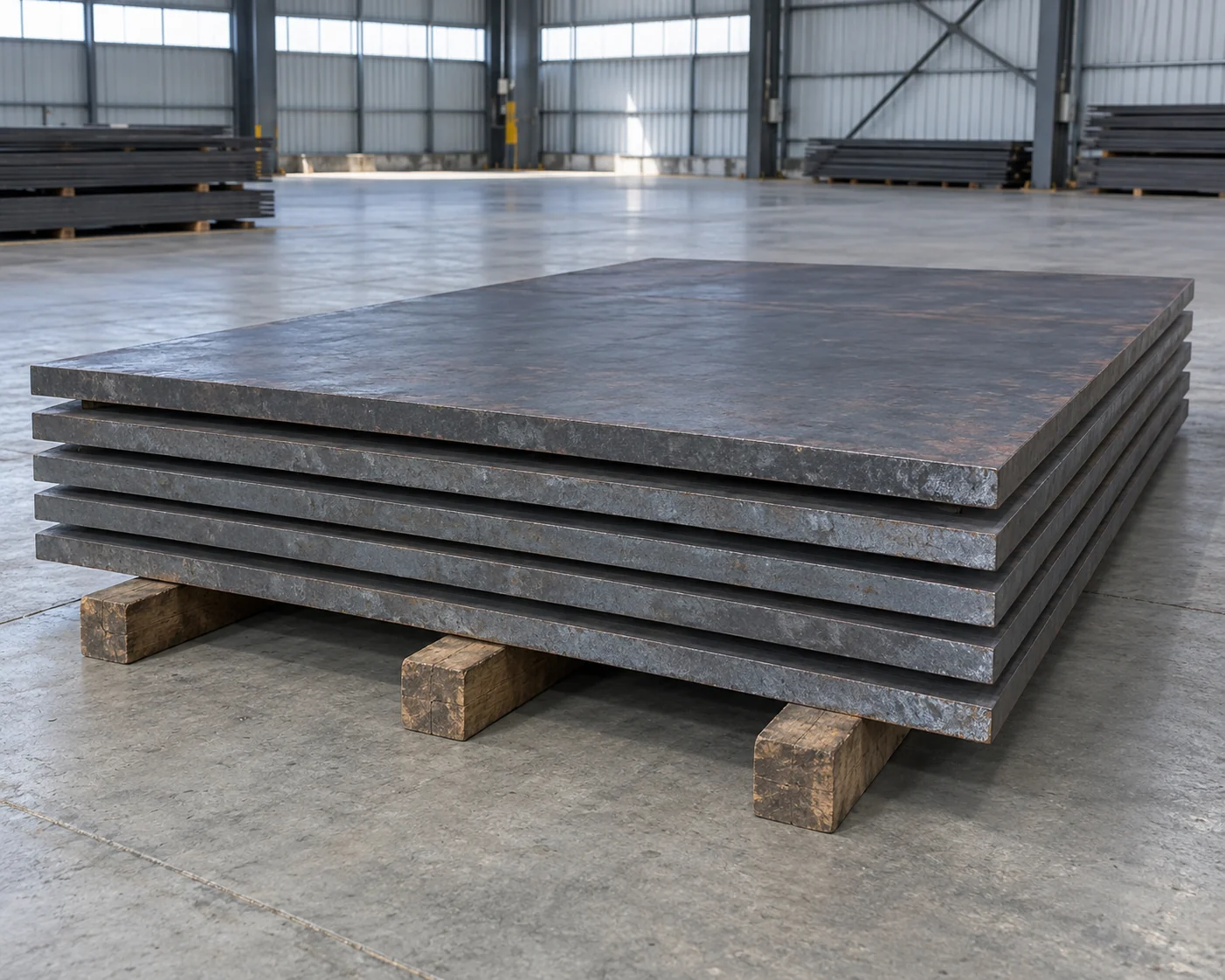
Treat these as different purchasing scopes. Stock plate is bought in an available size. Custom-size plate is supplied to an agreed rectangle before your shop cuts the parts. Precut parts arrive with an agreed part contour, which may still need machining or edge preparation. “Cut-to-length” alone does not promise a custom width; width trimming or slitting must be included when the nest needs it.

Choose among formats that already meet the drawing’s material, thickness, flatness and surface requirements and fit the cutting and handling equipment. A better geometric fit does not justify substituting a different product standard or delivery condition. Whether plate cut from coil is acceptable is a material-specification question, separate from its rectangle.
Swipe to view the complete table.
| Work pattern | Format to favor | What makes the choice worthwhile |
|---|---|---|
| Stable repeated parts; custom dimensions available at a usable lot size | Custom-size plate | Less purchased area for the same accepted output |
| Changing part mix; useful remnants can serve scheduled jobs | Standard stock plate or a small mix of stock sizes | Flexibility and combined-job nesting can outweigh a single-job offcut |
| Cutting capacity is constrained; finished contours are clearly specified | Supplier-precut parts | Moves cutting work to the supplier; compare accepted parts and the full processing scope |
Compare Plate Nests on the Same Cutting Basis
Part Geometry and Usable Plate Dimensions
Use the same released part revision, quantities and thickness for every candidate. Retain any required rolling-direction orientation and permitted rotations. Enter the actual usable plate dimensions, accounting for dimensional tolerance, damaged edges and the shop’s edge allowance. A nest that fits only the nominal rectangle is not a reliable purchasing basis.

Cutting Clearance and Reusable Remnants
Use the cutting process’s established part spacing, lead-ins, lead-outs and other clearance requirements. These are not all the same thing as kerf, the material removed by the cut. Common-line cutting changes the toolpath and needs a suitable process setup; do not remove the gaps simply to improve the spreadsheet result.
Keep three quantities separate: accepted part area, unrecoverable cutting loss, and identifiable material left for future work. A remnant has practical value when its material identity, thickness and usable shape are known and another job can use it. An unassigned offcut is not the same as recovered production.
A Worked Example: Stock Plate or Custom-Size Plate?
Define the Order Before Comparing the Nests
Consider a hypothetical order for 40 rectangular parts, each 900 × 400 mm, in one accepted grade and thickness. The assumed drawing keeps the 900 mm side parallel to the plate length; 90-degree rotation is prohibited. Both quoted formats meet the material requirements and delivery date. Ten plates can be ordered in either format: 2,000 × 1,000 mm stock plate or 1,840 × 840 mm custom plate, with both custom dimensions explicitly included.
For this hypothetical order, the quoted dimensions are usable minima. Assume the cutting process requires 10 mm between finished outlines and at least 10 mm from each outline to the plate edge. These are combined planning clearances, not a universal kerf setting. Two parts along the length need 2 × 900 + 10 + 2 × 10 = 1,830 mm; two across need 2 × 400 + 10 + 2 × 10 = 830 mm. Each plate holds four parts. With this orientation, neither rectangle fits a third row or column.

Calculate Purchased Area and Select a Format
The order contains 40 × 0.9 × 0.4 = 14.4 m² of net part area. Here, geometric utilization means net part area divided by the area of the ten plates used. It does not measure cutting speed, surface acceptance or total production cost.
Choose the custom rectangle for this order’s stated objective: minimizing purchased plate area while meeting the same requirements. It buys 4.544 m² less area. That is a geometric result under the assumptions above, not a quoted financial saving. The leftover area includes process clearances and potentially usable remnants; it should not all be labeled scrap.
Swipe to view the complete table.
| Measure | Stock: 2,000 × 1,000 mm | Custom: 1,840 × 840 mm |
|---|---|---|
| Parts per plate | 4 | 4 |
| Plates required and purchased | 10 | 10 |
| Purchased area | 20.000 m² | 15.456 m² |
| Net part area | 14.400 m² | 14.400 m² |
| Geometric utilization | 72.00% | 93.17% |
When Stock Plate Becomes the Better Purchase
Minimum Order Quantity Can Reverse the Choice
Now change one commercial condition: the custom supplier requires 20 plates, while ten stock plates remain available. The custom purchase becomes 30.912 m², including ten unused plates, versus 20 m² for stock. With no identified future use for the extra custom plates, choose stock for the current order’s minimum-purchased-area objective. The custom nest still has the same utilization; the purchasing lot has changed.
Credit Remnants Only Against a Credible Use
Likewise, a scheduled job that fits the stock plate’s remaining material can change the answer. Re-nest both jobs together using their actual due dates and compatible materials. Do not credit a future part that is merely hoped for, or mix thicknesses and grades to make the utilization look better.
If price is the objective, compare delivered material, size preparation, cutting, handling, inspection, remaining machining and the agreed treatment of offcuts. Count a service once when it is included in the quotation. Keep unknown charges open. A smaller purchased area can still cost more after a custom-size premium or extra setup; no price winner can be named without comparable offers.
Put the Chosen Plate Format into the Order
Specify the Rectangle or the Finished Part
For custom rectangles, state grade and product standard, delivery condition, thickness and tolerance, minimum usable length and width, squareness, flatness, edge condition, quantity and delivery date. Include the part revision used for nesting. The supplier needs a clear rectangle specification; a screenshot of a crowded nest is not enough.
For precut parts, add the finished contour revision, dimensional and edge-quality acceptance, any machining allowance, identification after cutting and the material-document relationship. Agree whether material outside the delivered parts remains the supplier’s property. Buying precut parts can remove offcuts from your shop without eliminating waste elsewhere in the supply chain.
Recheck the Format When the Job Changes
Before the repeat order, compare the planned nest with accepted production and the remnants actually returned to inventory. If the drawing or job mix changes, rerun the format comparison. Retaining a custom size after its original nest disappears can turn an efficient purchase into stranded stock.
Frequently asked questions
Is cut-to-length plate the same as a custom-size rectangle?
Not necessarily. Cutting to length controls one dimension; the starting strip or plate width may remain unchanged. If the nest depends on a narrower width, request both dimensions and the operation that produces them.
Should I choose one large plate to reduce the number of loads?
Compare it with smaller formats using the same part list and machine limits. Fewer loads may help production, but a larger plate can leave more unusable area or exceed handling capacity. Purchased area and handling time are separate measures.
Can I assume common-line cutting will improve every nest?
No. The cutting process and part requirements must support the shared toolpath. Check kerf compensation, lead arrangements and edge acceptance in the applicable setup before comparing the resulting nest with a conventional spaced layout.
Does a high nesting percentage mean less material was purchased?
Only when the purchasing quantities are comparable. An oversized minimum order can add unused plates despite an efficient nest. Report both the utilization of plates cut and the total area bought for the order.
Can coil-cut plate replace individually rolled plate?
Do not decide from size alone. Confirm that the specified product standard, grade, delivery condition, thickness, flatness and intended fabrication requirements permit the offered material. Obtain acceptance of any substitution before using its dimensions in the winning purchase option.
How should remnants be identified for the next job?
Keep the material identity and document reference required by the job, thickness, usable outline and storage location. The next nesting run must use the actual remnant shape. If its identity or condition cannot be established, do not count it as usable stock for a controlled-material order.
Technical Basis and Source Scope
Hypertherm, What is nesting software, sections “What is nesting software?”, “Nesting software typical features” and “How to get the best nesting results,” checked October 19, 2026: process inputs, part placement and inventory considerations. Hypertherm, ProNest: Common Line Cutting, January 23, 2017, definition and setup discussion: shared toolpaths and configured cutting parameters. These describe software capabilities, not a universal spacing allowance.
SSAB Service Center Ghedi, Steel Processing, “Cut to length line,” checked October 19, 2026: an example of a processing service with a defined material and dimensional range. It does not establish availability of the hypothetical sizes above or METDAX production capability. All example dimensions, quantities and commercial conditions are teaching assumptions.